
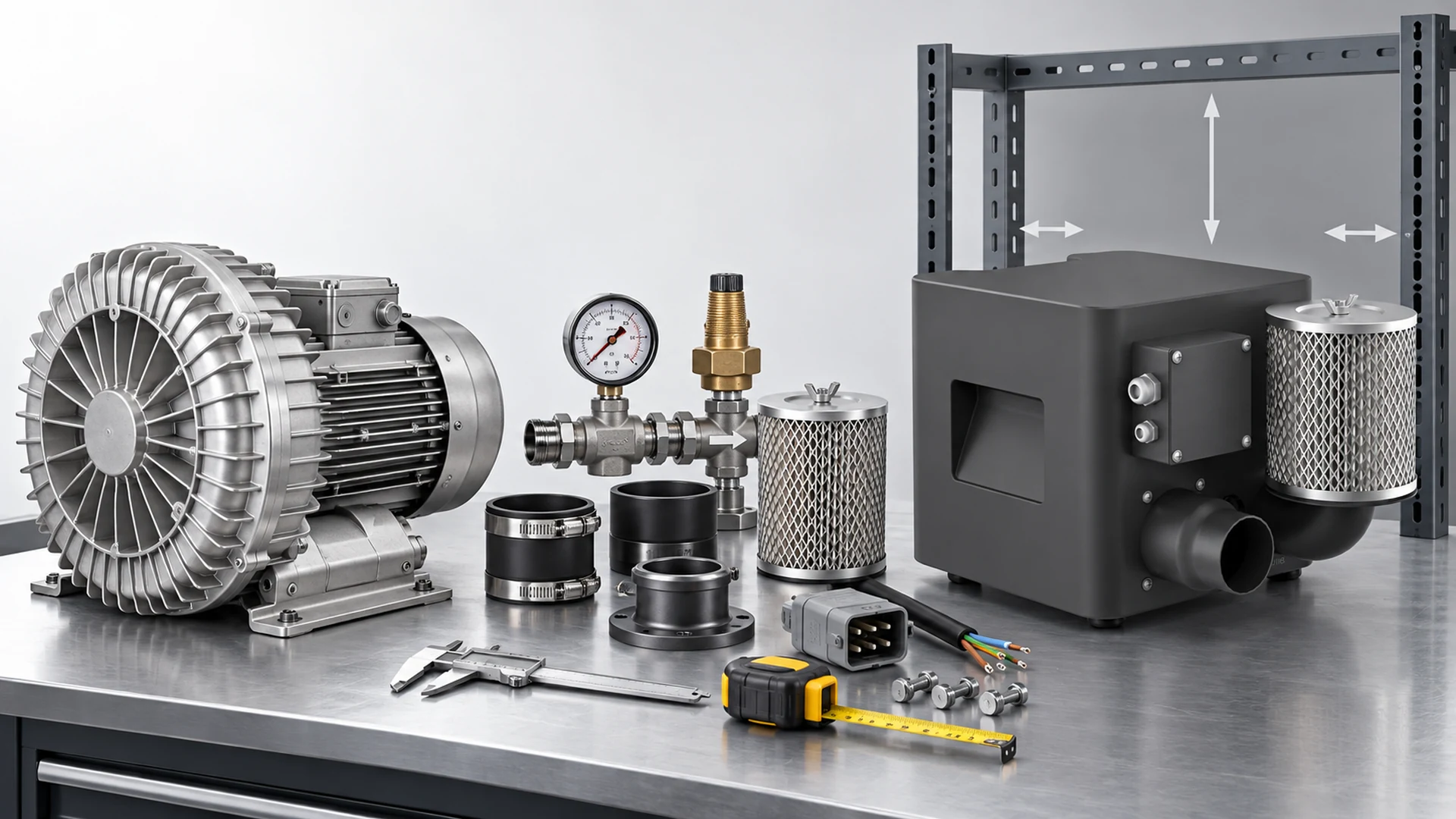
An existing side-channel blower fails, and the nameplate gives purchasing a model number and motor rating. That is enough to begin a search, but not enough to approve a replacement. The same unit family may be used for positive pressure or vacuum, and the installed system may depend on a filter, a relief or vent arrangement, and operating limits that are easy to miss in a quick quotation.
For a side-channel blower replacement, verify the service first: what air the process needs, at what pressure or vacuum, for how long, and through which connected components. Then check the exact proposed blower and controller against that duty. A Towwind energy-saving blower may be a suitable alternative in some applications, but suitability and savings cannot be inferred from matching motor kW or a similar-looking port.
The buyer’s task is not to redesign the machine alone. It is to make sure the supplier sees the whole operating arrangement before a model is chosen.
Identify the Existing Duty: Pressure or Vacuum?
Start with the flow direction. Is the side-channel blower supplying air to a manifold, air knife or diffuser, or is it creating suction at a fixture or process inlet? Some side-channel models can be configured for different uses, but their allowable operating conditions and accessories depend on the exact model and installation. Do not assume that a proposal suitable for pressure service is automatically suitable for vacuum service.
Record the pressure or vacuum required while the process is running, not a disconnected or closed-port maximum. Include the measurement location and units. Pair it with the required airflow or with a process outcome that can be verified. A vacuum level at the blower inlet may not equal the level at the tool when the line has leaks or restrictive piping.
If the machine has several states, describe each one. A packaging fixture may draw differently while sealing than while holding. An air-knife line may switch branches during product changeover. The replacement must cover the conditions that matter, not just the easiest point on a catalogue curve.
For a method of defining the required flow–pressure pair, see How to Define the Required Blower Operating Point. This article stays focused on the additional checks that a side-channel installation often demands.
Do Not Substitute a Maximum Rating for the Working Point
Side-channel blower catalogues commonly show maximum flow and maximum pressure or vacuum. Those values do not usually occur together. Ask the supplier to mark the required duty on the proposed model’s performance data and confirm the available flow there.
The old unit’s motor kW and frame size are useful for identification, electrical review and installation planning. They are not a guarantee of the air duty delivered to the process. A worn blower, blocked inlet filter, leaking suction line or throttled valve can shift what the existing machine actually does.
If the current process works well, record the production setting, active outlets, pressure or vacuum, filter condition and result before removing the old unit. If it does not work well, define the required result separately; duplicating a deficient old condition is not a successful retrofit. A site record such as Before Replacing a Ring Blower: Record These Site Measurements can be adapted to side-channel equipment without assuming the two installations are identical.
Trace the Protection and Control Air Path
Look beyond the main suction and discharge connections. The installed side-channel system may have a relief valve, vent or bleed arrangement, bypass, non-return valve, silencer or other protective component. Record what is present, where it is fitted, how it is controlled, and whether anyone has changed its setting.
These parts may limit pressure or vacuum, keep air moving under restricted conditions, or protect the process. They can also affect energy use and the apparent operating point. A valve that is permanently open may be an intentional protection measure, an old workaround, or a sign that the original blower was poorly matched. Do not remove it solely because a replacement brochure advertises electronic speed control.
The correct arrangement is model-specific. The existing manufacturer’s manual and the proposed Towwind model documentation should be reviewed before deciding whether a relief, vent, bypass or check valve remains necessary. Never copy a valve setting from another manufacturer’s manual into a new installation. If a closed outlet or restricted suction can occur during the machine sequence, tell the supplier how long that state lasts and ask for an approved operating and protection method.
Check Filtration and the Material Entering the Blower
Side-channel equipment is often used because it can supply clean, oil-free air, but that does not make the air path immune to dust, liquid or process debris. Inspect the inlet filter and its service history. For vacuum applications, check whether the suction side can carry particles, droplets or other material toward the blower. For pressure service, note the quality of inlet air and the demands of downstream equipment.
A dirty filter can raise resistance and reduce useful flow. A missing or unsuitable filter can expose the blower to material it was not intended to handle. The required filtration method, allowable media and maintenance interval must come from the final model documentation and the application review. Do not assume that an existing filter housing is suitable just because its pipe connection fits.
Record the filter condition during baseline measurements. If a replacement is tested with a new filter while the old blower was measured through a heavily loaded one, the energy and process comparison will be misleading. That does not mean leaving a faulty filter in place; it means documenting the change and comparing like with like where practical.
Cooling and Long-Run Conditions Matter
Operating at high differential pressure, with restricted flow or inside a cramped enclosure can affect temperature. A short startup test may not show a thermal problem that appears during a full shift. The supplier should confirm the proposed package’s permitted duty, ambient and inlet conditions, and cooling clearances for the actual installation.
Check where the old blower exhausts heat and whether the replacement controller needs its own ventilation space. If the current system has a relief or bypass path, its function may also affect cooling under particular operating states. Again, do not assume the same response for every side-channel or BLDC blower design; obtain model-specific guidance.
For machines that run for long periods, send the hours per shift, number of starts, time at high demand, and any restricted-flow state. Sizing a Blower for Continuous-Duty Equipment covers the complete-package thermal and operating-range review in more detail.
Verify the Physical and Electrical Interfaces
Measure inlet and outlet connections, orientation, mounting dimensions, weight support, available space and service access. A transition that joins different port sizes may add resistance; a tight elbow near the blower may change installed performance. Check the existing pipework for leaks and restrictions rather than assuming the old layout is sound. The pipework compatibility guide helps define this part of the retrofit scope.
Electrical compatibility is another separate gate. Record the actual site voltage, phase and frequency, then review the proposed blower and controller as a complete package. Check how the machine starts and stops the blower, whether speed control is required, and what fault signal or protective response the machine expects. A motor with the same nominal voltage does not guarantee a controller-compatible replacement.
If the process handles unusual gases, moisture, elevated inlet temperature or a classified environment, declare that in the enquiry. A generic air-blower recommendation should not be extended to those conditions without an explicit suitability review and the required approvals.
Compare Energy Use Only at Equivalent Service
Towwind Energy Saving Blowers use high-efficiency BLDC motor technology and may reduce electricity use in suitable replacements. Whether that happens in a particular side-channel application depends on the flow–pressure duty, the old blower’s condition, controls, runtime and system resistance.
Ask for electrical input to the complete proposed package at the required operating point. If the old unit remains in service, measure its real input under a representative condition and record the process output at the same time. The energy comparison should preserve the required pressure or vacuum and useful air delivery. A lower kW figure achieved by failing the process target is not a saving.
For changing duty, compare power and hours by mode. A valve or bypass arrangement can make one mode very different from another. Separate the effect of an improved blower from a change in control sequence or filter condition. The broader calculation method is in How to Calculate Blower Energy Use Without Overstating Savings.
Put the Right Evidence in the Enquiry
A supplier can make a better recommendation if the buyer sends one concise operating package rather than only a nameplate photograph:
| Information | Why it matters |
|---|---|
| Existing model and manual | Identifies the original configuration and its stated limits |
| Pressure or vacuum service | Prevents selection for the wrong duty direction |
| Required flow at duty | Tests useful capacity, not separate catalogue maxima |
| Process result and modes | Defines what must continue to work after replacement |
| Relief, vent, bypass and check valves | Reveals protection and control assumptions |
| Filter and media condition | Flags restriction, particles, droplets or unusual gas exposure |
| Piping and connections | Shows installation fit and possible system losses |
| Site power and controls | Confirms electrical and machine integration |
| Runtime and input power | Supports thermal and energy evaluation |
If airflow cannot be measured reliably, label it unknown and provide the other evidence. Ask what measurement or trial is needed before a final model is approved. A supplier’s preliminary shortlist is useful; presenting it as a guaranteed drop-in replacement is not.
Agree on a Replacement Test Before the Old Unit Leaves
Decide in advance how the new package will be accepted. Test the machine in a representative normal mode and any credible high-demand or restricted-flow mode that the supplier has approved. Record process result, airflow where measurable, pressure or vacuum at stated locations, electrical input, filter state and controller setting.
Check that any required protective component functions according to the delivered model’s instructions. Inspect connections for leakage and verify that cooling space and service access remain available. The test duration should be long enough to assess the real duty, but the pass criteria and method need to be tailored to the exact machine and package.
If the proposed Towwind system cannot be tested under equivalent conditions before purchase, make the uncertainty explicit in the quotation and commissioning plan. That gives purchasing a clear technical risk to manage rather than an implied promise.
A Sound Replacement Decision
Replacing a side-channel blower is not simply matching kW and pipe threads. Confirm whether the machine needs pressure or vacuum, locate the required flow on the proposed performance curve, and review the valves, filter, cooling, electrical controls and installation. Preserve the process requirement while evaluating energy use.
Send Towwind the current model, operating arrangement, site measurements and process target. A model-specific recommendation can then say what fits, what needs modification, and what still has to be verified on site.
Frequently Asked Questions
Is a side-channel blower the same as a regenerative blower?
The terms are often used for closely related blower designs, but names alone do not establish model equivalence. Compare the exact pressure or vacuum duty, performance curve, operating limits and installation requirements before replacing one unit with another.
Can I replace a vacuum side-channel blower with any pressure blower?
No. Confirm that the proposed model and controller are approved for the required vacuum duty and can deliver the needed flow at that vacuum level. The suction filter, vent or protection arrangement also needs review.
Can I remove the old relief or bypass valve when installing a new blower?
Not without a model-specific review. The device may protect the blower or process during restricted-flow conditions. Ask the existing and proposed equipment suppliers what function it serves and what protection the replacement requires.
Does a lower motor rating prove energy savings?
No. Compare real electrical input to the complete old and proposed packages while both meet the same useful process duty. Include the actual operating modes and hours before calculating annual savings.