
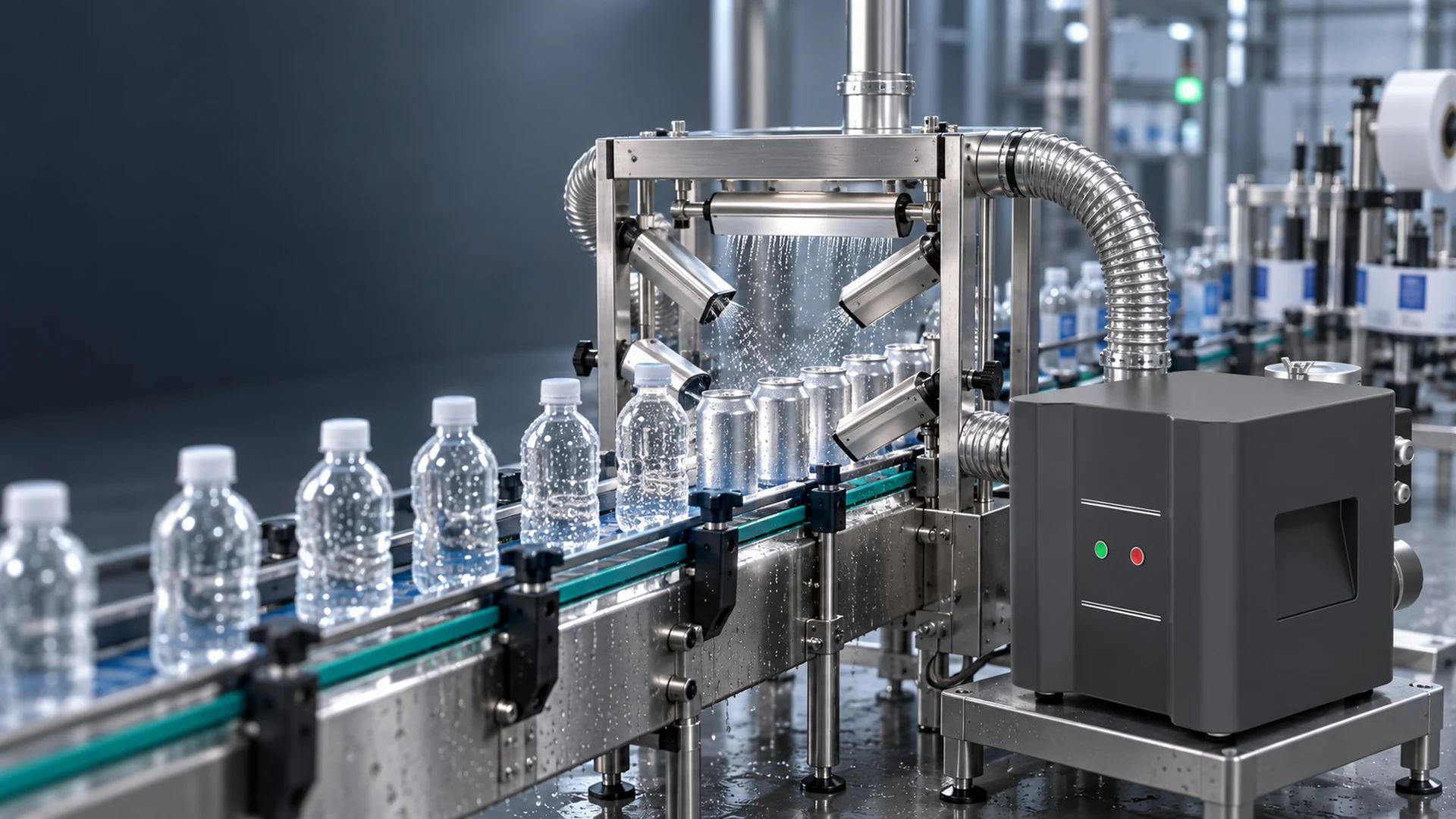
A bottle can look dry from the side and still carry water around its cap. A can may reach the coder with a wet rim. A carton may pick up droplets from containers that passed the dryer minutes earlier. On a packaging line, “dry enough” is decided by the next operation, not by how much air the blower produces.
Industrial air knives for container drying can remove surface water before labeling, coding, sleeving or packing when the air reaches the right areas at production speed. The buyer’s task is to define those areas, the acceptable result and the range of containers the line actually runs. Then the supplier can propose a nozzle layout and blower duty that are testable rather than simply larger.
Start at the Downstream Defect
Ask where water causes trouble. A label that lifts at one edge points to a different drying problem from an unreadable date code. Wet secondary packaging may come from droplets trapped on a lid or shoulder, not from the container sidewall. Walk the line from the last wet process to the first quality-sensitive operation, and note the time and distance available for drying.
Make the acceptance criterion specific. The labeler may need the label-contact area free of visible moisture under the chosen adhesive and substrate. The coder may need a clean, dry print zone that passes the site’s readability check. Cartoning may require no transferable water on the package exterior. The packaging and quality teams should approve these criteria; the blower supplier should not invent them.
If several problems occur, rank them. A single side-mounted air knife may dry the label panel but leave the closure wet. Adding air everywhere is expensive and may splash water onto other products. A targeted second stage could be more useful, but its performance should be demonstrated with the real container and line arrangement.
Map the Container, Not Just the Conveyor
Containers vary in ways a simple diameter figure misses. Grooves, shoulders, cap rims, recessed bottoms, handles and textured labels create water traps. Glass, metal and plastic may carry different amounts of residual water after washing or cooling. Product orientation and conveyor guides can shield the areas that matter most.
Photograph representative wet containers immediately before the proposed dryer. Mark where water remains and where the downstream process touches or prints. Include the smallest and largest formats, any non-round shape, and the product that has caused the most rejects. If the line changes bottle height or guide-rail position, show the range of those settings in the dryer brief.
This makes the project more precise than “dry bottles and cans.” A supplier can then explain why side knives, top nozzles, an angled stage or another arrangement is proposed. The nozzle-layout engineering is covered in Air-Knife Drying: Matching Air Supply to Nozzle Layout; here the main question is whether the arrangement protects the packaging step that follows.
Check What Happens at Full Line Speed
The faster the conveyor moves, the less time each container spends in the air stream. A demonstration at reduced speed may hide a weak dryer. Ask the supplier to test or specify performance at the agreed production speed and container spacing. Include starts, stops and short gaps if they affect water carryover or controls.
More blower power is not automatically the answer to a faster line. Knife position, angle and distance can change how effectively water is swept away. An air jet that drives droplets toward a cap seam or onto the next bottle may create a new problem. For some containers, two directed stages may do more useful work than one broad blast, but the correct arrangement must be proven on the actual line.
Give the supplier the complete wet-process context: rinse, cooling tunnel, washdown, condensation or another moisture source. If a cold container remains below the surrounding air’s dew point, moisture may form again after the air knife. A station that passes an immediate visual check may still fail at the labeler farther downstream. Test at the point where the defect occurs, not only at the dryer exit.
Specify the Air System Behind the Knives
An air knife is not a complete drying system on its own. The blower must supply the combined airflow needed by the active nozzles at the pressure imposed by the knives, manifolds, piping, filters and other components. Ask for the exact operating point on the proposed model’s performance curve. Maximum free-air flow and maximum pressure are not the same point.
If the dryer has several branches, record which ones operate at the same time and how air is distributed. A side knife close to the blower may receive more air than a remote cap nozzle unless the manifold is designed and tested for the intended balance. Measure pressure at useful locations during commissioning, not only at the blower outlet. The drying result, however, remains the final check.
Variable-output operation can be useful when the line has several formats or spends time idle. It should not be assumed to save energy in every case. Confirm the allowed control range and the minimum setting that still passes the hardest required packaging test. If the blower follows a conveyor signal, decide what it does during a jam, product gap or restart.
Compare Supplier Offers Using One Acceptance Sheet
Give every supplier the same product range and acceptance test. Otherwise one quote may cover sidewall drying only while another includes the cap, coder zone and controls. The comparison below keeps the commercial scope visible:
| Buyer question | What the offer should state |
|---|---|
| Which defects are covered? | Label, code, sleeve or carton acceptance point and test method |
| Which formats are covered? | Container sizes, shapes, material and changeover settings |
| What line condition was assumed? | Speed, spacing, water source and surrounding conditions |
| What air equipment is included? | Blower, controller, knives, nozzles, manifolds, filters and fittings |
| What installation work is needed? | Mounting, piping, electrical, controls and guarding changes |
| What is the operating duty? | Flow at pressure and expected real package input at that point |
| How will the result be proven? | Production trial, quality sign-off and open-item procedure |
Do not treat an attractive motor rating as a drying guarantee. The least expensive offer can become costly if operators slow the conveyor, manually wipe containers or reject printed packaging. Conversely, an oversized system may run all shift to solve a narrow wet spot that a better-directed nozzle could address.
Keep Air Quality and Product Contact in Scope
For food or beverage packaging, the site’s quality team should determine whether air contacts a food-contact surface, an open container or only the external package. Those are different exposure scenarios. An oil-free blower can avoid oil added by its own air path, but it does not make incoming air automatically clean or establish food-contact compliance. Inlet location, filtration, pipe cleanliness and the site’s hygiene plan still matter.
Keep the intake away from wet floors, cleaning mist and other contaminants where the installation allows. Make filters accessible so maintenance does not defer service. If the dryer is enclosed, verify that water has a drain path and does not simply collect inside the housing. The exact materials and cleaning method should fit the packaging environment and the delivered equipment manual.
FDA guidance on ready-to-eat food production notes the need to prevent air used on food or food-contact surfaces from becoming a contamination source. The application and local rules determine the required controls; neither an “oil-free” description nor a general marketing claim substitutes for the plant’s assessment.
Where Towwind May Fit
Towwind’s energy-saving blower can be considered as the air source for a suitable blower-powered container-drying system, including some installations now using traditional ring, regenerative or side-channel blowers. Its BLDC technology may lower electrical input when a model meets the real airflow and pressure duty. It does not make a poorly placed air knife effective, and no saving should be assumed from the product name.
For a retrofit, record the existing blower’s real input power, active nozzles, line speed and accepted drying result. Ask Towwind to identify a model-specific operating point for the same useful duty and state what controller, filtration or pipe changes are included. After installation, compare real electrical input only when the line passes the same packaging acceptance test. If nozzle layout changes at the same time, report it as a system improvement rather than a blower-only saving.
The purchase decision should include expected electricity use, maintenance access, integration work and the cost of rejects or rework—not only the blower price. A practical trial with representative containers often resolves more uncertainty than another round of catalogue comparisons.
Test the Result Where It Counts
Plan the trial before placing the order. Run the smallest, largest and most difficult containers at the required production speed. Include the wet condition that has caused trouble, not only a lightly rinsed sample. Check the cap or rim, sidewall, base and recesses as relevant, then inspect the label, printed code or secondary package at its normal station.
Record nozzle positions, control setting, active branches and filter condition so the result can be reproduced after a changeover. If one format passes and another fails, identify the local wet area before raising blower output for the whole line. Document who signs off the result and what happens if the dryer misses the criterion during production.
To review a Towwind option, send the container drawings or photographs, product range, line speed, wet-process description, downstream defect, air-knife layout and any existing blower measurements. A reliable recommendation should be tied to that real packaging duty and checked in a production trial.
Frequently Asked Questions
Can one air-knife arrangement dry every bottle or package format?
Not necessarily. Different heights, shoulders, caps and recessed surfaces change where water collects and where air can reach. Test the required format range and document any adjustment needed at changeover.
Why does a bottle pass the dryer but fail at the labeler?
Water may remain in a hidden feature and run down later, or condensation may form again on a cold container. Inspect the bottle at the labeler under normal production conditions, then locate the water source before adding blower power.
Is blower motor kW enough to compare two drying systems?
No. Compare airflow at the actual system pressure, complete equipment scope, real electrical input and the same accepted drying result at the required line speed.
Does an oil-free blower make air suitable for food packaging?
Not on its own. The plant must assess intake location, filtration, piping and whether the air contacts a food-contact surface or open product. Follow the applicable hygiene requirements for the specific process.
—
Editorial notes below — do not paste into the public WordPress article.