
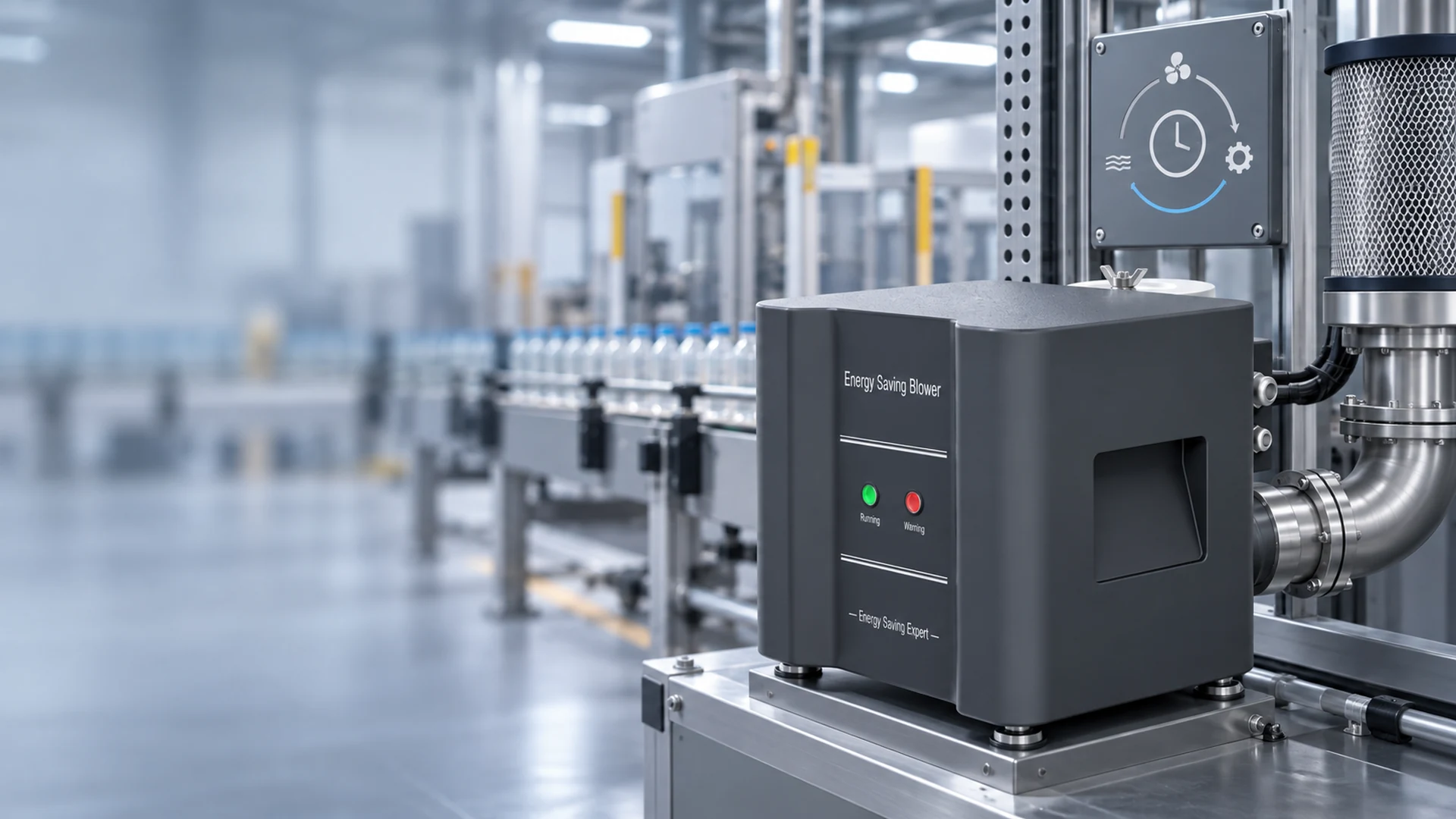
A blower that works through a short factory test may still be the wrong choice for a production line that runs through the night. At the test bench, the filter is clean, the cabinet is open and the room is cool. On site, the blower and controller may spend long periods at the process load, with warmer air and a gradually loading filter.
Continuous-duty blower sizing therefore asks two questions, not one. Can the proposed blower deliver the required airflow at the required pressure during normal production? And can the complete package keep doing that under the installation’s sustained electrical and thermal conditions? A nameplate kW or a “continuous duty” label, taken alone, answers neither question fully.
For buyers considering a Towwind energy-saving blower in place of a traditional ring blower, this distinction matters. Energy performance should be compared only after both options have been shown to meet the same long-running process duty.
What “Continuous Duty” Means in a Purchase Specification
In motor terminology, continuous running duty commonly describes operation at a constant load long enough to reach thermal equilibrium. That is useful, but the motor is only one part of a blower installation. The blower, electronic controller if fitted, inlet air path, enclosure and surrounding ventilation all affect whether the supplied system is suitable for the intended run.
Do not write only “24/7” in the enquiry. State the actual schedule: hours per shift, shifts per day, days per week, planned stops and whether the process changes load while the blower stays on. A machine that runs continuously at one duty point differs from one that remains energized while repeatedly changing speed, opening branches or cycling valves.
Ask the supplier to confirm continuous-operation suitability for the quoted blower and controller together, at the specified operating point and site conditions. Do not transfer a motor duty designation from a generic data sheet to an unverified complete Towwind configuration.
Size to the Air Duty That Persists
The starting point remains the process requirement: airflow at pressure or vacuum. For a continuous drying line, that means the air needed to meet the drying result at normal line speed, with the usual outlets operating. For an aeration or cleaning process, it means the air duty that must be sustained while the process runs. The target should be recorded with units, measurement location and a description of the operating condition.
A headline maximum airflow is not delivered at every pressure. Similarly, a maximum pressure figure does not prove useful flow at that pressure. Ask the supplier to mark the normal production point on the proposed performance data and confirm the corresponding electrical input. If demand varies, show the other meaningful points too. Reading a Blower P–Q Curve Before Choosing a Model explains how to check a supplier’s curve before approving a model.
Some buyers apply a large, unexplained margin “because it runs all day.” That can produce an oversized blower that is then throttled or operated inefficiently. Others choose a unit that only just touches the required point under ideal conditions. The better approach is to identify what actually changes the duty—filter loading, outlet count, process variation, ambient conditions—and have the supplier demonstrate an appropriate operating range. A margin should have a reason and a limit, not just a round percentage.
Check the Worst Credible Long-Running Condition
Peak conditions matter, but a brief startup transient is not the same as a condition that lasts for hours. Ask what the blower experiences after the machine has been running long enough to become warm.
Consider the inlet filter. As it loads, the air path changes. The installed operating point may shift, and some processes may lose useful airflow before anyone notices a warning. Review the filter state at which production still has to meet specification, then decide whether a differential-pressure check, routine cleaning or a different filter arrangement is needed. Do not specify a new blower to compensate for a filter that is allowed to become blocked beyond its intended service condition.
The hottest expected ambient also belongs in the selection. A blower next to a furnace, inside a crowded machine enclosure or under a roof in summer may see a different environment from the supplier’s test room. The controller needs its specified cooling space and installation conditions. A machine that can run for an hour with cabinet doors open has not demonstrated that it can run reliably with the doors closed.
Likewise, consider inlet-air temperature, dust, moisture and any corrosive exposure that the blower will actually see. The acceptable limits are model-specific; request them from the supplier. If the process air itself is warm or contaminated, say so before a model is recommended.
Speed Control Changes the Duty, Not the Need to Verify It
Variable-speed control can help a long-running machine avoid producing more air than it needs during reduced-load periods. Towwind’s BLDC-based approach may be attractive where the process can use such control. But a lower speed setting is not automatically safe or efficient for every blower and controller arrangement.
Ask the supplier for the permitted speed range and performance data at the settings you expect to use. Confirm that the required airflow and pressure remain available when production changes. Check whether the package has any cooling, alarm or operating restrictions at sustained low speed or high load. These details belong in the final model documentation; they should not be inferred from the word “adjustable.”
Also explain the control sequence. Does the blower slow when the line stops, or does it keep running against a closed valve? Are several stations switched independently? An air system that spends most hours at part load should be assessed at those hours, not only at the maximum production point.
What to Ask About the Whole Package
A buyer should request a written selection that connects process performance, continuous operation and the installation. The list below is not a substitute for engineering approval; it is a way to make supplier proposals comparable.
| Item | Confirmation to request |
|---|---|
| Process duty | Required airflow at pressure or vacuum for sustained normal operation. |
| Other modes | Credible high-load and reduced-load points, with duration of each. |
| Performance evidence | Model-specific curve or data covering those points and the proposed control setting. |
| Electrical input | Complete-package input power at the relevant points, not only motor rating. |
| Thermal suitability | Permitted ambient and inlet conditions, controller location and cooling clearances. |
| Air path | Filter, pipe, valve and outlet assumptions used in selection. |
| Protection | Model-specific alarms, limits and required responses from the machine control system. |
| Service | Filter access, inspection requirements and spare-part arrangements for long-running use. |
| Acceptance | Site test conditions and readings to record after the equipment has reached stable operation. |
If the current machine is being replaced, include its maker and model, nameplate photographs, current operating schedule, failure history and any measured pressure, flow or electrical input. A 4 kW old blower does not necessarily require a 4 kW replacement; neither does a smaller quoted input prove the replacement will meet the air duty. How to Select a Replacement Blower from an Existing Nameplate explains how to use the old plate without allowing it to dictate the whole selection.
Energy Cost Matters More When the Hours Accumulate
For a long-running blower, a small difference in real input power can matter over a year. The arithmetic is simple: electricity use equals input power multiplied by operating hours. The difficult part is obtaining power figures that represent the same process output and the actual time spent at each load.
If the line has a steady duty, compare measured or supplier-supported kW at that point. If it has distinct modes, calculate each mode separately, then add the results. Do not use nameplate motor kW as though it were measured power draw, and do not claim a fixed saving because one blower uses a different motor technology.
Towwind energy-saving blowers may reduce electricity use in suitable replacements. The actual result depends on the existing unit, airflow and pressure requirement, system resistance, controls, operating hours and installation. How to Calculate Blower Energy Use Without Overstating Savings gives a transparent method for estimating the value once comparable power data is available.
Commercially, the question is broader than electricity. Ask how the proposed package affects filter access, downtime exposure, maintenance, warranty coverage and replacement parts. A low purchase price has limited value if it creates an awkward service job on a machine that cannot stop easily.
Make the Acceptance Test Long Enough to Be Useful
A quick startup check can confirm wiring and basic rotation or control behavior. It cannot by itself establish sustained performance. Agree with the supplier on a site acceptance method that observes the machine in its normal production condition after temperatures have stabilized enough for the test to be meaningful.
Record at least the operating mode, airflow and pressure measurement locations, input power, ambient and inlet conditions where relevant, filter condition, controller setting and process result. Use the final manual to identify any alarms or temperature indicators that should be observed. The required run duration and pass criteria must be agreed for the actual model and process; there is no universal one-hour or eight-hour test that proves every installation.
For a retrofit, compare against a baseline taken under equivalent production conditions where possible. A new blower tested with a clean filter and open nozzles should not be declared more efficient than an old blower measured with a dirty filter and restricted line. The Installation Checks Before Blower Commissioning article covers the broader first-run and handover checks.
Leave Maintenance With a Baseline
Continuous operation makes drift expensive. Once the system is accepted, keep a short record of the normal pressure, input power, control setting, filter condition and process result. Maintenance can then see whether a later rise in pressure, falling flow or nuisance alarm is a change from a known good state.
The final Towwind or other supplier manual should set the inspection method, filter service interval, alarm meaning and operating limits for the delivered model. Do not reuse generic intervals from another blower. An accessible filter and a clear response to alarms are part of practical continuous-duty suitability, not afterthoughts.
Select for the Long Run
The right continuous-duty blower is not merely one with enough catalogue capacity. It must meet the sustained flow–pressure requirement, operate within the complete package’s thermal and electrical limits at the site, and deliver a process result that can be verified after installation. Its input power should be compared at that same duty.
For a Towwind assessment, send the application, normal and high-load air requirements, operating schedule, site supply, ambient and inlet conditions, air-path details and existing blower information. Where measurements are missing, identify them openly. That gives the supplier a sound basis to recommend a model or ask for a targeted test before you commit.
Frequently Asked Questions
Does “continuous duty” on a motor mean the complete blower can run 24/7 in my machine?
Not necessarily. The motor designation is only one part of the assessment. Confirm the complete blower and controller package for your sustained operating point, ambient and inlet conditions, cooling arrangement and installation limits with the supplier.
Should I oversize a blower because it runs continuously?
Not by an arbitrary percentage. Define the normal and credible long-duration high-load conditions, including filter and process variation, then check the supplier’s performance and operating limits. Unnecessary oversizing can raise purchase and operating costs.
What power figure should I use for annual electricity cost?
Use measured or documented electrical input for the complete package at the relevant duty, multiplied by the hours spent at that duty. If operation has several modes, calculate each mode separately. Motor nameplate kW is not a substitute for actual input.
Can an energy-saving blower replace a ring blower on a continuous line?
It may be suitable, but the supplier must verify airflow at pressure, continuous-operation limits, site power, controls, cooling and installation fit for the proposed model. Savings should be assessed only after equivalent process performance is established.