
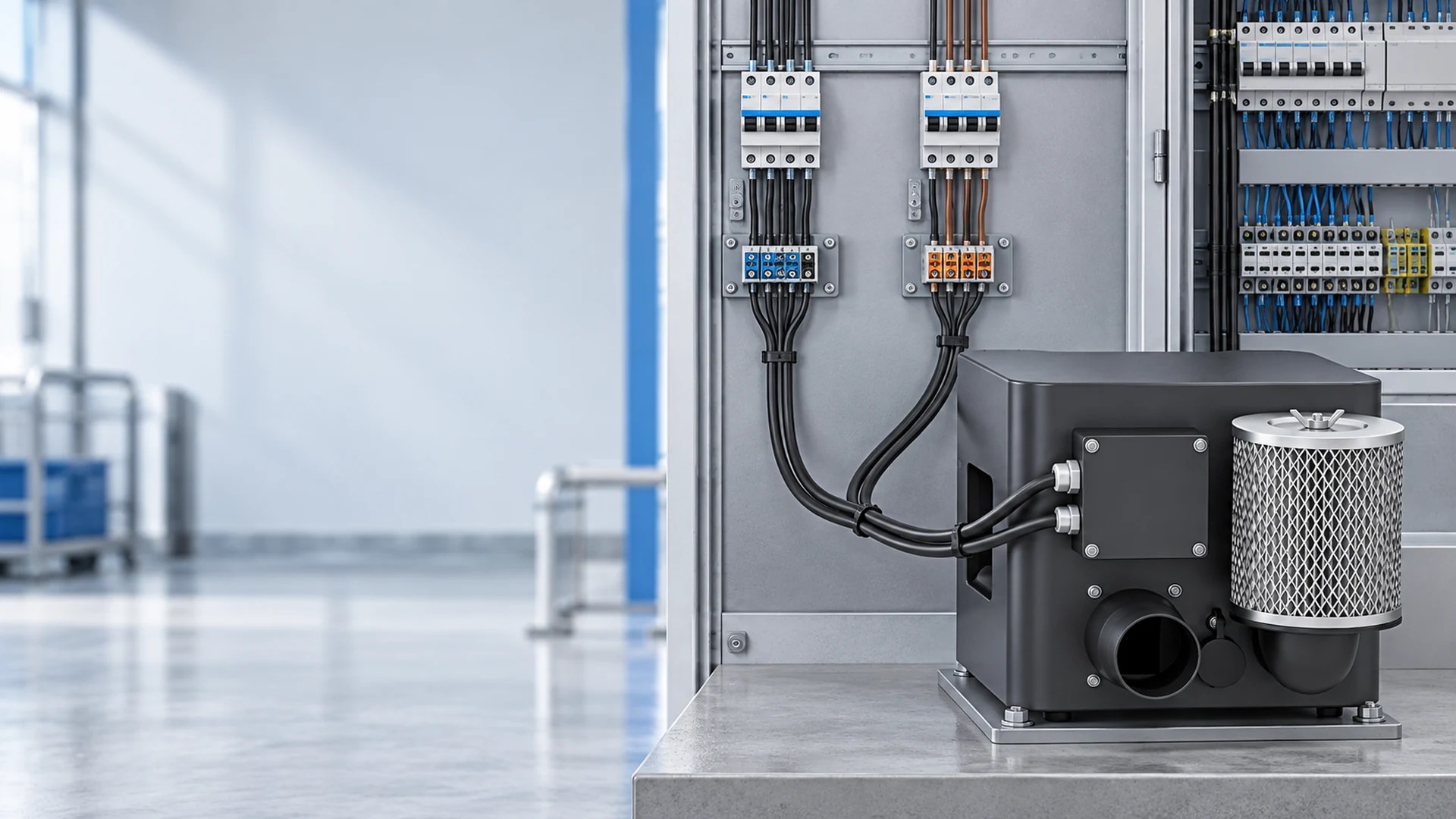
Two blower quotations reach the purchasing desk. One says 220 V, the other 380 V. The 220 V unit costs less on the quotation, while the 380 V unit is described as “more industrial.” Neither statement tells you which one belongs on the machine—or which will cost less to run.
To compare 220 V and 380 V blower options, first establish the supply available at the installation point. Then compare the complete installed packages at the same required airflow and pressure. Voltage is a compatibility condition, not an efficiency score. A lower-voltage blower is not automatically cheaper to operate, and a higher-voltage blower is not automatically a better fit for continuous production.
This matters when replacing an older ring blower with a Towwind energy-saving blower. The buying decision may include a new controller, panel changes, wiring work, and commissioning. Leaving those items out of one quotation makes the cheaper option look better than it is.
Start With the Power Actually Available
“The factory has 380 V” is not enough information. The blower connects to a particular circuit or machine panel, which may have different available capacity from the building’s main supply. Confirm the electrical information at the intended connection point with the site’s qualified electrical team.
At minimum, the purchasing specification should identify nominal voltage, phase, frequency, the available circuit capacity, and any site voltage variation relevant to the equipment. The destination matters too. A machine assembled in one country may be installed where the supply arrangement differs.
Do not infer phase from voltage. A supply described as approximately 220 V may be single-phase or three-phase, depending on the site. A 380 V supply is commonly three-phase, but the exact arrangement still needs verification. Likewise, an existing motor with two voltage ratings does not prove that the entire blower-and-controller package can be reconnected for either supply. Follow the documentation for the specific proposed system, not a generic motor example.
If the site cannot provide the supply a proposal requires, that proposal is not a direct alternative. It becomes an electrical modification project. Price and schedule it as such before approving the blower purchase.
Compare the Same Air-Delivery Job
Voltage alone does not establish whether either blower will perform on the process. Put both proposals against one written air duty: required airflow at the required pressure or vacuum, under the normal production condition. If demand changes materially, include the other operating points too.
A proposal may quote maximum airflow at low resistance, while another emphasizes maximum pressure at a different flow. Those headline values cannot be compared as if they occur together. Ask each supplier for the proposed operating point on its performance data and for electrical input at that point. Airflow vs. Pressure: What Matters in Blower Selection? explains why the two ratings must be checked together.
For a Towwind energy-saving blower, this is the fair test: can the proposed model meet the process requirement on the available supply, and what is its input power while doing so? If the two voltage options do not deliver equivalent air performance, the energy comparison is not meaningful. A low-power unit that misses the drying or aeration target is not a saving.
What Is Included in the Installed Price?
The purchase price is only one line of the job. Ask both suppliers to quote to the same boundary: equipment delivered and operating at the agreed site, not just the blower in a box. The installation may require different work for each option.
| Cost item | Question for each quotation |
|---|---|
| Blower and controller | Is the exact supply-compatible configuration included? |
| Electrical panel | Are breakers, protective devices, isolators and panel modifications included? |
| Cabling | Who supplies and installs the cable, terminals and route? |
| Controls | Is speed control, start/stop integration and alarm feedback included? |
| Mechanical fit | Are adapters, mounting changes and pipe connections included? |
| Commissioning | Who checks supply compatibility, air duty and process result? |
| Support | What documentation, warranty scope and service response are offered? |
Not every project needs every item. The point is to assign responsibility before the purchase order, particularly when one supplier quotes a blower only and another quotes an installed package.
Existing electrical capacity can change the ranking. If the required 380 V circuit already exists beside the machine, that option may be straightforward. If it requires a new distribution run or panel work, a suitable 220 V option may have a lower installed cost. At another site, the reverse may be true. Neither conclusion can be made from the voltage printed on the offer.
Does 380 V Use Less Electricity Than 220 V?
Not by itself. Electricity use is based on real input power over operating time, not the voltage number alone. For two blower packages that meet the same air duty, compare measured or supplier-documented input in kW at the relevant operating points. Then apply the site’s running hours and electricity tariff.
Higher voltage can be associated with lower current for a given comparable electrical load and phase arrangement, which may affect cable and protection design. That is not proof of lower kWh consumption. Phase, power factor, controller losses, motor efficiency, and the actual process load all matter. Current by itself is also a poor energy comparison when the proposals use different electrical architectures.
The simple operating-cost comparison is:
Annual electricity cost = measured or verified input power (kW) × annual hours at that load × electricity price per kWh.
If the machine spends time at several speeds or process loads, calculate each portion separately and add them. Do not compare one blower at full output with another at reduced output unless both still meet the same production requirement. The method in How to Calculate Blower Energy Use Without Overstating Savings can be used for the detailed calculation.
Towwind’s BLDC-based energy-saving blowers may reduce input power compared with a traditional ring blower in suitable applications. The size of any saving depends on the existing machine, the required air duty, controls, system resistance and operating schedule. The voltage choice alone does not establish the saving; neither does a general percentage taken from an unrelated installation.
Look at the Work Behind the Voltage Choice
There are practical differences between a clean replacement and a technically possible one. A buyer should ask the electrical designer and installer to describe what will change in the panel, at the machine, and in the maintenance documentation.
For a 220 V option, check whether the proposed unit is truly compatible with the available phase and circuit capacity. If it is a single-phase package, make sure the dedicated circuit can support the complete system and that any resulting panel changes are included. Do not assume “220 V” means it can be plugged into an ordinary outlet.
For a 380 V option, confirm that a suitable three-phase supply is available at the machine, not just elsewhere in the building. Check the proposed controller’s input requirements and the site’s protection and isolation arrangements. A three-phase supply may be familiar to the plant, but a new electronically controlled blower can still require a different integration plan from the old motor.
Frequency and controls matter with either choice. A traditional AC motor’s performance can change if it is used at a different frequency from the one for which it was selected. An electronically controlled blower has its own defined input and control limits. Ask for the final model-specific documentation rather than assuming the package will adapt automatically. The companion article 220V or 380V Blower: What Equipment Builders Need to Confirm is a more detailed electrical handover checklist for machine builders.
Use a Simple Decision Gate Before Negotiating Price
Purchasing can reduce back-and-forth by putting the options through three gates in order.
1. Site fit: Is the exact proposed blower-and-controller package compatible with the supply at the installation point? If not, what modifications are needed, who will design them, and when can the work be done?
2. Process fit: Will it deliver the required airflow and pressure throughout the intended operating range? Request performance evidence for the proposed configuration and agree on an acceptance test at the machine.
3. Commercial fit: What is the total installed price, expected electricity cost at the same duty, warranty scope, spares position and support arrangement? Keep assumptions visible so the quotations can be compared like for like.
A proposal that fails the first two gates should not win because its unit price is low. Conversely, do not pay for an electrical conversion or unused capacity without a process or commercial reason. If the project is a retrofit, the Ring Blower Replacement: An Engineering Review Checklist covers pipework and mechanical interfaces as well as the operating point.
A Better RFQ for Towwind and Other Suppliers
Send each supplier the same brief. Include the destination site; available voltage, phase and frequency; existing blower model and nameplate; required airflow and pressure or vacuum; operating hours; control signals; space and connection constraints; and any known electrical limitations. Mark missing measurements as unknown instead of filling them with catalogue maxima.
Ask the supplier to identify the exact proposed model and controller, the operating point, input power at that point, assumptions, exclusions and commissioning responsibilities. If both 220 V and 380 V configurations are available for the project, request two separate, complete quotations. If only one configuration is suitable, the supplier should say why.
For an energy-saving proposal, request a comparison against the existing blower at the same useful output. Towwind can then evaluate whether its blower fits the air duty and site supply, while your team can judge the full cost of making it work in the machine.
The Buying Decision
Choose neither voltage by reputation. Choose the complete blower package that fits the verified site supply, meets the air requirement, and offers the stronger installed-and-operating-cost case. A sound comparison may favor 220 V at one site and 380 V at another; it may also show that the existing circuit needs work before either option can be approved.
Once the requirements are written down, the decision becomes less subjective. You can challenge a low quote with missing installation work, reject an energy claim without equivalent air performance, and give the commissioning team a test it can actually perform.
Frequently Asked Questions
Is a 380 V blower more energy efficient than a 220 V blower?
Not because of voltage alone. Compare real input power while both proposed blowers deliver the same required airflow and pressure. The motor, controller, operating point and load profile determine the energy result.
Is a 220 V blower always the cheaper option?
No. A lower unit price can be offset by circuit, controller, panel, cabling or installation costs. Compare complete installed quotations and the expected electricity cost at the same process duty.
Can I choose a blower from the voltage on the existing nameplate?
The nameplate is useful but incomplete. Confirm the site’s actual supply, the full blower-and-controller requirements, and the airflow and pressure the process needs. A matching voltage does not guarantee a matching air performance curve.
Can Towwind recommend a 220 V or 380 V replacement from motor kW alone?
No responsible selection should rely on kW alone. Towwind would need the site supply, phase, frequency, required airflow and pressure or vacuum, operating schedule, controls, and installation details to assess a suitable configuration.