
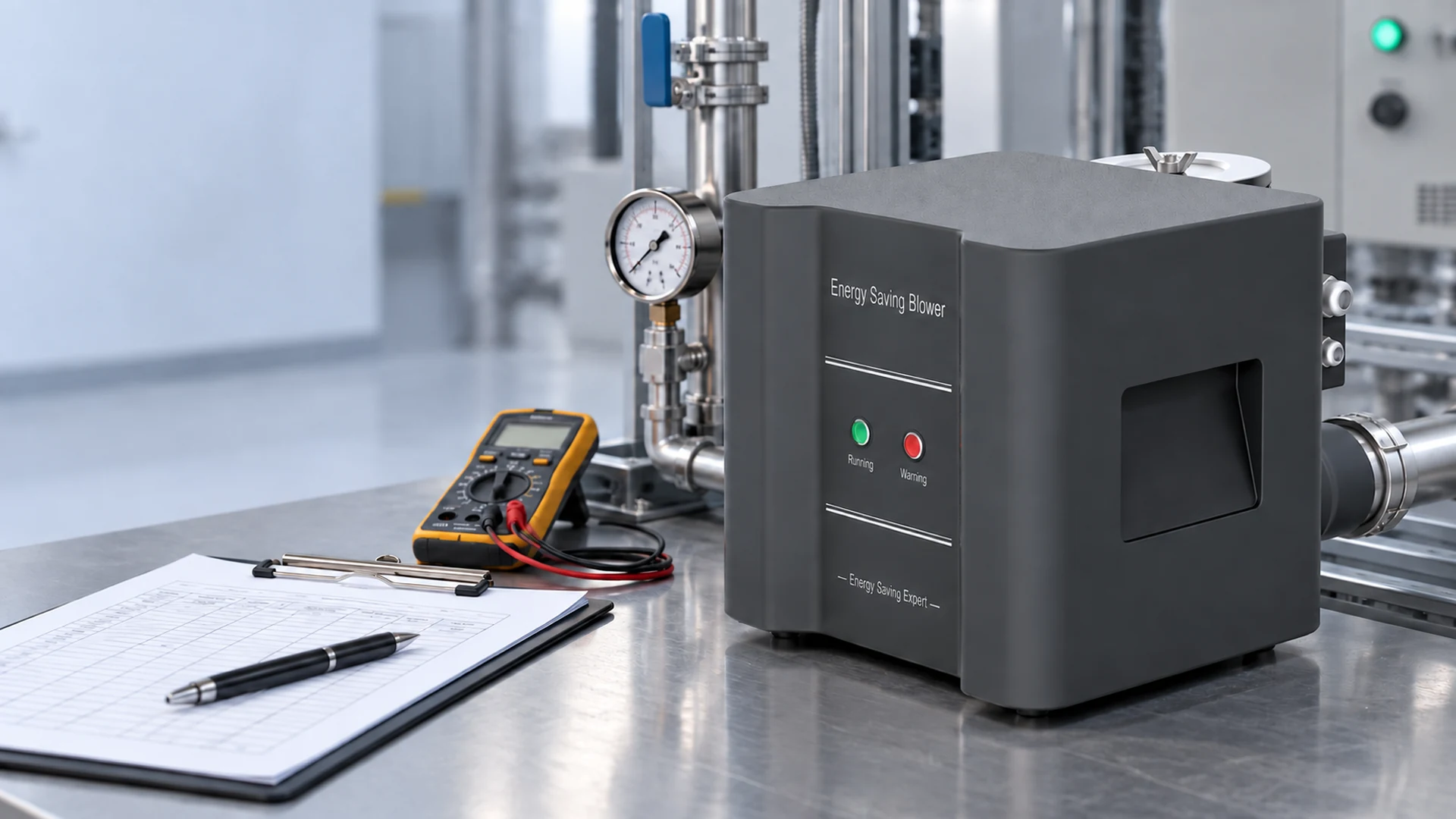
The replacement blower has the right voltage and appears to fit the machine. Its outlet can even be joined to the old pipe with an adapter. That does not yet make the retrofit compatible. A narrow transition, a leaking hose, or an elbow tight against the blower can change the delivered airflow enough to undermine the selection.
Checking blower retrofit pipework compatibility means looking at two kinds of fit. The first is physical: can the inlet and outlet be connected, supported and serviced safely? The second is aerodynamic: will the existing air path let the proposed blower deliver the required flow at the pressure or vacuum the process needs? A purchase decision needs both answers.
This is particularly relevant when replacing a traditional ring blower with a Towwind energy-saving blower. A Towwind model may be a good performance match in a suitable application, but a nominally matching port or an easy-looking adapter is not proof of a drop-in installation.
Start at the Process End, Then Trace Back to the Blower
Before measuring flanges, identify what the air system must achieve. An air-knife line may need a drying result at full conveyor speed. A vacuum fixture needs the required hold under normal leakage. An aeration system has an outlet and operating condition that set its duty. The replacement must satisfy that process, not simply reproduce the old pipe connection.
Walk the complete air path from inlet to final outlet or suction point. Mark filters, silencers, valves, flexible hoses, branches, manifolds, nozzles and diffusers. Note any changes since the old blower was installed. A machine that gained more outlets or longer pipework may no longer be operating at its original design point.
If the existing system is underperforming, check for a pipework fault before using the old blower as the sole sizing reference. A blocked filter or leak can make a capable blower appear inadequate. Before Replacing a Ring Blower: Record These Site Measurements gives a field record for the current process condition, pressure, airflow and input power.
Check the Connection Details, Not Just Nominal Diameter
The inlet and outlet need a dimensional review. Record the actual port dimensions and orientation on the proposed unit, the inside diameter of the existing pipe, the flange pattern or thread, gasket face, and the distance to nearby components. A nominal pipe size can conceal different internal bores, wall thicknesses or connection standards.
Ask who supplies the adapter and how it is built. An abrupt reducer may join two parts mechanically while adding resistance or disturbing the flow. A long unsupported adapter can also put unwanted load on the blower casing. The supplier or installer should approve the transition shape, support and sealing method for the exact package.
If a flexible connector is proposed, check its pressure or vacuum suitability, temperature rating, material compatibility and installation length. A hose that kinks under routing or collapses under suction is not a solution to poor alignment. The goal is a connection that remains tight and serviceable after the machine vibrates and heats through normal operation.
Review Pipe Size and Pressure Loss Together
At a given flow, smaller pipe sections generally increase air velocity and friction loss. Long runs, bends, tees, valves, filters and restrictive outlets add resistance too. The total loss depends on the actual geometry and operating flow; it cannot be judged from one diameter printed on a drawing.
The buyer does not need to calculate every fitting by hand, but should ask the supplier which pipework assumptions were used to select the model. If the new blower’s curve is marked at a required flow and pressure, confirm that the pressure includes the existing air-path losses at that flow. A proposed “high-flow” machine can deliver less than expected when connected to a more restrictive system.
Do not automatically enlarge every pipe, either. Some processes need a particular air velocity in an outlet or conveying section, and space or product constraints may prevent a simple change. The correct response to a narrow section is to determine whether it is a deliberate process feature, a legacy compromise or an avoidable bottleneck. How to Define the Required Blower Operating Point explains how system resistance connects to the flow–pressure duty.
Look Closely at Bends and the First Connection
Pipework immediately beside a blower deserves special attention. A tight elbow, tee or partly closed valve near an inlet or outlet can disturb the air entering or leaving the machine. Published performance data normally assumes stated test conditions; a cramped installation may behave differently.
Document the distance and orientation of the first bend or fitting, the available straight run, and any sharp transition. Send photographs from several angles. If the proposed Towwind blower has a different port orientation from the ring blower, the installer may be tempted to add a very tight turn. That change belongs in the performance and cost review, not in an unpriced installation note.
There is no universal straight-pipe length that can be promised for every blower and layout. Ask the manufacturer or a qualified system designer whether the proposed connection meets its installation requirements. If space is limited, request a reviewed alternative rather than assuming the test-curve performance will survive any elbow arrangement.
Find Leaks and Restrictions Before They Become “Blower Problems”
Leaks waste air on a positive-pressure system and admit unwanted air on a vacuum system. Either can reduce useful performance at the process. Typical places to inspect include aging flexible hoses, loose clamps, flange gaskets, branch joints and maintenance access covers. Mark known leaks before selection so they are repaired or accounted for openly.
Restrictions can be harder to spot. Check the filter, silencers, valves, crushed hoses, blocked manifolds and nozzles. A high pressure reading at the blower outlet with weak air at the process can point to a restriction downstream; a reading by itself is not a complete diagnosis. Use measurements at known locations and compare them under the same machine state.
Do not size a larger or higher-pressure blower merely to compensate for a fault that should be corrected. A replacement installed after a leak repair or filter change will see a different system resistance from the one measured beforehand. Record both the original state and the corrected state if they affect the proposal.
Check Branches and the Most Demanding Outlet
Total flow at the blower can hide poor distribution. If several air knives, nozzles or suction stations run at once, record which branches are active and which outlet is hardest to serve. A long branch or undersized manifold may be the real limitation.
Ask whether balancing devices or valves are already present. A new blower could change how the branches share air, even if the total supply appears sufficient. The commissioning test should include the process condition that stresses distribution, not just a blower-outlet gauge reading.
For equipment sold to different customers, note which pipework is part of the machine and which is installed at the site. A factory acceptance test on a short temporary connection may not represent the final line’s piping. The supplier recommendation should state the connection boundary and what changes if the site adds length, branches or filters.
Allow for Support, Drainage and Maintenance Access
Pipework is not only an airflow calculation. The blower ports should not be asked to carry unsupported pipe weight or absorb misalignment. Review supports, vibration isolation and service clearances with the installer. The exact mechanical requirements belong in the final manufacturer documentation.
Consider where water, condensate or process residue could collect if the application produces it. The air-path design should keep unwanted material from reaching the blower or controller, with any drainage or filtration arrangement reviewed for the actual process. Do not add a drain or fitting without checking how it affects pressure, leaks and maintenance.
Make filters and flexible sections accessible. A retrofit that performs well on day one but requires dismantling the pipe every time a filter needs service will impose a cost throughout its life. Buyers should include these mechanical changes in the installed-price comparison rather than treating them as small site extras.
Put the Pipework Review Into the RFQ
Send the supplier enough detail to judge the air path and the work required. A compact package includes:
| Item | What to provide or request |
|---|---|
| Existing layout | Sketch or marked photos from blower inlet to critical outlets |
| Dimensions | Pipe inside diameters, lengths, branch sizes, ports and connection standards |
| Components | Filters, silencers, valves, bends, hoses, manifolds and outlets |
| Condition | Known leaks, restrictions, filter state and past modifications |
| Operating duty | Required flow at pressure or vacuum, including normal and credible peak modes |
| Space | Port orientation, mounting, support, access and available room for transitions |
| Scope | Who supplies adapters, seals, supports, modified pipe and testing |
| Verification | Where flow, pressure and process performance will be checked on site |
If some values are unknown, say so. A measured pressure with a clear gauge location is stronger evidence than a guessed system-loss figure. The supplier should identify assumptions and any measurements needed before a firm model is selected.
For a Towwind candidate, request the exact model and performance point, then ask whether the proposed pipework layout is compatible with its inlet and outlet requirements. If modifications are needed, compare the complete installed package with the old ring blower, including adapter work and commissioning. Savings should be assessed at equivalent process output, not from motor ratings alone. The Ring Blower Replacement: An Engineering Review Checklist covers the remaining electrical, duty-cycle and commercial gates.
Verify the Result After Installation
Agree on a site acceptance condition before the old blower is removed. Run the process in a representative mode and record the process result, pressure or vacuum at stated locations, airflow where reliable, electrical input, filter state and control setting. Where practical, use the same measurement points and operating conditions used for the old unit.
Inspect the new joints and supports under normal operation. Check for leaks, unexpected vibration, hose deformation and service access problems. If the measured duty differs from the proposal, investigate the air path as well as the blower. A curve match on paper does not prove that a changed installation has the same system resistance.
The aim is not to make every retrofit a full laboratory test. It is to avoid declaring success merely because the new blower powers on and the pipe can be attached.
A Compatible Pipe Is More Than a Connected Pipe
A blower retrofit is pipework-compatible when the connection is mechanically sound, the air path permits the required flow at pressure, and the installed result can be verified at the process. Check port details, transitions, bends, diameter, leakage, branches, supports and maintenance access before placing the order.
Send Towwind the existing layout, site measurements and process requirement with your enquiry. That gives the team a basis to assess an energy-saving model and identify pipework changes that should be priced and tested, rather than discovered after the ring blower has been removed.
Frequently Asked Questions
If the new blower has the same port diameter, can it use the old pipework?
Possibly, but port diameter alone is not enough. Check the internal pipe size, connection standard, port orientation, bends, filter, leakage, support and total system resistance. The proposed blower must still deliver the required flow at pressure through the installed air path.
Will a reducer between the blower and pipe affect performance?
It can. A transition may add resistance or disturb airflow, especially if it is abrupt or close to the blower. Have the supplier or installer review the exact adapter geometry and include its effect in the selection and installed scope.
Should I replace the old piping when I replace a ring blower?
Not automatically. Inspect and measure it first. Sound pipework may be reusable, while leaks, restrictive sections or awkward connections may justify repair or modification. The decision depends on process duty, layout, condition and cost.
What should be checked after the retrofit?
Test the machine under a representative process condition. Confirm the result at critical outlets, pressure or vacuum at known locations, airflow where reliable, electrical input, joint tightness and mechanical support. Compare with the baseline using equivalent conditions where possible.