
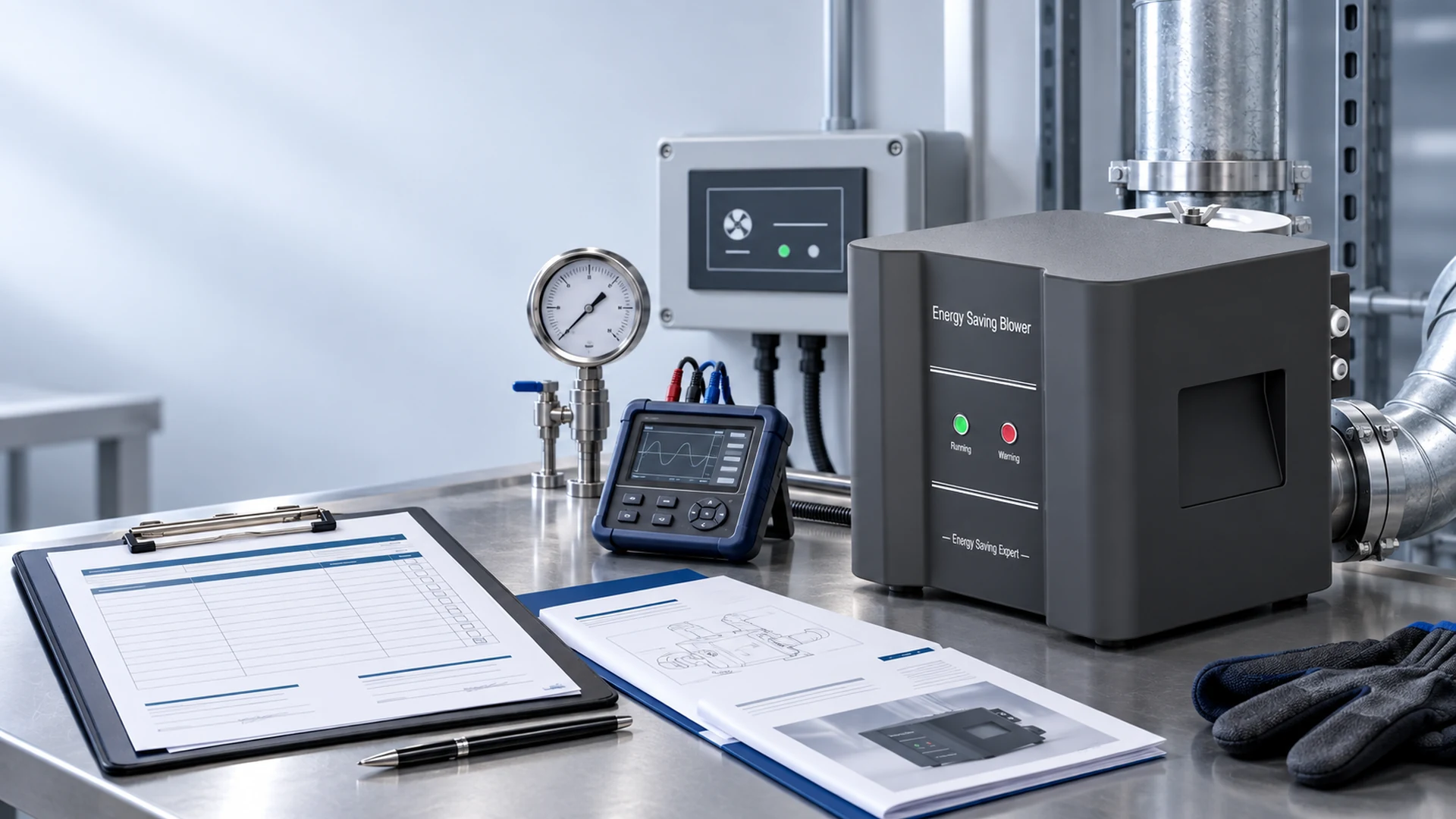
The replacement blower is running and production has resumed. Six months later, a pressure alarm appears. Was that pressure normal at handover? Did someone change the speed setting? Was the inlet filter clean when the original reading was taken? If the answer is buried in a technician’s notebook, the commissioning record did not do its job.
Useful blower replacement commissioning records are not a thick folder of unchecked forms. They are a small, traceable account of the delivered equipment, the conditions under which it was tested, the process result and the decisions made at handover. Those details help maintenance diagnose drift, purchasing resolve supplier questions and energy teams compare performance on a fair basis.
Keep One Record for the Installed Configuration
Start with identification. Record the machine and line location, old blower model, new blower model, serial numbers where available, controller identification and relevant document revisions. List any adaptor, filter, valve, sensor or controller accessory added during the retrofit. A nameplate photograph can help, but it should not be the only record; photographs are easy to misfile and may not show the final configuration.
Attach the as-built piping sketch and electrical or I/O drawings if the installation changed. Mark pressure taps, flow-measurement locations and the point where electrical input was measured. If a drawing differs from what was installed, update the drawing or record the deviation explicitly. A commissioning sheet that cites an obsolete drawing can mislead the next technician.
For a Towwind energy-saving blower, file the manual and performance information for the exact delivered model and controller. Do not substitute a brochure for the final operating instructions. Model-specific limits, alarm meanings and settings belong to that documentation, not to a generic retrofit template.
Record the Test Conditions Beside Every Reading
A single pressure number is almost useless without context. The maintenance team needs to know whether the line was at normal production speed, which branches were open, what product was running and whether the filter was clean. The same is true for electrical power and airflow. Make the condition part of the measurement, not a footnote added later.
A compact test sheet can use these fields:
| Field | What to retain |
|---|---|
| Date, time and test owner | Who took the reading and when |
| Production condition | Product or recipe, line speed, active outlets and run duration |
| Air-path condition | Filter state, valve positions, known leaks or temporary restrictions |
| Flow and pressure | Value, units, measurement point and instrument or method |
| Electrical input | Real kW, meter location and whether controller losses are included |
| Ambient and inlet conditions | Temperature or other conditions relevant to the comparison |
| Controller state | Speed or setpoint, operating mode, local/remote control |
| Process result | Dryness, aeration, suction or other agreed acceptance outcome |
| Reference | Required range or acceptance criterion and its source |
Do not invent precision the instruments cannot support. If a value was estimated from a curve or inferred from a gauge rather than directly measured, label it. Record the instrument identity and calibration status where the site’s procedure requires it. For critical acceptance measurements, note the method and any obvious uncertainty, such as an unstable reading or poor access to a measurement point.
The pre-replacement baseline should be kept with the post-installation sheet. Before Replacing a Ring Blower: Record These Site Measurements explains how to capture that initial condition. If the old blower was underperforming, flag that fact; a deficient baseline should not quietly become the new performance target.
Separate Equipment Operation from Process Acceptance
The blower can run normally while the machine fails its actual job. A PCB drying line may show stable outlet pressure while a board leaves with residual water. A suction fixture may hold pressure at the blower but lose grip at the tool. Commissioning records should therefore distinguish equipment checks from process acceptance.
The equipment record can show mounting, airflow direction, pipe condition, cooling clearance, electrical supply and controller operation. The process record should show the agreed production mode and its actual outcome. Where several recipes or load points matter, keep a row for each tested mode. Do not claim that one easy operating point proves the most demanding duty.
Record who accepted each part. Maintenance may sign that the installation is serviceable; controls may sign that the PLC interface works; production or quality may sign that the product meets the agreed requirement. A single undifferentiated “passed” box hides important limits. How to Compare Existing and Proposed Blower Operating Points explains why the measured and proposed points should be kept on the same basis.
Save the Controller Settings and Alarm Test Results
If the new blower includes a controller, record the settings that affect operation: control mode, speed or setpoint limits, start/stop source, relevant ramp behavior and alarm or reset settings. Record only parameters that are present and approved for the delivered model. Include the date and person who changed them. Where a controller backup or parameter export is available and permitted, file it with the readable settings summary; a backup alone is difficult to review during a fault.
Also retain a short I/O test record. State what the PLC requested, what the blower did and what the operator saw for normal start, normal stop, run feedback, fault feedback and loss of process proof where applicable. For each simulated fault, note how it was created, who authorized the test and how the system was restored. Safety-related tests should follow the site’s approved procedures and be signed by the responsible personnel.
This is more useful than merely recording “alarms checked.” If the controller reports a fault but the HMI does not, the interface is incomplete. If an HMI “running” lamp lights before adequate process air is established, the record should identify the distinction. The earlier article Control and Alarm Interfaces to Check During a Blower Retrofit covers the signal design; the commissioning file should preserve the tested result.
Document Deviations and Open Items Honestly
Not every issue has to prevent handover, but every unresolved issue needs an owner and a decision. Use an open-item log with the observed condition, risk or production effect, temporary measure if approved, responsible person and due date. If a critical air duty or protective function has not been verified, do not make the acceptance sheet appear complete. The person releasing production should know what remains uncertain.
Changes made during commissioning need the same treatment. If the pipe route, filter specification, control setting or sensor position changed from the approved proposal, record the as-built condition and why it changed. Otherwise, a future performance comparison may attribute a pressure or power difference to the blower when the air path was altered at installation.
Keep evidence of corrective action with the original finding. A later “closed” mark without a retest result is weak. For a repaired leak, for example, show the new reading under the same relevant operating condition. For a controls fault, capture the revised setting and the retested sequence.
Preserve an Energy Baseline Without Calling It a Verified Saving
One commissioning reading can establish a useful starting point for the new installation. It cannot, by itself, prove an annual savings figure. To compare old and new electricity use, both readings need a stated electrical boundary, a comparable process output and a realistic operating profile. If the new blower was tested at a different production rate, filter condition or pressure, record that difference before calculating anything.
File the measured real input power of the old and new packages, operating hours or mode estimates, production conditions and any adjustments made in the comparison. State which values are measured and which are predicted. A supplier’s curve point should remain labeled as a prediction until field measurements confirm it. U.S. Department of Energy measurement-and-verification guidance emphasizes preserving baseline conditions because they are difficult to reconstruct after the equipment is removed.
If the project includes an energy target, agree when performance will be reviewed again. A short commissioning test may miss long-running modes, seasonal changes or filter loading. A follow-up log under normal production is more credible than extrapolating a favorable first-hour result across the year. How to Calculate Blower Energy Use Without Overstating Savings provides the separate calculation method.
Make the File Findable and Usable
The best record is the one a technician can find during a night-shift callout. Store the final packet where the site’s maintenance system or machine documentation points to it. Use consistent filenames, an equipment tag and a revision date. Avoid scattering the manual, parameter list, measurement sheet and sign-off across personal email threads.
Give maintenance a one-page operating baseline that identifies normal readings at named production modes, expected alarm indications and the locations of the full files. Give production the acceptance criteria and any operating restrictions. Give purchasing the model and warranty or support documents. The detailed packet can remain in a shared document system, but the people using the machine need a clear route to it.
Set a rule for future changes: if a filter type, pipe layout, controller setting or production recipe materially changes, update the relevant record rather than overwriting the original commissioning result. Preserve the historical version. Otherwise, the “baseline” becomes a moving target and loses value for troubleshooting.
A Practical Handover Packet
For most replacements, a sensible packet contains the installed-equipment register, as-built drawings, exact-model manual, operating-point test sheet, controller settings, I/O and alarm test results, process acceptance, open-item log, sign-offs and follow-up schedule. The depth can match the machine’s risk and complexity. A small standalone blower may need fewer pages than a multi-branch production line, but both need a clear record of what was installed and whether it met the required duty.
Before approving the final handover, ask a maintenance technician who was not at the installation to find three things: the normal pressure for the main production mode, the setting that controls blower output and the action required when a fault appears. If those answers are hard to locate, simplify the packet.
Towwind can help review model-specific documents for a proposed energy-saving blower replacement. When you send an enquiry, include the existing blower details, required airflow and pressure, process modes and the site acceptance criteria. After installation, use the actual delivered-model documentation and field results as the permanent record, not the assumptions in the original quotation.
Frequently Asked Questions
What is the minimum useful record after replacing a blower?
Keep the exact installed model and controller, as-built connections, test conditions, measured airflow and pressure where practical, real electrical input, process result, controller settings, alarm test results and sign-offs. Add unresolved items with owners and dates.
Should we keep the old blower’s measurements after it is removed?
Yes. They provide context for performance and energy comparisons. Label whether the old blower met the process requirement and record its test conditions; an underperforming baseline should not be treated as the desired new duty.
Is a controller parameter backup enough for maintenance?
Usually not. Keep the backup if available, but also provide a readable list of important operating settings, the correct controller version and the person who approved changes. Maintenance needs to understand what the settings do without opening proprietary software during a fault.
Can commissioning readings prove annual energy savings?
Not on their own. Annual savings depend on comparable useful output, measured electrical input across relevant operating modes and realistic hours. Commissioning readings establish a post-installation reference; longer-term verification may still be needed.
—
Editorial notes below — do not paste into the public WordPress article.