
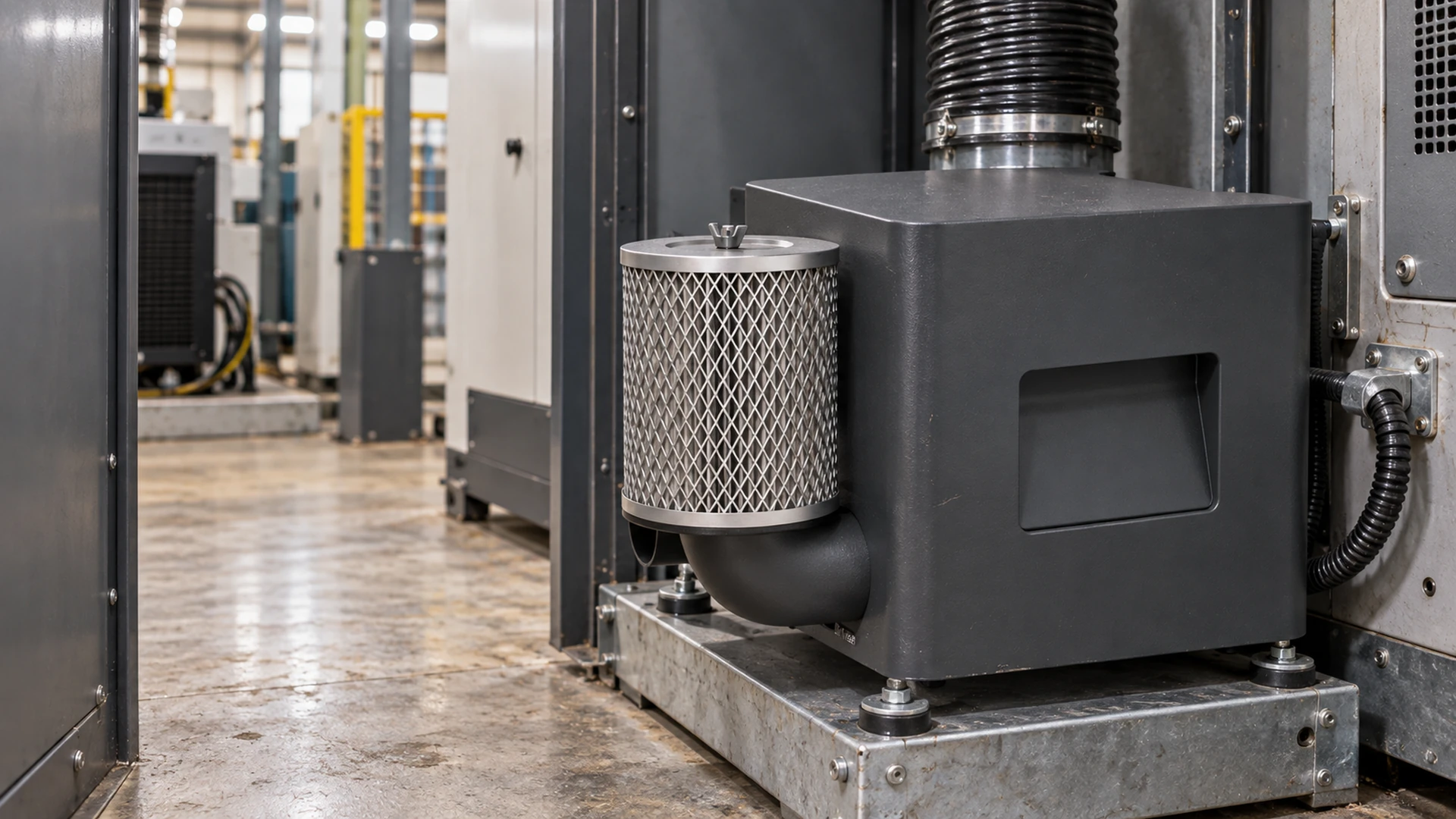
A blower can fit neatly into a machine and still be difficult to live with. An enclosure panel may restrict its cooling air. A cable tray can block the controller’s vents. A filter may be visible but impossible to remove without taking off a guard or disturbing the pipework. These are layout decisions, not faults that a different motor rating will fix.
For an equipment builder, adequate blower cooling and service clearance means two things: the installed unit can operate within the temperature and ventilation limits of its exact model, and a technician can perform the work required by its manual safely. There is no single distance that proves both. The necessary space depends on the blower, controller, enclosure, surrounding heat sources and the tasks that must be done after delivery.
This guide is for teams reviewing a new machine or a retrofit layout before they commit to panel positions and pipe routes. It does not replace the supplied model’s installation instructions or applicable electrical and machine-safety requirements.
Start with the exact unit and its maintenance tasks
Ask the supplier for the final blower and controller documentation before approving the layout. A provisional envelope drawing can help reserve space, but the installed model determines orientation, permitted ambient conditions, cooling openings, access points and service procedures. If a controller is separate from the blower, treat it as another heat-producing, serviceable component.
On the drawing, mark the blower body, inlet filter, terminal or connector area, controller, electrical isolator, mounting fasteners and any condensate or inspection points specified for the model. Then list the work a technician will actually do: inspect or change a filter, read a label, check a connection, remove a cover, replace a unit, or use a meter at an accessible test point. A clear gap beside the housing is of little value if the part must slide out in a different direction.
The distinction matters to buyers. A compact proposal may save machine footprint, but an inaccessible filter or controller can add labor and downtime over the machine’s life. Ask the builder to show both the operating envelope and the service-removal envelope in the as-built layout.
Follow the cooling air, not just the free space on a drawing
Open volume around a blower does not guarantee cooling. Identify where the unit or controller takes in cooling air and where warm air goes. If both openings face the same small sealed compartment, discharged heat may circulate back to the inlet. A nearby wall, foam lining or cable bundle can reduce the effective opening even when a nominal clearance exists.
Review the whole path with every normal guard and cover installed. Check whether the blower receives air from the room, from an enclosure ventilation opening or from air already warmed by another component. Look for exhaust paths that discharge against a panel and return toward the intake. Other machine heat sources—heaters, drives, power supplies and hot process piping—belong in the same review.
Large packaged blowers and compact machine-mounted units will not share one ventilation arrangement. Some may use a defined air path through a cabinet; others may require free space around specific surfaces. The correct inlet, outlet, ambient and clearance limits come from the delivered model’s manual. Do not borrow a dimension from another manufacturer’s drawing or assume that a small housing generates no meaningful heat.
Do not confuse process air with cooling air
The process-air inlet and outlet move air for the application. The blower and controller may have separate thermal requirements. A machine can deliver the required nozzle pressure while its controller sits in a hot pocket. Conversely, a well-ventilated cabinet does not prove that the process inlet filter is clean or that the air system has the required flow.
Mark both routes separately on the layout. Process-air piping should not block a cooling opening or require a tight bend solely to make room for a service door. Cooling-air ventilation should not draw contaminated air into an unprotected location or send hot discharge into a sensitive part of the machine. If these routes compete for the same space, resolve the conflict before ordering the enclosure.
For a cabinet-mounted assembly, consider whether room air can enter and leave under normal installation conditions. A factory may place the machine near a wall or next to another cabinet. The customer’s floor plan can therefore change the available ventilation, even if the machine passed a test in an open workshop.
Allow for the real filter-change and removal path
Filter access is often the clearest test of service clearance. Can a person open the filter housing, remove the element without bending it, clean the seating area and fit the replacement while the machine is in its normal location? If the answer depends on moving the entire machine, the layout needs another look.
Repeat the exercise for other model-specific service items and for the whole blower if replacement is a realistic maintenance task. A removable panel is useful only when there is room to remove it. A hinged door needs its full swing. A heavy unit may need lifting access or a safe removal route; the acceptable method depends on its actual weight and the site’s handling equipment. Do not assume one technician can lift a component without checking the final model and local procedures.
Also leave a workable route for isolating power and reaching required electrical service points. Electrical working space is not a generic blower clearance: it must follow the applicable site rules and the machine’s electrical design. Keep routine filter work separate from live electrical areas where possible.
Review the final machine, not the empty frame
Three-dimensional models are good at showing collisions, but they often hide the order in which a machine is built and serviced. During an assembly review, ask the technician to demonstrate each planned task on the actual machine or a representative mock-up. Include hoses, connectors, acoustic panels, guarding, cable trays and neighboring equipment in the demonstration.
This catches a common failure: the blower had generous access before a later design revision added a safety guard or a larger product conveyor. The revision may not touch the blower in CAD, yet it can remove the only practical route for a filter element or replacement unit.
A useful design-review record includes the component to be accessed, the required action, the panel or guard to be opened, the isolation step and any tool or lifting method. Keep the record short enough for assembly and purchasing teams to use. The purpose is to prove that access exists, not to produce a decorative checklist.
| Review point | Question to answer on the assembled machine |
|---|---|
| Cooling intake | Is the specified opening unobstructed with covers closed? |
| Warm-air exit | Can heat leave without returning to the intake? |
| Ambient exposure | Does the installed location stay within the model’s allowed conditions at full duty? |
| Filter service | Can the specified element be removed and replaced safely? |
| Controller service | Are vents, indicators, connectors and required work areas accessible? |
| Unit replacement | Is there a safe removal route and handling plan for the final model? |
Verify thermal behavior at the demanding duty
An open-door trial on an empty machine is not a useful thermal acceptance test. Run the completed assembly with normal guards and covers installed, the expected filter and pipework in place, and the process at its demanding normal duty. Record ambient conditions at the site or test area and conditions around the blower and controller at suitable measurement locations. Use the supplier’s specified limits and measurement method where provided.
The test duration needs to represent the duty cycle. A short start-up check may miss heat build-up in a cabinet during continuous production. If full-duration testing is impractical at the OEM factory, say so and identify the remaining site-acceptance step. Where the machine has high- and low-demand modes, check the configuration most likely to produce the highest thermal load rather than assuming it is always the mode with the highest process airflow.
Do not use an invented housing-temperature target. Some surfaces can run warm in normal operation; the meaningful limits depend on the selected design and where temperature is measured. If an alarm occurs, record the operating state and investigate airflow, ambient temperature, loading and installation before changing settings. Do not bypass a protection function merely to complete a factory test.
What a buyer should ask the equipment builder to deliver
Cooling and service clearance can be included in the purchase review without specifying an arbitrary number of millimeters. Ask for a marked-up layout showing the unit, controller, cooling-air entry and exit, service panels and removal routes. Request confirmation that the final model’s manual has been used and that any installation exceptions are approved by the supplier.
The factory-acceptance record should state what was tested with the enclosure closed, the operating mode and duration, ambient conditions and any relevant temperatures or alarm status. It should also identify tasks demonstrated on the assembled machine, such as filter replacement. If the actual customer installation may obstruct ventilation, require a site check before final acceptance.
This protects both parties. The builder knows the acceptance basis before fabrication. The buyer receives a machine that can be maintained without discovering after delivery that a wall, cabinet or guard blocks essential access.
Towwind applications: verify the chosen model, not the brand name
A Towwind Energy Saving Blower may suit an OEM design or a replacement of a traditional ring or side-channel blower when the required airflow, pressure and operating conditions match a specific model. Compactness may make integration easier, but it does not remove the need for cooling and service space. A smaller package can still be installed poorly.
When requesting a Towwind proposal, send the process-air duty, enclosure drawing, planned ambient conditions, operating schedule and available electrical supply. Ask for the exact model and controller configuration, the applicable installation documentation and the access needed for the specified service tasks. If the machine will be enclosed, describe the cabinet ventilation rather than sending only external machine dimensions.
The energy case should remain separate from the clearance claim. Energy savings depend on comparable process output, operating points and measured electrical input, not on how small the blower looks in a drawing. This article does not assume a particular Towwind clearance, temperature limit or saving for an unspecified model.
A layout decision worth making early
Moving a bracket in CAD is cheap. Reworking a finished enclosure or asking a customer to pull a machine away from a wall for routine service is not. Reserve cooling and service space when the blower model is selected, test it after the final guards and pipework are fitted, and pass the evidence to the owner.
If the manual, drawing and physical service demonstration agree, buyers can approve the installation with more confidence. If they do not, the builder still has time to change the layout before the machine leaves the factory.
Frequently Asked Questions
How much clearance does an industrial blower need?
There is no universal distance. Use the exact blower and controller manuals for cooling, ambient and installation limits. Then allow additional space for the filter, connectors, panels and complete-unit removal tasks required by the machine layout.
Is free space around the blower enough to prevent overheating?
Not necessarily. Cooling air needs a workable entry and exit route. Warm exhaust recirculation, blocked vents, nearby heat sources and a closed enclosure can cause problems despite visible space around the housing. Verify the completed assembly at its demanding normal duty.
Should service access be checked before or after the machine is built?
Both. Reserve the removal paths during design, then demonstrate them on the assembled machine with guards, hoses and cable trays installed. A drawing may miss a later obstruction.
Can a compact energy-saving blower be installed without a ventilation review?
No. Compact size does not establish thermal suitability. Match the selected model to the process duty and check its specified cooling and ambient conditions in the actual enclosure.
What evidence should a buyer request at handover?
Ask for the final model manuals, an as-built layout of cooling and service access, a record of filter or other service demonstrations, and thermal checks made with normal covers closed. Any site-dependent ventilation check should remain an explicit acceptance item.