
A ring blower replacement can look correct on paper and still disappoint after installation. The new unit may have the same motor rating, a similar connection size, and enough maximum airflow in the catalogue. Once connected to the actual machine, however, it may miss the required pressure, run near its limit, or need permanent throttling.
For a buyer, the risk is not limited to the blower price. A poor match can lead to pipe modifications, control-panel changes, repeated supplier discussions, delayed commissioning, and production loss.
A proper review does not need to become a long engineering study. It does need to answer four questions clearly:
- What is the real operating point?
- How much resistance does the air system create?
- Will the mechanical and electrical interfaces fit?
- Can the blower handle the actual duty cycle?
This ring blower replacement checklist gives purchasers, equipment owners, and maintenance teams a practical way to check those points before an order is approved.
Quick Answer: What Should Be Checked Before Replacing a Ring Blower?
Before replacing a ring blower, verify airflow and pressure at the real operating point, estimate pipe and component losses, inspect mechanical and electrical interfaces, and record the operating schedule. Then compare supplier proposals at the same duty point rather than comparing motor power or maximum catalogue values.
At minimum, the review should include:
- Measured positive pressure or vacuum
- Required airflow during normal and peak production
- Pipe diameter, length, bends, valves, filters, and nozzles
- Existing blower model and performance curve
- Voltage, phase, frequency, current, and control signals
- Port size, orientation, mounting, weight, and available space
- Running hours, starts per hour, load variation, and ambient temperature
- Verified input power at the required duty
Check 1: Establish the Real Operating Point
The operating point is the combination of airflow and pressure or vacuum at which the blower actually works. It is the foundation of a replacement review.
Motor power alone cannot define it. Two 4 kW blowers may have different impeller designs, speeds, controls, and performance curves. One may suit a high-flow, lower-pressure duty, while another performs better against higher resistance.
Measure pressure during production
Pressure should be measured while the machine is performing its normal process. An open-pipe reading does not represent the installed duty because much of the system resistance has been removed.
Record the unit and direction. “35 kPa” is incomplete if the supplier does not know whether it is positive pressure or vacuum. Note normal and peak values, particularly when filters load, valves move, or several process stations operate together.
Verify the airflow requirement
Airflow is often harder to measure than pressure. If a dependable measurement is unavailable, use the original blower model and its performance curve together with the measured pressure. Process information can provide another check.
For example, an air-knife system depends on stable flow against nozzle and pipe resistance. A vacuum fixture may be more sensitive to leakage. An aeration system has losses through pipework and diffusers. The same nominal airflow does not describe these duties equally well.
Ask whether the stated airflow is a maximum catalogue value, a measured process value, or a value read from a curve. Those are not interchangeable.
Do not combine two maximum values
Maximum airflow and maximum pressure usually occur at different points on a blower curve. Requesting both at the same time can create an impossible specification.
The supplier proposal should show that the selected blower provides the required flow at the required pressure. If only maximum values appear on the quotation, the buyer still does not know how the blower will perform on the machine.
Check 2: Review Pipe Loss and System Resistance
The blower does not operate by itself. Pipework, filters, valves, silencers, nozzles, diffusers, and process equipment determine the resistance it must overcome.
Common sources of avoidable pressure loss include:
- Pipework that is too small for the required flow
- Long flexible hoses with rough internal surfaces
- Repeated elbows close to the blower outlet
- Partly closed valves
- Dirty inlet filters
- Restrictive silencers or separators
- Small manifolds and unequal branches
- Blocked air knives, nozzles, or diffusers
- Deposits inside process equipment
A larger blower may force more air through a restrictive system, but that does not make the system efficient. It can increase input power, temperature, and noise while leaving the original restriction untouched.
Inspect the existing control method
Valve position tells part of the story. If the existing blower runs continuously with a discharge valve partly closed or a relief valve open, it may be oversized for the useful duty.
Replacing it with another unit of similar maximum capacity can preserve the same waste. Before selecting the replacement, measure the process requirement with the system adjusted to a safe, representative condition.
Separate process resistance from maintenance problems
A filter that is dirty today should not become the design basis for the next blower. At the same time, the replacement must tolerate the realistic pressure increase between clean and scheduled filter-change conditions.
Define both conditions where possible. This gives the supplier a normal operating point and a credible upper condition without treating a neglected system as normal.
Check 3: Confirm Every Interface
A blower that performs correctly still needs to fit the machine. Interface errors are a common source of unexpected retrofit cost.
Mechanical interface
Compare:
- Overall dimensions
- Mounting-hole pattern
- Inlet and outlet diameter
- Thread, flange, or hose connection type
- Port direction and installation orientation
- Weight and support requirements
- Flexible-joint arrangement
- Filter and silencer clearance
- Space needed for inspection and removal
Do not force rigid pipework into alignment with a different port position. Pipe strain can transfer load and vibration into the blower housing. A properly supported adapter is usually a better solution.
Compact equipment also needs service space. A blower may fit inside the enclosure but leave no practical way to change the filter, reach the terminals, clean the cooling path, or remove the unit later.
Electrical interface
Confirm the site and machine supply in writing:
- Nominal voltage
- Single-phase or three-phase supply
- Frequency
- Available current
- Protective earth and distribution arrangement
- Circuit protection
- Cable and terminal requirements
Do not assume that 220 V always means single phase or that every 380 V site has the same electrical arrangement. Export machines need particular attention because the builder’s workshop supply may differ from the destination factory.
Control interface
An electronically controlled energy-saving blower may offer more control than a fixed-speed ring blower, but the signals must match the machine.
Review:
- Local or remote start and stop
- Manual or automatic speed command
- Analog or digital input requirements
- Run and fault feedback
- Alarm handling
- Emergency-stop behavior
- Restart behavior after power interruption
- Communication protocol, if required
The quotation should identify what is included. A controller, cable, filter, silencer, adapter, or remote control device should not be assumed unless it is listed.
Check 4: Match the Blower to the Duty Cycle
The phrase “runs every day” is not enough to describe duty. A blower that operates continuously across three shifts has different thermal and commercial demands from one that runs for two minutes every half hour.
Record:
- Hours per day and days per year
- Continuous or intermittent operation
- Starts and stops per hour
- Time at full and reduced demand
- Seasonal changes in production
- Normal ambient temperature
- Enclosure ventilation
- Dust, moisture, and inlet-air conditions
Frequent starting may affect controls and protection. Continuous operation makes efficiency and cooling more important. Variable process demand may create an opportunity for speed control instead of throttling or bypassing.
Operating hours also determine the value of energy savings. A lower input-power figure has limited annual impact on a rarely used machine but can be commercially significant on continuous equipment.
Compare Supplier Proposals on the Same Basis
Purchasing teams often receive quotations that cannot be compared directly. One supplier quotes motor power, another quotes maximum airflow, and a third provides a complete duty point.
Normalize the information before comparing price:
| Review item | What the proposal should state |
|---|---|
| Selected duty | Airflow at the required pressure or vacuum |
| Performance margin | Reasonable allowance and its technical basis |
| Input power | Expected or verified input at the selected duty |
| Electrical supply | Voltage, phase, frequency, and controller input |
| Controls | Included functions, signals, and accessories |
| Mechanical fit | Dimensions, ports, adapters, and mounting changes |
| Operating conditions | Duty cycle, ambient limits, and inlet requirements |
| Scope of supply | Blower, controller, filter, silencer, cables, and accessories |
| Support | Documentation, warranty, commissioning, and spare parts |
A supplier should be able to explain why a model was selected. “It replaces a 4 kW ring blower” is not an engineering explanation.
Review Energy Savings Without Guessing
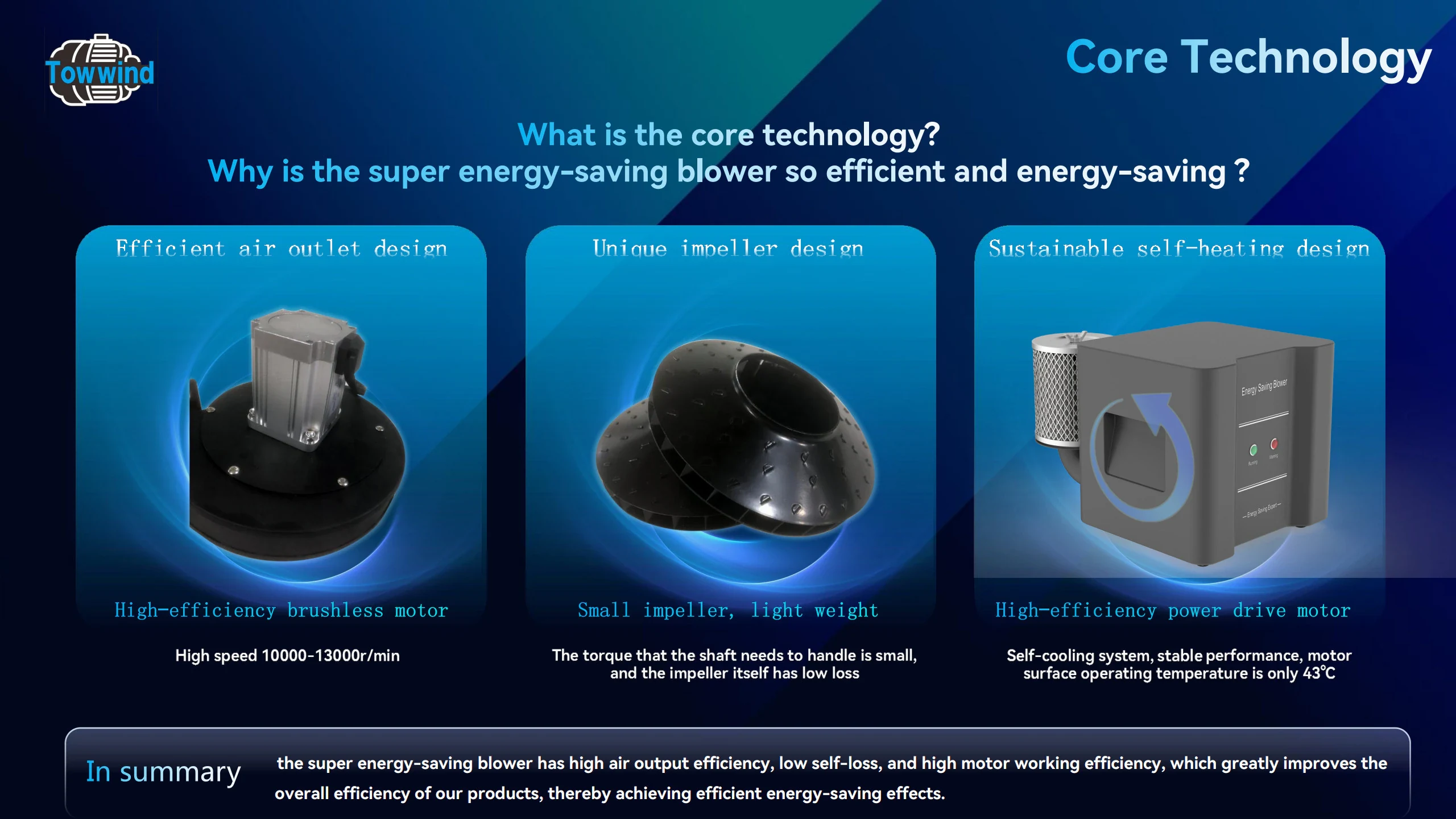
Towwind Energy Saving Blowers use high-efficiency BLDC motor technology and may replace traditional ring blowers, regenerative blowers, side-channel blowers, and vortex blowers in suitable applications.
Traditional blowers in the 2.2 kW to 5.5 kW range are common candidates for evaluation. That range is a screening reference, not a model-selection rule.
Energy performance is site-specific and is not automatic. Actual savings depend on the existing blower’s efficiency, operating point, airflow and pressure, system resistance, operating hours, piping, control method, and installation conditions.
For a credible comparison, use:
Annual electricity consumption = measured input power × annual operating hours
Annual electricity cost = annual electricity consumption × electricity rate
Compare the existing and proposed blowers at an equivalent process duty. A lower power figure is not meaningful if the proposed unit delivers less useful airflow or cannot reach the required pressure.
Include Retrofit Cost in the Buying Decision
The purchase price is only one part of the project. A complete review may include:
- Mechanical adapters and pipe changes
- Electrical-panel modifications
- Cable and protection changes
- Controller integration and programming
- Installation labor
- Commissioning time
- Planned production shutdown
- Filters, silencers, and other accessories
- Future maintenance and spare parts
A slightly higher quotation may be the lower-risk choice if it includes a verified duty point, clear scope, appropriate controls, and fewer site modifications.
Conversely, do not pay for extra capacity without a process reason. Oversizing can increase purchase cost and preserve the throttling losses the retrofit was intended to remove.
Final Ring Blower Replacement Checklist
Before approving the order, confirm that the project file contains:
- Existing blower and motor nameplate photographs
- Measured normal and peak pressure or vacuum
- Required airflow or a defensible method used to estimate it
- Original and proposed performance curves
- Pipe and component review
- Voltage, phase, frequency, current, and protection details
- Control-signal list
- Dimensions, port orientation, and adapter drawing
- Duty cycle and environmental conditions
- Input-power comparison at the required duty
- Complete scope of supply
- Installation and commissioning responsibility
If one of these items is unknown, mark it as unknown rather than filling the gap with an assumption. The supplier can then identify what must be measured or confirmed.
For a Towwind engineering review, provide the existing model, nameplate photos, airflow, pressure or vacuum, pipe information, voltage, operating hours, control requirements, and installation photographs. These details allow the proposed energy-saving blower to be checked against the real system rather than selected from motor power alone.
Frequently Asked Questions
Can I replace a ring blower with another blower of the same motor power?
Not without checking the operating point. The same motor power does not guarantee the same airflow, pressure, efficiency, control behavior, or installation fit. Compare both blowers at the required airflow and pressure.
How do I find the operating point of an existing ring blower?
Measure positive pressure or vacuum during normal production and obtain the airflow if possible. If airflow cannot be measured, use the original model’s performance curve, measured pressure, valve position, and process information to develop a defensible estimate.
Why does pipe loss matter in a blower retrofit?
Pipework and components create the resistance that determines where the blower operates on its curve. Small pipes, bends, dirty filters, valves, and restrictive nozzles can reduce useful airflow and increase operating stress.
Should I select extra blower capacity as a safety margin?
Use only a technically justified margin. Excessive capacity can increase cost and require throttling or bypassing. The allowance should cover credible operating variation, such as filter loading or peak process demand, rather than an undefined percentage.
What information does Towwind need for a replacement review?
Provide the existing blower model, nameplates, required airflow, measured pressure or vacuum, pipe details, voltage, phase, frequency, duty cycle, controls, application, and installation photos.