
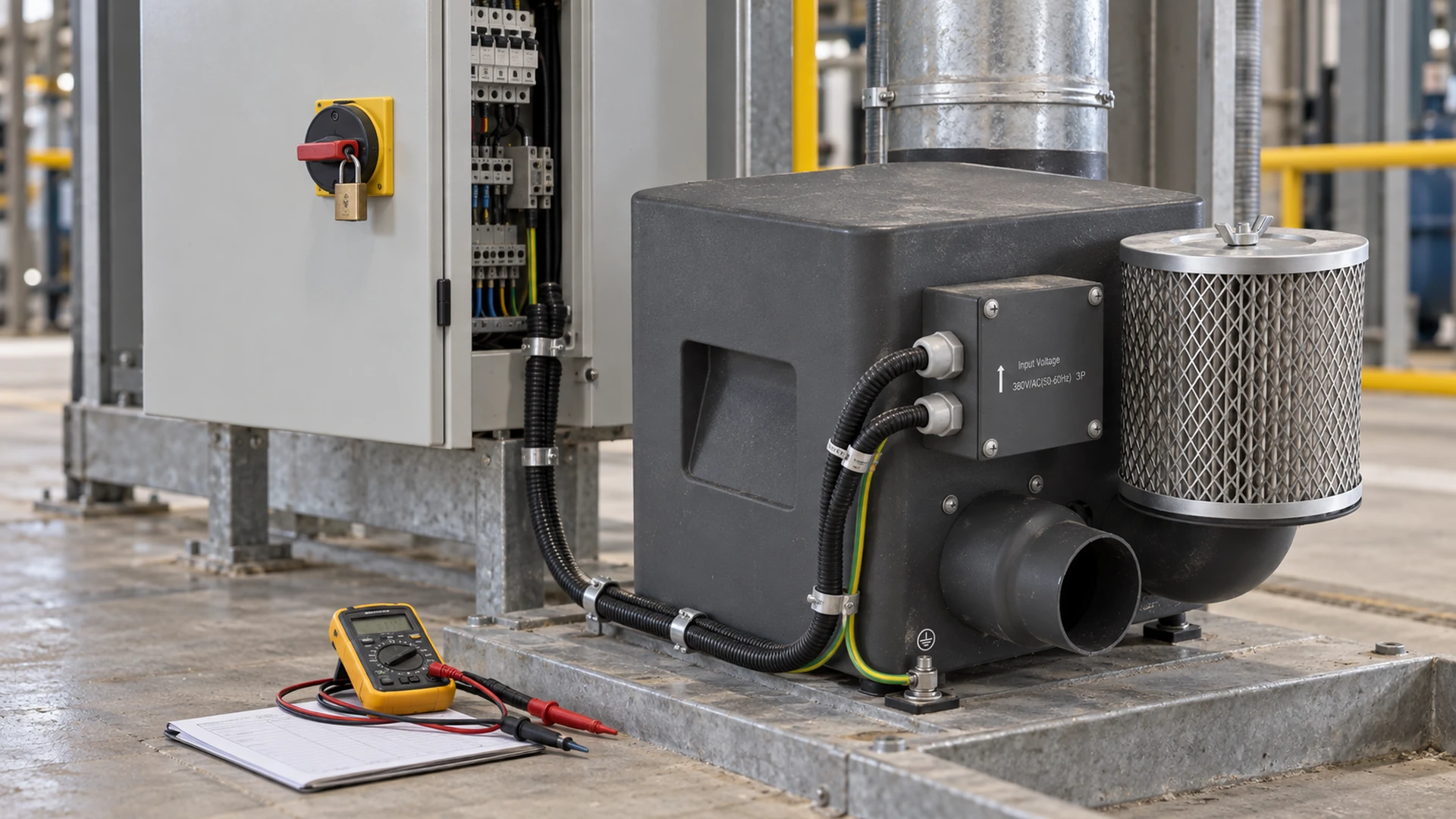
A new blower has been bolted into the machine, the pipework is connected, and production wants to run a trial. The electrician notices that the quotation says “380 V,” while the controller label and the machine drawing use different descriptions. That is a reason to pause. The label on a quotation is not a substitute for checking the supplied unit and the power available at its installed location.
A blower electrical supply check before startup confirms that the actual blower and controller match the site’s voltage, phase, frequency, wiring, protective arrangement and control design. It also establishes who is authorized to energize the equipment and what must be recorded. This is different from choosing between 220 V and 380 V models during procurement: the order has arrived, and a mismatch now has consequences for safety, machine availability and acceptance.
This article is a buyer’s review guide, not a wiring procedure. Electrical inspection, testing and first energization belong to qualified personnel following the final model documentation, the machine design and applicable site requirements. If any identity, rating or connection detail is unclear, stop and resolve it with the supplier before startup.
Begin with the delivered model, not the purchase description
Ask the electrical team to compare three records: the purchase specification, the delivered blower and controller labels, and the final approved wiring diagram. They should identify the exact part and configuration supplied. A blower package may include a motor, controller, filter or other accessories with separate ratings and connection needs. The motor’s nameplate alone may not describe the supply to a complete electronically controlled package.
Record any difference as an open item. A substituted model, revised controller or alternative regional electrical option may be perfectly workable, but someone must confirm it against the machine and site supply. The same applies to an OEM machine built for export: workshop power at the builder’s site does not prove compatibility at the customer’s site.
For a Towwind Energy Saving Blower, request the final wiring and operating instructions for the exact model and controller delivered. Do not assume the connection method of a traditional ring blower applies to a high-efficiency electronically controlled replacement. A similar-looking terminal or cable is not proof of the same electrical interface.
Verify the supply at the point where the blower will run
The rating on a distribution-board schedule is a starting reference. The relevant supply is the one feeding the installed blower package under the site’s real conditions. The electrician should confirm nominal voltage, phase arrangement and frequency against the final documentation, then assess the actual supply and any expected variation according to the applicable procedure.
For a machine with a controller, distinguish the controller’s supply input from its output to the motor. Confusing those two sides can lead to a costly error. For a three-phase installation, phase presence and any model-specific phase-sequence or rotation requirements should be checked by the qualified team. For a single-phase installation, do not assume the phase arrangement from a “220 V” label alone. The exact terminal design and acceptable limits vary by product.
If the blower is supplied from a generator, transformer, long feeder or shared production circuit, include those details in the review. Voltage measured with the machine stopped may not describe conditions when other loads start. A site with intermittent dips or trips deserves investigation rather than repeated attempts to restart the blower.
Confirm protection, isolation and grounding as a complete design
Buyers should ask whether the machine’s electrical design has been reviewed for the delivered package—not simply whether a breaker is present. The protection and isolation arrangement must be suitable for the final equipment, conductors, controller and local installation. Any required protective-earth connection and continuity check must be handled in accordance with the model instructions and applicable electrical rules.
There is no responsible universal breaker size for “an energy-saving blower.” Protection depends on the exact package rating, starting or control characteristics, cable arrangement and relevant standards. A device that trips during startup may indicate an application or wiring issue; increasing its setting without finding the cause is not an acceptance method.
Access to the isolating device matters as well. The maintenance team should be able to identify which device isolates the blower package and what other energy sources may remain. Controllers can contain stored electrical energy after disconnection, and a machine may have more than one feed. Before anyone opens electrical equipment, qualified staff must follow the site isolation and verification procedure. Do not treat a dark display as proof that conductors are safe to touch.
Inspect the installation before asking for power
An electrical pre-start review should catch assembly errors while the equipment remains isolated. The qualified team should compare cable routing and terminations with the approved drawings and final manual. They should check that the correct connectors, glands, cable support and enclosure features are present, and that no conductor or cable is exposed to foreseeable heat, abrasion, washdown or mechanical damage.
The inspection should also account for the finished machine. A cable that was safe on an open frame may be pinched by a guard. A controller mounted close to a heater may exceed its permitted ambient condition during production. These are reasons to address the physical layout before energization. The electrical team should document any deviations and obtain an approved correction, not rely on a temporary arrangement that becomes permanent after the trial.
Functional checks involving energized circuits require the appropriate risk assessment, personnel and method. This article intentionally does not prescribe meter placement, terminal sequences or protective-device settings. Those details belong to the site’s electrical procedure and the selected equipment documentation.
Make the control state predictable at first startup
The first energization should not cause an unexpected machine motion or an unplanned blower start. Before power is applied, the controls team should know what the start command, speed reference, run feedback, fault signal and stop command are expected to do. If the blower can start automatically after a power return or fault reset, that behavior needs to be understood and controlled as part of the machine-level design.
A run indication may prove only that a controller has accepted a command; it does not necessarily prove that the process is receiving enough air. If the machine must wait for adequate pressure, flow or another process condition, the appropriate sensing and interlock strategy should be defined and tested separately. Likewise, a fault indication should trigger the intended machine response instead of disappearing into an unused input on the control system.
For variable-speed operation, record the initial setting and the permitted range for the delivered model. Do not assume a generic controller parameter from another installation. A change to speed can change both air delivery and electrical load; the settings used during factory or site acceptance should be traceable later.
Agree on a controlled startup and stop conditions
Once the electrical team has cleared the installation, first startup should be planned rather than improvised. Identify who authorizes energization, who observes the machine, where the process readings will be taken and which abnormal conditions require a stop. Keep guards and normal protective features in their required state. If a test cannot be conducted without bypassing a machine safeguard, that calls for a separate approved method—not a shortcut in a blog checklist.
The qualified team can compare observed voltage and electrical input, alarms and operating behavior with the selected model’s documentation. The process team should check that the blower delivers the required result through the actual filter and pipework. Record the operating mode, control setting and measurement boundary. A no-load spin is not a substitute for a test at the intended air duty.
Unexpected protective trips, repeated controller faults, unusual smell or noise, abnormal heating or a process result below the required limit are reasons to stop and investigate. Repeated resets can erase useful evidence and may expose the machine to further damage. The response should follow the final manual and site procedure.
What purchasing should receive before acceptance
The buyer does not need to perform electrical tests personally. The buyer does need a clear record that they were performed on the delivered configuration. A concise startup pack should include:
- Delivered blower and controller model identifiers and the approved electrical drawing revision.
- The site supply characteristics verified against the package requirements.
- Confirmation that isolation, grounding and protective arrangements were reviewed by qualified personnel.
- Open wiring or installation deviations, their resolution and who approved it.
- The tested control and fault-response behavior.
- Initial operating settings and the process condition used for the trial.
- Recorded electrical and process results, with measurement location and test date.
If a commissioning contractor, OEM and site electrician divide the work, state who owns each record. Otherwise a successful startup can leave no one able to explain why a breaker trips during the next shift. A written baseline also helps distinguish a later supply problem from a change in filter resistance, control setting or process load.
| Decision | Evidence the buyer should ask for |
|---|---|
| Safe to schedule energization? | Delivered-model identity, approved drawings and qualified electrical clearance |
| Supply compatible? | Voltage, phase and frequency checked at the installed feed against final documentation |
| Machine response understood? | Start, stop, run and fault behavior tested as designed |
| Ready for process acceptance? | Electrical readings tied to the same operating mode as the air-performance test |
How Towwind fits into this review
Towwind Energy Saving Blowers may suit certain machines and replacements for traditional ring, regenerative or side-channel blowers, subject to the required airflow, pressure, operating conditions and the exact model selected. Any expected reduction in electricity use must be assessed at equivalent process output; the nameplate ratings of the old and new machines do not establish actual savings.
When a Towwind unit is proposed, give the supplier the destination-site supply details, machine wiring arrangement, start/stop needs, operating schedule and process-air duty. Ask for the final electrical information for the selected blower and controller, including any connection or protection requirements and startup checks. If the existing machine uses direct-on-line motor wiring, do not assume it can be reused unchanged for a controlled replacement.
The useful purchasing question is not “Will it start on our voltage?” It is whether the complete package can be integrated safely, run through the intended process modes, and be supported by a test record that shows what it delivered.
Close the gap before the first shift
A first start should confirm a completed design, not be used to discover what was purchased. Match the delivered model to the site supply, close electrical and control deviations, and let qualified personnel authorize a controlled test. Then record both electrical behavior and process performance under the same operating conditions.
If the supply, wiring or protection does not match the final documentation, hold the startup and ask the equipment builder or supplier for a documented resolution. That pause is usually easier to manage than a damaged controller, an unexplained trip or a production line that cannot rely on its air supply.
Frequently Asked Questions
Is matching the voltage printed on the quote enough before starting a blower?
No. Check the delivered blower and controller identifiers against the approved drawing and the actual site supply. Phase, frequency, input arrangement, protection and control connections also matter.
Can an electrician reuse the old ring blower’s wiring for an energy-saving replacement?
Not without reviewing the selected replacement’s final instructions and the machine design. An electronically controlled package may have different supply, signal, protection or isolation requirements from a directly connected motor.
Who should verify the blower supply and authorize first energization?
Qualified electrical personnel should perform the inspection and testing under the site’s approved procedures. The buyer should receive a record of the result, but should not use a generic article as a wiring or live-testing instruction.
What if a breaker trips or the controller alarms during the first run?
Stop and record the operating state and fault information. Have the qualified team investigate the supply, wiring, settings, protection and process load using the final documentation. Do not repeatedly reset or raise a protection setting simply to complete the trial.
Does a lower blower motor rating prove lower electricity cost?
No. Compare measured electrical input while the old and new arrangements meet the same accepted process duty, then account for the hours spent in each operating mode and the applicable electricity tariff.