
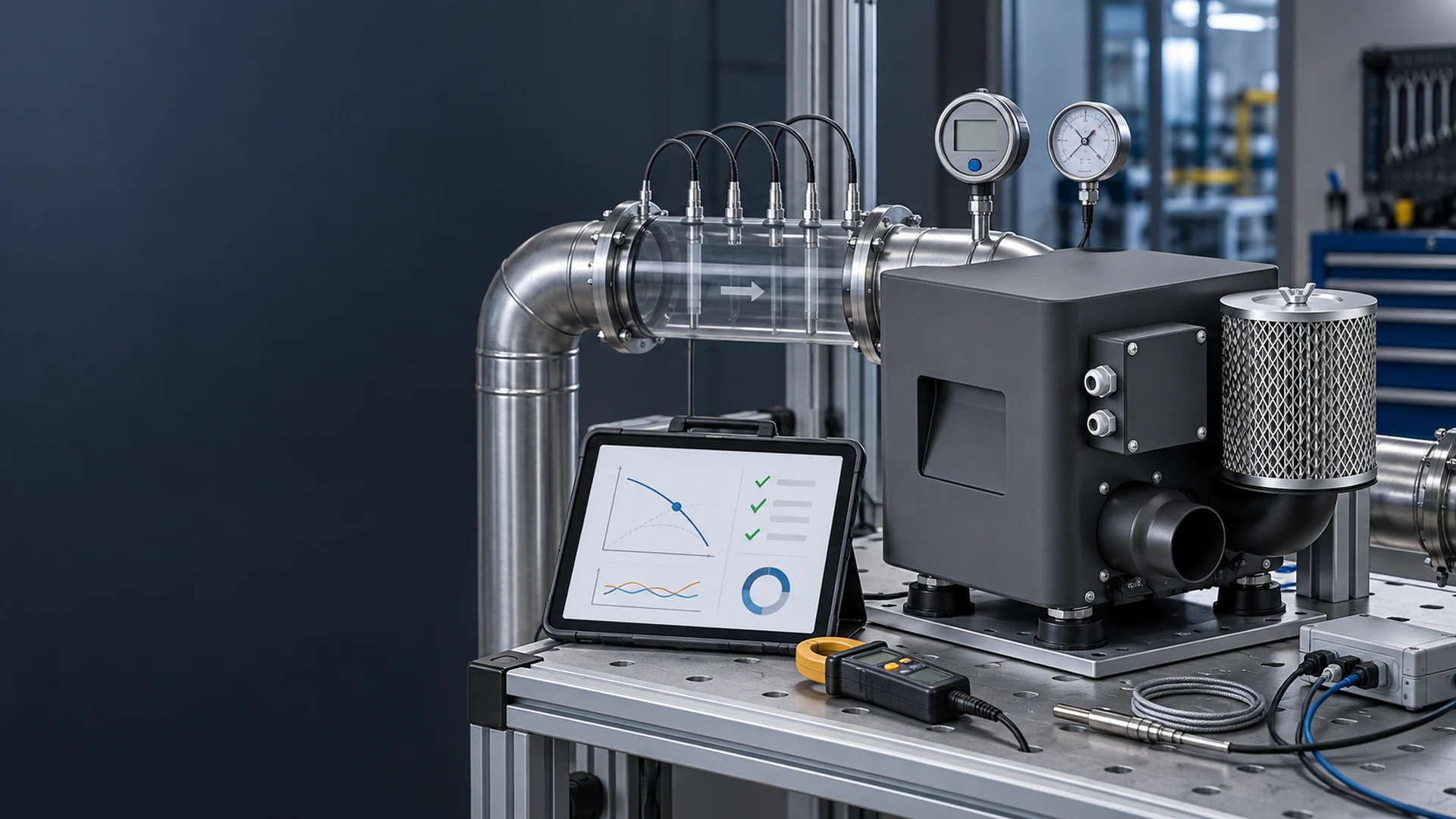
A supplier has named a blower model and sent a quotation. The stated airflow looks ample, the motor rating is lower than that of the installed unit, and the price is reasonable. Purchasing still cannot tell whether the machine will get enough air. None of those figures describes what happens once the proposed blower is connected to the actual pipework.
To validate a blower proposal, compare the required process result with the candidate’s airflow and pressure at the same operating point. Check the assumed pipe losses, air conditions, run schedule, electrical supply and control interfaces. Finally, agree on how process performance and electrical input will be measured after installation. Catalogue maximums alone cannot answer those questions.
This is a review for buyers who already have a proposed model in hand. It helps distinguish a selection supported by application data from one that still depends on untested assumptions.
Start with the result the air must produce
An air requirement should be tied to an observable process outcome. For a PCB cleaning line, that might mean water removed from a defined board area before the next station. For an air knife on a packaging line, it might be a dry label zone at full conveyor speed. In aeration, it could be a process-defined air delivery requirement at a stated operating depth and system configuration.
Describe the outcome, its acceptance limit and where it will be checked. “Strong airflow” is not an acceptance criterion. Neither is “same as the old blower” if the old system was undersized or running against a partially blocked filter.
Ask your process owner to identify the conditions that make the job hardest: maximum line speed, wettest incoming product, all nozzles open, highest normal liquid level, or the longest operating shift. A proposal proven only at an easy condition can look sound on paper and fail during ordinary production.
Separate measured data from assumptions
Buyers often receive a mixture of field readings, estimates and catalogue values without labels. That makes comparison difficult. Put every important number into one of three groups:
| Data status | Example | How to use it |
|---|---|---|
| Measured at the existing site | Electrical input recorded during normal production; pressure at a documented tap | Useful baseline, provided the instrument, location and operating state are recorded |
| Calculated or estimated | Pipe-loss estimate for a proposed longer hose | Ask for the method and test it against the final layout |
| Proposed or catalogue-rated | Candidate blower flow, pressure and input at a stated speed | A prediction until checked at the intended operating point and then commissioned |
This distinction matters most in retrofits. A pressure reading taken at the blower outlet is not automatically the pressure available at the last nozzle. Likewise, a motor nameplate is not a measurement of electrical input under load. Record the boundary of every number: blower terminals, package inlet, manifold or point of use.
Where a value is unknown, mark it unknown. A proposal with an agreed measurement step is easier to manage than one built on an unexamined guess. Ask the supplier to show which assumptions would change the model choice if later measurements differ.
Confirm the required operating point, not two catalogue maxima
Airflow and pressure must be considered together. The installed blower will operate where its performance meets the resistance of the connected air system. A free-air flow figure and a maximum-pressure figure normally refer to different conditions; neither proves the required combination is available.
Give the supplier the required flow at the relevant pressure, with units and measurement locations. Include the expected operating range if demand changes between product formats or machine modes. Then ask for the candidate’s performance curve or other model-specific performance data showing the proposed point. The response should identify speed or control setting, inlet conditions, and whether quoted pressure is static, total, gauge or differential as appropriate to the equipment.
Do not assume a single point explains a variable process. A machine may have a normal setting, a high-demand setting and a reduced-flow idle state. The proposed blower should be reviewed at each condition that materially affects output or power.
Account for the air path the blower will actually see
A proposal can be correct for an ideal bench connection yet weak in the finished machine. Filters, silencers, hoses, bends, valves, manifolds and nozzles impose resistance. Their condition and arrangement matter. So do suction-side restrictions where the application uses vacuum.
For a new installation, send the intended routing and ask which losses are included in the supplier’s calculation. For a replacement, photograph the existing pipework and identify any planned changes. Note hose internal diameter and length, filter type, branch count, valves and the discharge or suction termination. If the design includes a long flexible hose or a tight bend close to the unit, flag it rather than assuming the catalogue test reflects it.
The buyer does not need to produce a perfect system curve personally. The buyer does need to know whether the supplier’s selected point accounts for the real system and who is responsible if the final pipework changes.
Check the full operating schedule and controls
“Runs eight hours a day” may hide several different duty modes. A blower might spend most of the shift at a low-demand setting, cycle with the machine, or run continuously while production stops. These patterns affect thermal suitability, controls, energy use and the value of any proposed efficiency improvement.
Share the expected hours by mode, start/stop pattern and control signal. If several nozzles or process branches open and close, show the combinations that must work. Ask whether the proposed unit can operate over that range without an unacceptable pressure excursion, overheating or process instability. Any control limits need to come from the selected model’s final documentation, not from a generic promise that a variable-speed blower will cover everything.
Electrical and interface information belongs in the same review: available voltage, phase and frequency; protection arrangement; start command; speed reference; run and fault feedback; and the machine’s response to an alarm. These details may not change the airflow calculation, but they can determine whether a technically plausible proposal can be installed and accepted.
Make energy claims comparable to the process duty
An energy-saving proposal is useful only if the existing and proposed systems are compared while doing the same work. Ask for measured existing electrical input under a documented operating state. Ask the supplier to state predicted electrical input for the complete proposed package at the same required air duty. Clarify whether a controller, filter or other auxiliary is included in the quoted power boundary.
If operation varies, compare the modes separately and weight them by actual hours. Annual energy can then be estimated as the sum of input power in each mode multiplied by hours in that mode. Electricity cost also depends on the tariff applied to those hours. Do not multiply the difference between two motor nameplate ratings by annual operating hours and call the result verified savings.
The supplier should also state how a prediction will be checked after installation. A test at the same process output is more meaningful than a no-load demonstration. If the new blower requires a different nozzle or a change to the process, that change should be made visible in the comparison.
Ask for a proposal you can test
A credible proposal should let purchasing trace the chosen model back to the supplied data. Request a short selection record containing:
- The application and process result being protected.
- Required flow and pressure together, with units, measurement points and operating conditions.
- The candidate model, configuration, speed or control setting, and model-specific performance evidence at those points.
- The assumed air-path layout, air conditions and any excluded losses or accessories.
- Predicted electrical input at each material duty condition, with the measurement boundary stated.
- Electrical supply, control interfaces, alarm behavior and installation constraints.
- Open assumptions, proposed site measurements and pass/fail criteria for commissioning.
The last line is particularly important. If no one can measure a quantity safely at the proposed location, agree on a practical alternative before the purchase order. For a drying machine, acceptance may combine measured pressure at the manifold with a documented dry-product test at maximum line speed. For another process, a different output measure may be more appropriate. The criterion should follow the application, not be copied from a generic blower brochure. The purchase order should also say who will provide instruments, who will witness the test and what happens if the result falls short.
Where Towwind fits into the comparison
Towwind Energy Saving Blowers are candidates for suitable industrial air-supply duties and replacements for some traditional ring, side-channel, regenerative or vortex blowers. A smaller motor rating or a supplier’s general savings claim is not enough to validate a particular installation. The selected Towwind model still needs to meet the required airflow and pressure at the actual system resistance, duty cycle and electrical conditions.
For a Towwind proposal, send the current blower identification, process requirement, measured readings where available, pipework details, electrical supply, control needs and operating schedule. Ask for the proposed operating point and the assumptions behind its predicted power. If a key field measurement is missing, treat the recommendation as provisional and agree on the verification step before ordering.
This is also where purchasing can compare total scope fairly. An offer that excludes a controller, adapter, filter or commissioning support should not be placed beside a complete installed offer as though they are equivalent. Keep the technical basis and the commercial boundary on the same review sheet.
A sensible approval decision
Approval does not require every uncertainty to disappear. It does require the important uncertainties to be named and assigned. If the process duty is defined, the proposed model has evidence at the required point, installation interfaces are confirmed and the acceptance test is practical, the proposal has a defensible basis. If the recommendation rests on maximum catalogue airflow, old motor kW or an unverified savings percentage, request a revised selection record.
Send Towwind the application data you have and clearly mark what is measured, estimated or unknown. That gives both sides a better starting point for selecting and testing an energy-saving blower that serves the process—not merely a model that looks attractive in a quotation.
Frequently Asked Questions
Is an existing blower nameplate enough to validate a replacement proposal?
No. It helps identify the old equipment and electrical rating, but it does not establish the actual airflow, pressure, system resistance or process result. Use it alongside site readings, operating details and the proposed blower’s performance at the required duty point.
What if we do not have an airflow measurement?
State that it is unavailable. Provide pressure readings with locations, the air-path layout, nozzle or outlet details, and a measurable process acceptance criterion. Ask the supplier what can be estimated, what should be measured before ordering, and what must be checked during commissioning. Do not label an estimate as a measured flow.
Should a supplier quote maximum airflow and maximum pressure?
Those values can describe a model’s limits, but they do not validate its performance at your operating point. Request airflow and pressure together for the intended system, plus the applicable curve or model-specific performance data.
How can a buyer check a claimed energy saving?
Compare electrical input for the existing and proposed complete systems at the same accepted process duty, then account for the hours spent in each operating mode. Treat proposed values as predictions until measured after installation.
What belongs in the purchase acceptance criteria?
Specify the process result, test operating conditions, accessible measurement points, required air performance where measurable, electrical input boundary, and who records the commissioning results. Include the worst normal operating condition, not only an easy demonstration setting.