
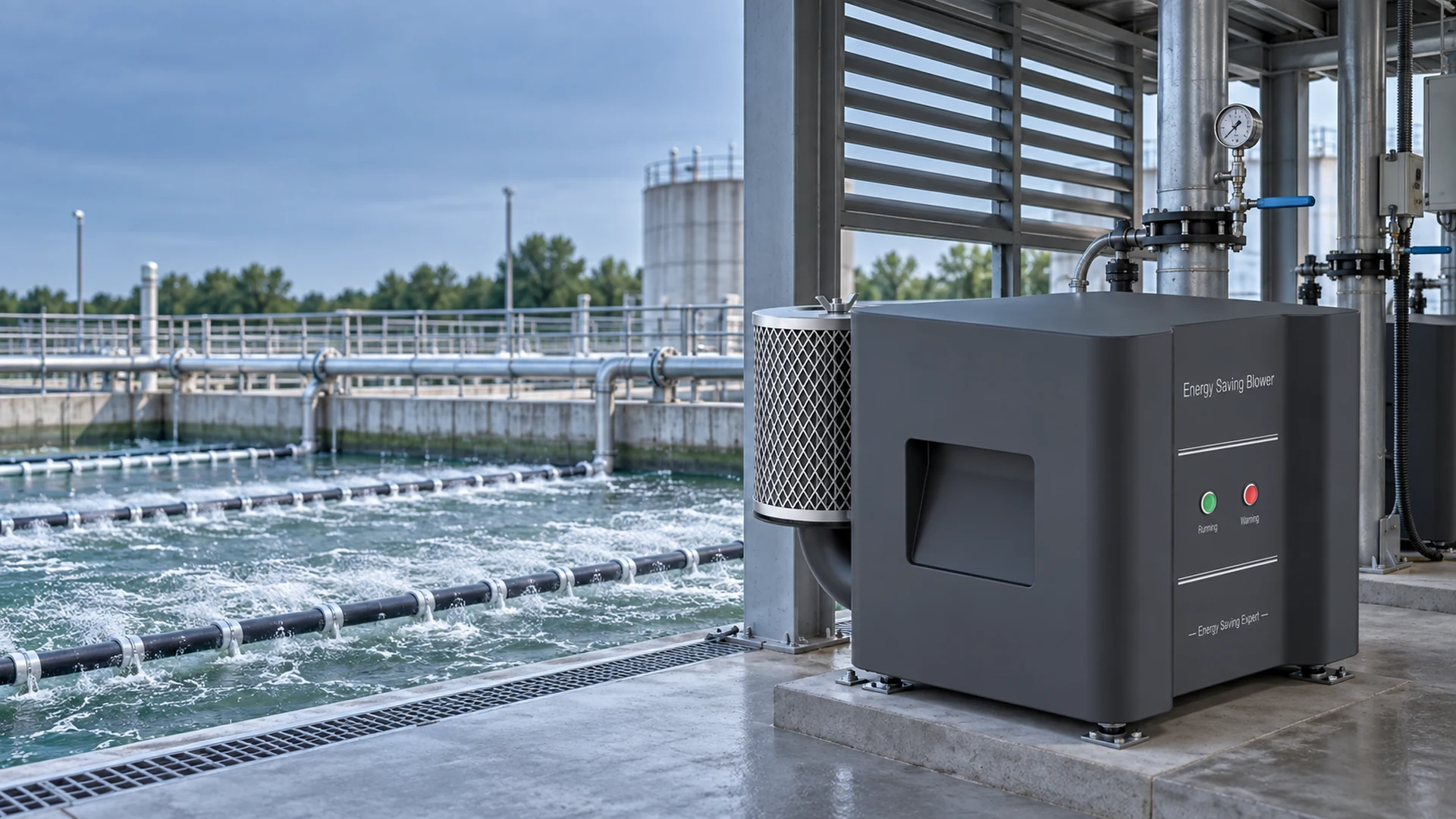
An aeration blower that meets the plant’s peak air demand may spend most of the year operating well below that point. Another unit may look efficient on a catalogue curve but struggle as diffuser backpressure rises or a second basin comes online. Either mistake can leave operators choosing between excessive electricity use and poor process control.
Sound wastewater aeration blower selection starts with the treatment process, then works backward through diffusers, pipework and controls to the blower. The question is not “What motor size replaces the old one?” It is “What air must reach each basin at the pressure the installed system imposes, across the load range the plant actually sees?”
Define the Treatment Duty Before the Machine Duty
The aeration system supports a biological process. Organic load, ammonia load, wastewater flow and operating strategy can change oxygen demand through a day and across seasons. The process engineer should define the air requirement and treatment targets for the plant’s actual configuration. Do not copy a dissolved-oxygen (DO) setpoint from another facility or use a fixed air rate because that is how the existing blower happens to run.
Collect operating data that explains the range: influent flow and load where available, basin DO trends, ammonia or other process indicators, valve positions, blower staging and periods of high or low demand. Identify which basins or zones run together. If a site already misses its treatment target, its current blower output is evidence of the present condition, not automatically the required replacement duty.
The useful selection brief describes at least three situations: the normal load that occupies many operating hours, the highest required air demand, and the lowest demand at which adequate process performance and mixing still have to be maintained. Their actual values are site-specific. A blower that covers only the peak point may be an expensive choice for the hours spent near minimum load.
Translate Oxygen Demand into Air Delivery Carefully
Airflow is not the same as oxygen transferred into mixed liquor. Diffuser type and condition, basin geometry, water depth, wastewater characteristics and operating DO affect transfer. If diffusers are fouled, more air at the blower may be needed to get the same process result. That does not mean the blower is the root cause.
Ask the process and diffuser suppliers how the required oxygen delivery becomes an air rate for each operating condition. State whether the airflow figures are actual or standardized and what reference conditions apply. For a retrofit, record any planned changes to diffuser type, quantity or layout. Changing the diffusion system while changing the blower can improve the plant, but it also means a before-and-after power comparison is no longer a simple blower-only test.
The U.S. EPA’s fine-bubble aeration guidance identifies wastewater load, diffuser design, fouling and DO control among the factors that influence aeration-system performance. That is why a blower quotation should list the process and diffuser assumptions used to select the machine rather than present an isolated maximum airflow figure.
Calculate Pressure at the Real Operating Flow
The blower must supply air against the pressure required by the submerged diffusers and the losses between the blower and the basin. Water depth creates a substantial part of that pressure. Diffuser resistance, pipe friction, valves, filters and other components add to it. Their contributions change with airflow and equipment condition, so one outlet-pressure reading is not a complete system description.
Create an air-path sketch from the blower inlet to each basin. Mark submergence depth, shared headers, branches, valves, pressure taps and diffuser type. Identify the basin or zone that imposes the controlling pressure when the required number of branches runs. A long branch with restricted piping can be the limiting path even if another basin has more diffusers.
For a running installation, compare pressures at the blower discharge and selected downstream points. A rising header pressure may reflect diffuser fouling, a closed valve or another restriction; it does not by itself prove the blower has become inefficient. For a new design, use the diffuser supplier’s data and an engineering estimate of pipe losses, then identify uncertainty that still needs field verification.
The blower selection must show the required flow at the corresponding pressure on the exact model’s performance data. Maximum free-air flow and maximum pressure are separate ratings; neither proves the proposed operating point. How to Define the Required Blower Operating Point explains the general flow–pressure method.
Check the Full Operating Range and Control Method
Activated-sludge air demand rarely remains fixed. Decide whether the plant will vary blower speed, stage multiple blowers, adjust basin valves, or use a combination. Ask how the proposed model behaves at normal, peak and minimum required air rates. The lower limit matters: an adjustable blower is not automatically able to operate at any arbitrarily low flow or speed. The exact machine and controller documentation must establish its permitted operating range.
Controls should be designed around the process. A DO sensor can indicate what is happening in a basin, while airflow and header-pressure measurements help the control system distribute and deliver air. Poor sensor placement or calibration can make an efficient blower chase a bad signal. The plant’s controls engineer should define how DO, airflow, valve positions and blower output interact and what happens when a sensor fails.
An EPA review of aeration control describes how basin DO, basin airflow, common-header pressure and blower flow may appear in a conventional control arrangement. The point for procurement is straightforward: the replacement blower’s control and feedback interfaces must fit the site’s actual strategy. A unit that can be started manually is not necessarily ready for automatic load-following operation.
If the plant needs continuous mixing even when oxygen demand is low, the process engineer should state the minimum air service or alternative mixing method. Energy reduction cannot be achieved by slowing the blower below a condition that keeps the treatment process stable.
Decide How Much Capacity Must Remain After a Fault
Redundancy is not an optional footnote when an aeration interruption threatens permit compliance or process recovery. Review what happens if one blower trips, the power supply fails, a valve sticks or a common header develops a problem. The required standby capacity and response time depend on the facility’s risk assessment and operating permit; no universal arrangement is appropriate for every site.
Write the duty and standby philosophy into the quotation request. If two existing machines alternate, replacing one with a lower-power model should not silently remove the plant’s ability to cover a critical load. Check whether standby equipment can actually start and deliver air at the needed pressure, whether the control system transfers duty, and whether operators receive a useful alarm.
Also consider the physical installation. A blower room may have constraints on ventilation, inlet-air quality, service access, noise and electrical supply. A model that fits the air duty but cannot be maintained or cooled as its manual requires is not a complete selection.
Compare Proposals on the Same Basis
The following request sheet is more useful than asking three suppliers for a blower with the old unit’s motor kW:
| Requirement | What the plant should provide or request |
|---|---|
| Process duty | Normal, peak and minimum required air conditions by basin or zone |
| Airflow basis | Units and whether flow is actual or referenced to stated standard conditions |
| Pressure basis | Required point, water depth, diffuser and pipe losses, measurement locations |
| Operating schedule | Hours at each relevant mode and basin configuration |
| Controls | DO/airflow strategy, command and feedback signals, alarm response |
| Redundancy | Duty/standby arrangement and failure response |
| Electrical input | Expected real power at each proposed operating point, including controller boundary |
| Acceptance | Air delivery, process performance, controls and power test conditions |
Label each value as measured, calculated or assumed. If the plant cannot yet quantify a critical diffuser loss, ask the supplier what measurement or test would resolve it. Do not conceal uncertainty behind an oversized motor allowance.
Where a Towwind Energy Saving Blower May Fit
Towwind’s energy-saving blower is an option to review for suitable wastewater aeration duties, including some smaller systems now using traditional ring, side-channel or regenerative blowers. Its BLDC technology may lower electrical input at a matched duty, but suitability depends on the required airflow, pressure, operating range, site conditions and control integration. Larger or deeper systems may require a different machine type or system arrangement; Towwind should not be presented as a universal municipal-plant replacement.
Ask Towwind for the exact model’s performance data at the site’s normal, peak and minimum points, plus expected package input power and installation requirements. Compare it with the existing unit using measured electrical input, similar diffuser and valve conditions, and the same useful treatment duty. A claimed saving that comes from delivering less air than the biological process requires is not a valid improvement.
For annual cost, use real or defensible power estimates at each mode multiplied by operating hours. If the blower, diffusers and controls change together, document the full project boundary. The plant may gain from the combined system, but the result should not be attributed to the blower alone. How to Calculate Blower Energy Use Without Overstating Savings covers the calculation logic.
Specify the Acceptance Test Before Ordering
Agree which basins and load conditions can be tested at commissioning, what instruments will be used, and which process outcomes must remain acceptable. Record actual flow and pressure at named locations, blower electrical input, controller settings, valve positions and diffuser condition. Confirm alarms and standby response under an approved procedure. A brief first start can verify installation; it cannot represent every influent-load condition the plant will see later.
Plan a follow-up review using normal operating data. Check whether the blower can hold the required air service as filters and diffusers age, whether controls remain stable, and whether the plant meets its treatment obligations. The final purchase decision is therefore a system decision: adequate oxygen delivery, appropriate pressure, usable turndown, resilience and operating cost together.
If you are evaluating a Towwind option, send the basin layout, water depth, diffuser details, normal and peak air requirements, pressure readings, existing blower data, controls and duty/standby plan. Those facts allow a model-specific review instead of a recommendation based on motor size.
Frequently Asked Questions
Can I select an aeration blower from the existing motor kW?
No. Motor rating does not show the air delivered at the basin’s required pressure. Define the normal, peak and minimum process air duties, then check the exact proposed blower at those flow–pressure points.
Does a higher blower pressure improve wastewater treatment?
Not by itself. Higher pressure can indicate diffuser depth, added resistance or fouling. The plant needs adequate air and oxygen transfer under its process conditions; excess pressure may waste power or signal a restriction that should be corrected.
Why does minimum airflow matter when peak demand sets the blower size?
Plants often operate below peak load for many hours. A proposed blower and control arrangement must cover that lower duty while preserving the process’s oxygen and mixing requirements. Its allowable operating range must be verified from the exact model documentation.
Should standby capacity be included in the comparison?
Yes. State the plant’s duty/standby requirement and test what happens after a fault. Compare quotations with the same reliability scope rather than pricing only the normally running machine.
—
Editorial notes below — do not paste into the public WordPress article.