
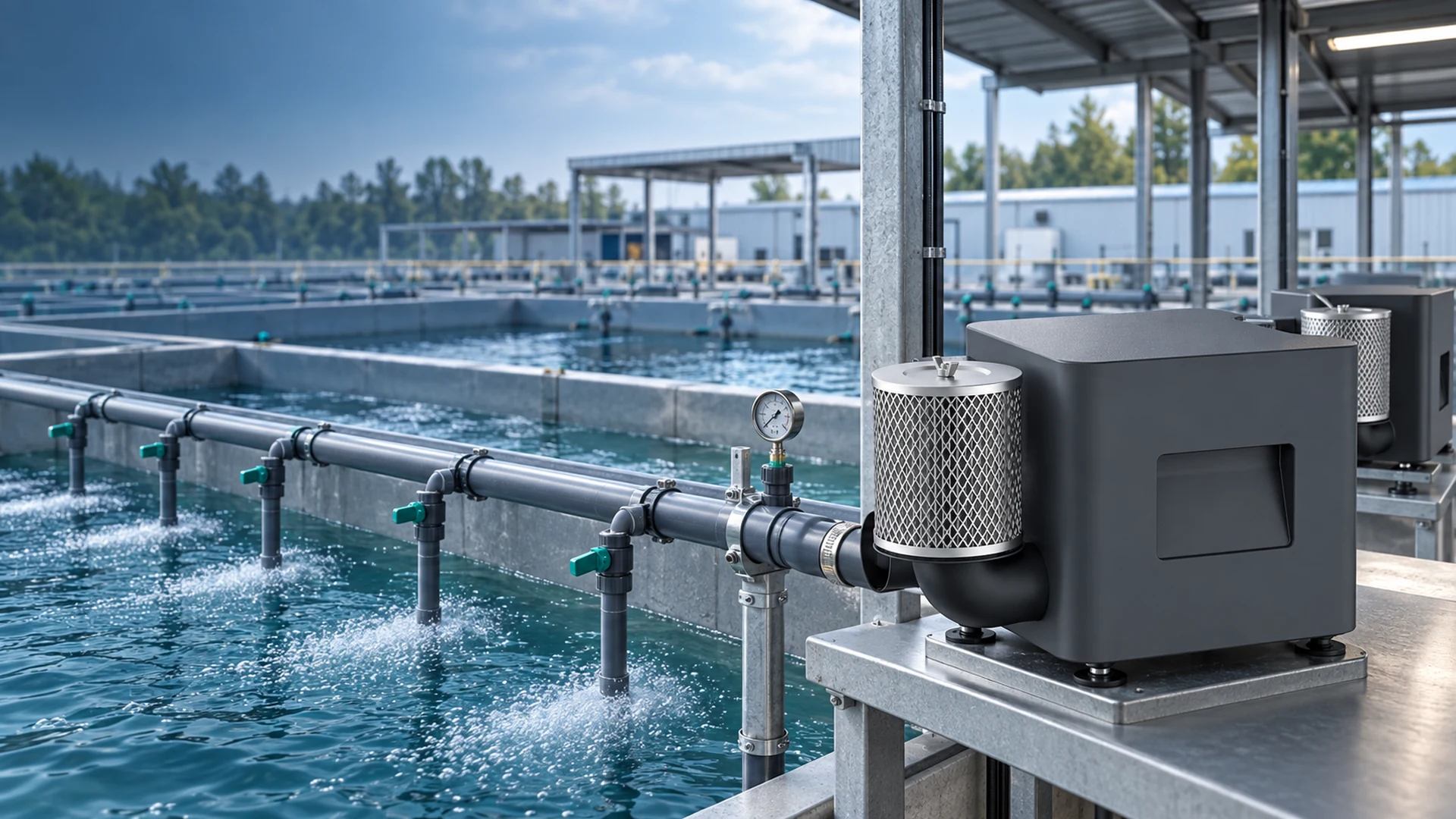
A blower can send plenty of air to a fish tank while dissolved oxygen still falls at the wrong time of day. The trouble may be uneven distribution, fouled diffusers, an undersized pipe, rising biomass or a loss of power. Buying a larger blower before finding the cause can add electricity cost without solving the oxygen problem.
An aquaculture aeration air supply should be selected for the actual water system. First decide how oxygen is being added and where air is needed. Then define the air demand at the diffuser or other device, calculate the pressure needed to deliver it, and check how the system will perform when a component fails. For an operating farm, dissolved-oxygen readings and a practical backup plan matter as much as a catalogue flow figure.
Decide Whether a Blower Is the Right Air Source
“Aquaculture aeration” covers several different jobs. A pond may rely on paddlewheels or other surface aerators that also circulate water. A hatchery tank or recirculating aquaculture system (RAS) may use a blower to feed submerged diffusers, air lifts or a degassing device. Some intensive systems use pure-oxygen equipment for part of the load. These options should not be treated as interchangeable simply because they all affect dissolved oxygen.
For a broad pond, begin with the farm’s water-circulation and oxygen problem. A diffuser grid supplied by a blower may be appropriate in one layout; surface aeration may be better suited to another. Farm geometry, stocking, water depth and management practice determine the choice. This article focuses on blower-fed air systems, especially tanks and smaller distributed aeration networks, rather than prescribing a blower for every pond.
In RAS, ask whether the air serves the culture tank, a biofilter, an air lift, a packed column or more than one of these. Each device has a different operating requirement. If one blower feeds several uses, the combined flow and the pressure at the hardest branch must be checked. A catalogue statement that a machine is “for aquaculture” is not an engineering specification.
Start with the Water-Quality Requirement
The farm should define its dissolved-oxygen (DO) operating range for the species, life stage and management plan with its aquaculture specialist. Avoid copying a single DO target from another farm. Demand changes with stocking density, biomass, feed rate, temperature, microbial activity and water exchange. The least favorable period may not coincide with the time the equipment supplier visits.
Collect DO readings at meaningful locations and times, including periods when oxygen has historically been lowest. Note fish behavior, feed changes, seasonal conditions and any alarms or emergency aeration events. A surface reading at midday may not describe a tank’s critical condition. If the existing system performs poorly, record that problem explicitly; do not use its current air output as the sole target for a replacement.
The important distinction is between airflow delivered and oxygen transferred into water. Bubble size, diffuser condition, submergence, water movement and water chemistry affect transfer. Airflow is part of the design, but it is not a direct measure of fish safety or growth. The farm must verify the water result through monitoring and, where appropriate, a system-level oxygen-transfer assessment.
Trace the Air Path to the Deepest or Most Restrictive Branch
For submerged diffusers, the air source must overcome the water pressure at the diffuser depth, the diffuser’s own resistance and losses through filters, headers, valves and pipework. A deeper diffuser generally requires more delivery pressure than a shallower one. Fouling or a closed valve can raise resistance further. The selected blower must supply the required flow at that pressure, not just a maximum free-air flow.
Map each tank or zone: number of diffusers, water depth, distance from the blower, pipe size, fittings and controls. Include any branches that operate simultaneously. If the system contains air lifts or other devices, identify their duty separately. The branch that needs the greatest pressure can constrain the whole network, even if it carries only part of the total air.
Do not add pressure values for parallel tanks as though they were connected in series. The blower supplies the combined simultaneous flow while overcoming the governing branch pressure and shared-header losses. A pressure gauge at the blower outlet cannot show whether the far tank receives adequate air. Where practical, check pressure and distribution at the relevant branches.
| Information to give a blower supplier | Why it matters |
|---|---|
| Tank or zone plan and active combinations | Establishes simultaneous air demand |
| Water depth at each diffuser | Sets part of the required pressure |
| Diffuser type, quantity and condition | Affects flow resistance and distribution |
| Header and branch piping | Reveals friction loss, leaks and imbalance |
| Filter, valves and other devices | Adds losses and maintenance requirements |
| Required operating modes | Shows normal, peak and reduced-load conditions |
| Site power and available backup | Determines electrical fit and outage response |
| DO history and acceptance plan | Links equipment performance to the farm’s real goal |
If the diffuser manufacturer’s flow and pressure data are unavailable, mark that gap. The supplier may need a site test or a different diffuser specification before it can recommend a blower responsibly.
Design for Distribution, Not Only Total Volume
A farm can have enough total air and still leave one tank short. Unequal pipe runs, leaks, plugged diffusers and poorly set valves can send more air to the easier branches. Check the visible bubble pattern as a clue, but use appropriate measurements and DO monitoring to assess performance. Similar-looking bubbles do not guarantee equal oxygen transfer.
Plan how branches will be balanced and how changes will be detected. A branch valve can help trim distribution, but heavy throttling to compensate for badly sized piping wastes pressure. If a new blower has a different output characteristic, retest the distribution across the network instead of assuming the old valve positions remain correct.
Accessible filters and diffusers make this practical. The maintenance plan should state how a blocked inlet, fouled diffuser or leaking line will be noticed and corrected. Record clean-system readings at commissioning so later pressure changes have a reference. The exact service interval depends on water and air conditions; avoid a generic schedule copied from another farm.
Treat Reliability as Part of the Air-Supply Specification
Aquaculture air supply may support living stock around the clock. A small reduction in energy use is not worth losing the ability to respond to a fault. Ask what happens if the blower trips, power fails, a controller loses its command or the main header is damaged. The answer may involve standby equipment, a separate emergency source, power backup, automatic transfer, alarms and staff response. Which combination is adequate depends on the farm’s risk assessment and the time available before DO becomes unsafe.
Specify the alarm at a point that reflects useful service. A motor-running signal does not prove air reaches every tank. Consider header or branch pressure, flow and DO monitoring as appropriate, with thresholds established by the farm’s technical team. Test alarm notification and changeover under a controlled procedure. A standby blower that has never been run against the actual network is not a verified contingency.
Do not assume one energy-saving unit can replace a duty-and-standby arrangement. A proposal should make the redundancy scope clear. If the existing installation uses two blowers for resilience, compare both the normal operating duty and the emergency arrangement before discussing annual electricity savings.
Compare Operating Cost at the Same Water Service
A traditional ring or side-channel blower may be a candidate for replacement if the required flow and pressure fit a suitable Towwind energy-saving blower. Towwind uses BLDC motor technology, but no model should be approved from motor kW alone. Request model-specific performance at the network’s operating point and the expected real electrical input for the blower and controller package.
For an existing farm, measure current real power during representative operation and record which tanks and branches were active. After installation, compare the new input under a similar air-delivery and water-quality condition. If diffusers, pipework or stocking have changed, explain those changes before attributing all power difference to the blower. DO control, water result and reliable supply remain the acceptance criteria.
Annual electricity use depends on input power in each operating mode multiplied by the hours in that mode. A farm that runs high output continuously will have a different result from one that varies air supply across zones. Variable output may help when demand changes, but the minimum air service must be verified for the relevant process, and any controller settings must follow the exact model’s documentation.
What to Confirm Before Ordering
Ask for a proposal that states the exact blower model, performance basis, expected flow at the required pressure, electrical input at that point, controller and alarm interfaces, installation needs and service provisions. Identify assumptions about diffuser cleanliness, pipe losses and simultaneous branch operation. Compare supplier offers at the same duty and scope, including any necessary backup or control hardware.
Commissioning should measure the new air-system behavior and observe the water result over a period meaningful to the farm, not only for a few minutes after start-up. Record the tested branch arrangement, pressure and flow measurement locations, electrical input, DO readings and alarm tests. The farm’s aquaculture specialist should decide whether the observed DO performance is acceptable for its stock and conditions.
The right air supply is not necessarily the largest blower or the cheapest one on the quotation. It is the arrangement that delivers the required air to the right places, maintains the farm’s water-quality plan, survives credible failures and does so at a defensible operating cost. Towwind can review a blower-fed aeration application when you provide the tank or zone plan, diffuser details, depths, piping, DO history, operating modes and backup requirements. Any recommendation should be checked against the exact model data and verified on the installed system.
Frequently Asked Questions
Can I choose an aquaculture blower from the number of fish or tank volume alone?
No. Stocking and tank volume help describe oxygen demand, but blower selection also requires the aeration method, diffuser data, water depth, pipe losses, simultaneous zones and required flow at pressure. Water-quality monitoring is needed to confirm the system result.
Does more air always mean more dissolved oxygen?
No. Oxygen transfer depends on the diffuser, water conditions and distribution as well as airflow. Extra air may add power without fixing a blocked branch or poor mixing. Check DO and the air path before increasing blower output.
Is blower pressure at the outlet enough to confirm that every tank is aerated?
No. A header can show pressure while a remote branch is restricted or leaking. Check relevant branch conditions and the water result, particularly at the least-favored tank.
Should backup capacity be included in the blower quotation?
Yes, if continuous air service is critical to the farm. Define the failure scenarios, response time, alarms and standby or emergency source in the project scope. The required arrangement depends on the farm’s risk assessment; it should not be assumed from the normal-duty blower rating.
—
Editorial notes below — do not paste into the public WordPress article.