
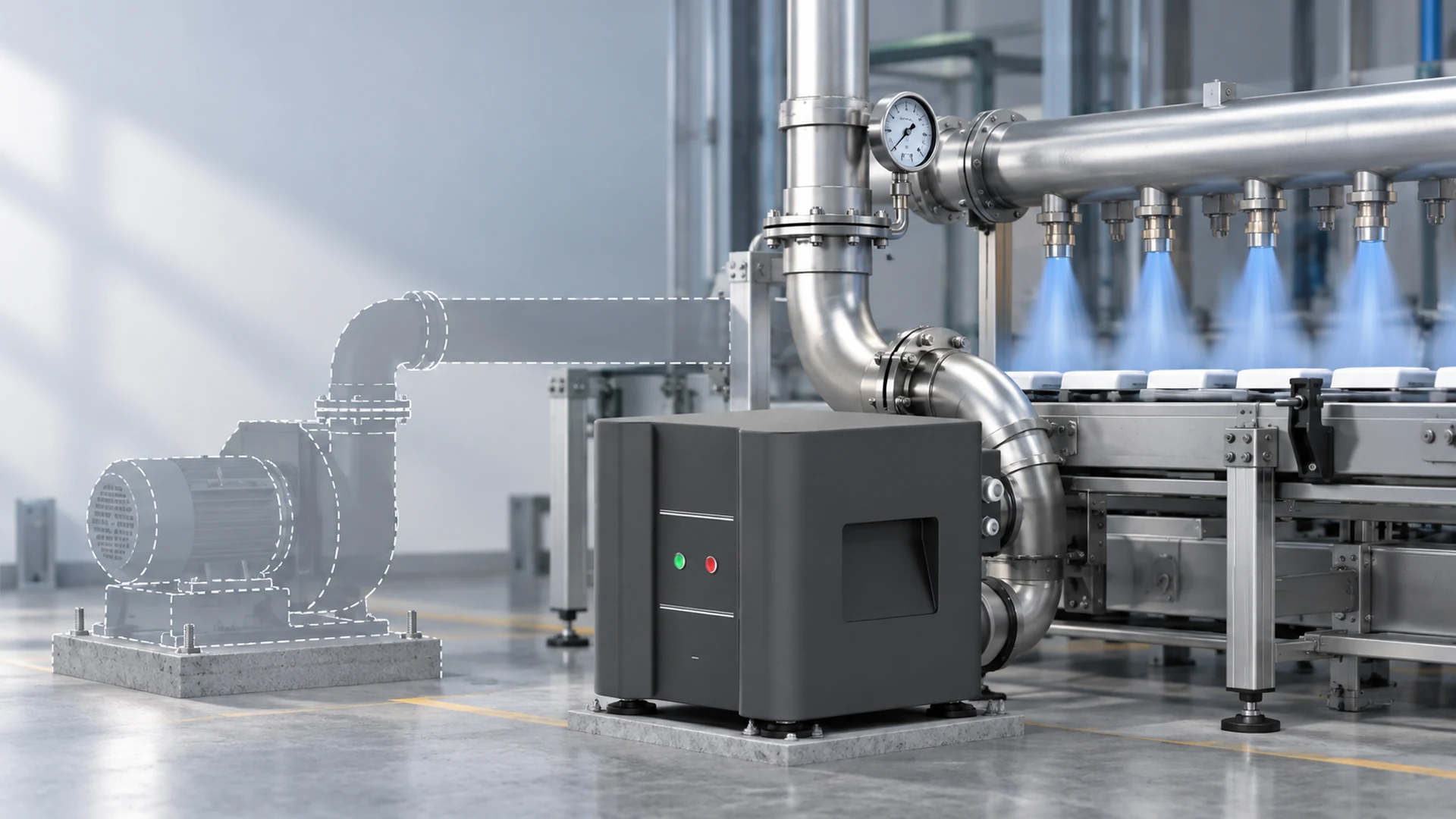
The electricity bill gives a good reason to replace an old ring blower. Production gives a condition: the drying, cleaning, holding or aeration job must still work. A retrofit is not successful if the new unit draws less power only because it supplies less useful air.
Retrofitting a blower without changing the process air requirement means defining that requirement before model selection, keeping it visible through installation, and testing the replacement against it. The new blower does not have to copy the old motor size or run at the old speed. It does have to deliver the air service the process needs, within the site’s electrical and mechanical limits.
Towwind Energy Saving Blowers may offer lower power use than traditional ring, regenerative, side-channel or vortex blowers in suitable applications. The meaningful comparison is at equivalent production performance, not between two nameplate ratings.
Define What Must Stay the Same
“Keep the process unchanged” can mean different things to different departments. Purchasing may mean no new nozzles or pipework. Production may mean the same output rate and product quality. Maintenance may mean no extra intervention during a shift. Write down the actual acceptance requirement before the old blower is removed.
For an air-knife line, that may include the product, conveyor speed, number of air knives operating and acceptable condition at the exit. For vacuum holding, it may be the hold achieved through a normal cycle with expected leakage. For aeration, it is the process air duty at the actual outlet condition. The examples differ, but the principle is the same: describe the result the air must support, not only the blower that currently supplies it.
If airflow and pressure or vacuum have been measured reliably, include the values, units and locations. If they have not, record the process result and plan the measurement needed for a firm selection. How to Define the Required Blower Operating Point covers the technical step of turning the process need into a flow–pressure duty.
Do Not Confuse the Old Blower’s Output With the Required Output
An installed ring blower is useful evidence, but it may not represent the right target. It could be oversized and permanently throttled, or it could have become weak because a filter is blocked or the system leaks. It might also have struggled to meet a production rate that increased after installation.
That creates two different baseline questions. What does the old system deliver today? And what does production need the replacement to deliver? They may be equal, but do not assume it. If the old line fails quality checks at full speed, matching that failure is not an acceptable replacement goal. If the old blower is oversized, preserving its unused maximum capacity may add cost without helping the process.
Record the current operating state honestly: active branches, valve settings, filter condition, pressure readings, process speed, result, and input power. Note abnormal faults separately. The pre-replacement site-measurement guide gives a practical record for that work.
Hold the Process Boundary Steady During Comparison
Before-and-after tests are easily distorted by small changes. A new blower tested after the line receives fresh filters, repaired leaks and a different nozzle setting may improve the result for several reasons. Those repairs may be worthwhile, but the energy report should not credit all of their effect to the blower alone.
Agree which conditions will be held constant or documented: product type, line speed, number of operating outlets, filter state, valve or bypass position, piping arrangement, ambient or inlet conditions where relevant, and the measurement locations. Record any unavoidable differences. A transparent adjusted comparison is better than pretending the two tests were identical.
The same rule applies to operating hours. A control change that turns the blower off between batches can save energy even if the blower itself is no more efficient at the working point. Count that benefit, but label it as a control or runtime change rather than a motor-efficiency gain. The buyer should be able to see which part of the savings comes from the replacement package and which comes from a new way of operating the line.
Select the New Blower for the Required Duty, Not the Old Motor kW
Once the process requirement is clear, ask the supplier to show the proposed operating point on model-specific flow–pressure data. A maximum airflow value and a maximum pressure value usually describe different conditions. The selected model must cover the required combination at the intended speed or control setting, with an approved operating range around credible process variation.
The old motor nameplate can help identify the existing equipment and electrical supply. It cannot prove the air duty or the electricity the old system actually uses. Likewise, a Towwind candidate with a smaller rated kW is not automatically suitable. A smaller input becomes valuable only after the new blower meets the process requirement.
Check the complete system. A suitable performance curve is not enough if the proposed connection adds a sharp reducer, a new tight bend or an inaccessible filter. Those changes can shift system resistance and move the installed operating point. The pipework compatibility guide explains the mechanical and aerodynamic checks behind that decision.
What May Change Without Changing the Air Requirement?
The goal is not to make the replacement look exactly like the old blower. A retrofit may change motor technology, controller, mounting, connections or operating speed. Those changes are acceptable when they are engineered, documented and do not remove required process capability.
A Towwind BLDC-based blower may allow control adjustments that better match demand at different production modes. If the process genuinely needs less air during a reduced-load mode, the new package can potentially operate differently then. That does not change the air required during the main production mode. Specify each mode separately so a supplier does not size the whole project around the easiest one.
Pipework may also need an adapter or a repaired leak. If so, the supplier should show how those changes affect the duty and the installed cost. Electrical panel or controller changes need their own review. “Same process air requirement” is a performance boundary, not a promise that every physical component stays untouched.
Write the Acceptance Test Before Ordering
A buyer-friendly acceptance plan can be short, but it must say what will be compared. Agree on the normal production mode, any credible high-demand mode, the process result, where airflow and pressure will be checked, and which electrical input boundary will be measured. Include the state of filters and valves.
| Acceptance question | Evidence to record |
|---|---|
| Does production still meet its target? | Product or process result at the agreed throughput and outlet configuration |
| Is the air duty sufficient? | Flow and pressure or vacuum at stated points, where reliable measurement is possible |
| Is the package operating within limits? | Proposed model and controller settings, alarms and relevant site conditions |
| Is input power lower at equivalent duty? | Real electrical input to the complete package under the same service condition |
| Are installation changes controlled? | Pipework, filter, valve and electrical differences from the baseline |
Use the final manufacturer’s instructions for the exact Towwind model and controller when setting permissible limits. If direct airflow measurement is impractical, agree on process-based evidence and state the limitation. Do not declare an unmeasured airflow value merely because the product looks acceptable in one short run.
The acceptance test should include enough operating time and normal production variation to reveal problems that a brief startup check might miss. The required duration depends on the machine; no universal period proves every retrofit. Installation Checks Before Blower Commissioning covers the wider start-up and handover work.
Keep Energy Claims Separate From Air-Service Proof
The retrofit has two tests. First, can the new blower meet the required process air service? Second, at that service, how much electrical energy does it use compared with the old system? Passing the second test without passing the first is not an energy-saving success.
For each meaningful operating mode, compare real input power to the complete old and new packages, with the measurement boundary clearly stated. Pair those values with actual hours at each mode. If only supplier data is available before purchase, call the result a projection and state the assumptions. Verify on site after installation before describing it as an achieved saving.
Towwind may deliver substantial savings in suitable applications. The actual result depends on the existing blower, required airflow and pressure, air-path resistance, controls and schedule. Do not turn a generic potential into a guarantee for a particular line. How to Calculate Blower Energy Use Without Overstating Savings explains the full calculation method once comparable data exists.
A Purchase Specification That Keeps Everyone Aligned
The purchase order or technical attachment should record more than a replacement model number. Include the agreed process modes and output requirements, proposed blower and controller, flow–pressure evidence, electrical supply, pipework changes, measurement locations, acceptance method, and who is responsible for correcting any shortfall.
This protects both sides. The supplier knows what the machine must do, and the buyer can distinguish a model problem from an installation or process change. It also gives maintenance a useful baseline after commissioning rather than leaving only a brochure and an invoice.
If the process requirement is still uncertain, do not conceal the gap in a fixed-price specification. Request a preliminary recommendation with a measurement or trial plan. A narrower commitment backed by evidence is more useful than a confident promise built from the old motor rating.
The Standard for a Successful Retrofit
A successful blower retrofit preserves the air service that production actually requires while improving the economics or reliability of supplying it. The new blower may look different and run at a different speed. It should not be allowed to achieve a lower kW figure by letting the process go short of air.
Send Towwind the current process result, measured air duty if available, site conditions, operating modes and existing blower details. Ask for a model-specific selection and an acceptance plan based on equivalent output. That keeps the retrofit focused on useful performance first, with energy savings assessed on the same ground.
Frequently Asked Questions
Does a replacement blower need the same motor power as the old ring blower?
No. Motor rating is not the process requirement. Select the replacement to provide the needed airflow at pressure or vacuum, then check site power, controls and installation. A different motor rating may be appropriate if equivalent process performance is demonstrated.
Is matching the old blower’s measured airflow always enough?
Not always. The old blower may be oversized, restricted or unable to meet today’s production target. Define what the process actually requires and compare the current result with that target before selecting the replacement.
Can an energy-saving blower use less power without reducing useful air?
It may, in a suitable application. The claim must be checked at equivalent process output and an appropriate flow–pressure duty, using comparable complete-package electrical input. Actual savings depend on the old system, new model, controls and operating hours.
What if the retrofit also changes filters or piping?
Document those changes and their effect on system resistance and process output. They may be good improvements, but a before-and-after energy comparison should identify them rather than attributing every difference to the blower alone.