
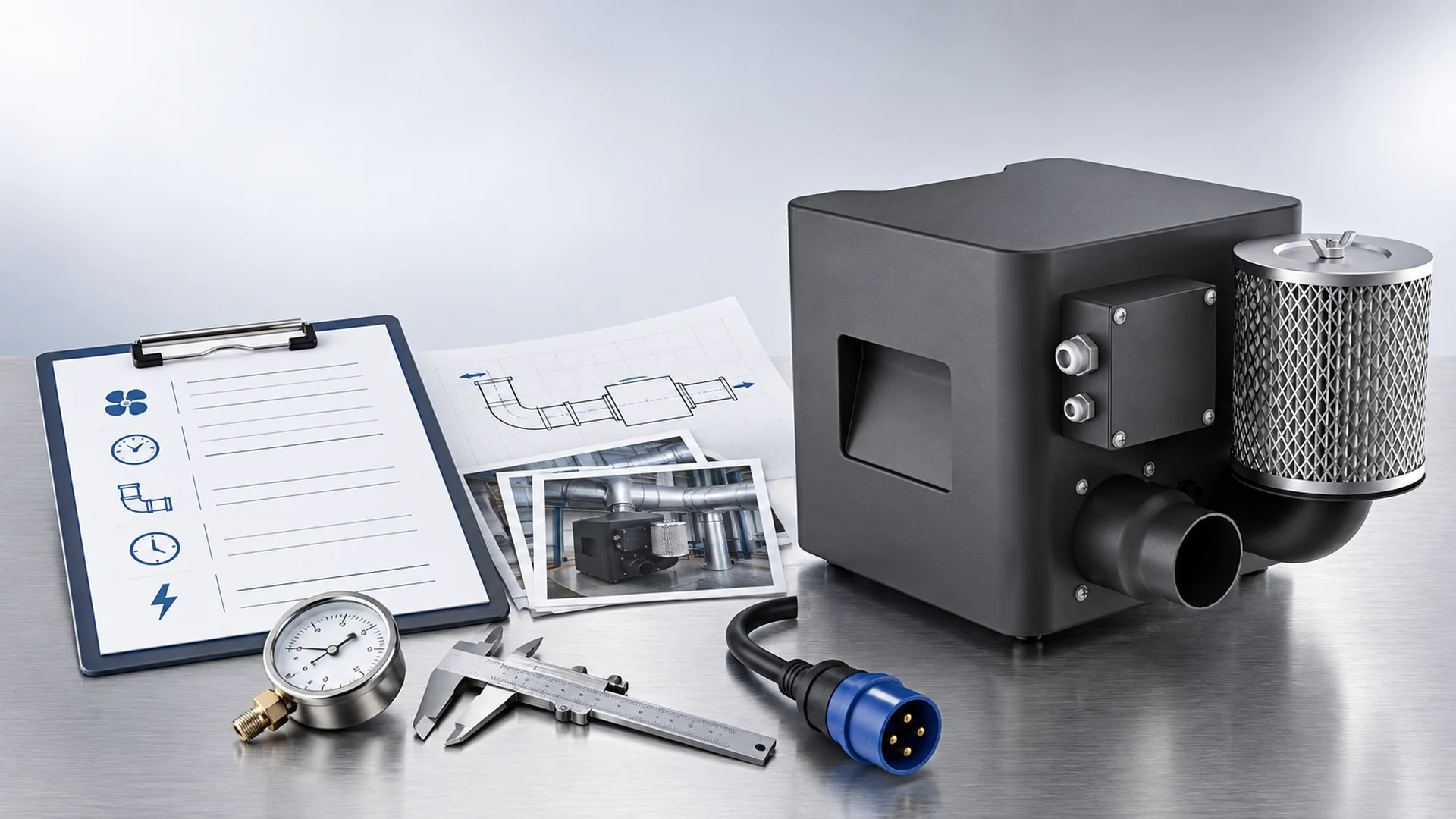
“We have a 4 kW ring blower. Which energy-saving model replaces it?” is a reasonable first message. It is not enough for a reliable model recommendation. The old motor rating tells a supplier something about the existing equipment, but not how much air reaches the process or what pressure the system imposes.
For a useful blower recommendation, send the process result you need, the available airflow and pressure information, the layout of the air path, and the site’s electrical and operating conditions. Photos and nameplate details help, particularly for a retrofit. If you do not know a value, label it “not measured” rather than filling the gap with a catalogue maximum. A good supplier should then tell you what can be recommended now, what remains provisional, and what must be checked before an order.
This is an information handover, not a test of how many technical terms a buyer knows. A clear description of the machine can be more useful than a precise-looking number with no measurement basis.
Begin With the Work the Air Must Do
Tell the supplier what the blower supports and what “working properly” means at your site. A drying line might need parts dry at a stated conveyor speed. A vacuum fixture might need a reliable hold while normal leakage is present. An aeration system has its own process requirement and outlet resistance. “Industrial air blowing” does not narrow the duty enough to select a model.
Include the application, product or material being handled, number of stations, and whether those stations operate together. State the normal production rate and any credible high-demand mode. If there is a problem with the current machine, describe it plainly: a wet product at full speed, weak airflow at the far end of a manifold, frequent overheating, or a filter that loads quickly. Those observations may point to the process or air path rather than the blower itself.
When a process target has not been quantified, do not invent one for the enquiry. Say how the result is currently judged and ask the supplier what measurement would turn that observation into a selection requirement.
Send Airflow and Pressure Together—If You Have Them
The most valuable technical pair is required airflow at required pressure or vacuum, under a defined operating condition. These values should have units and measurement locations. A pressure reading at the blower outlet is not necessarily the pressure available at the last nozzle; a flow rating from the old catalogue is not necessarily installed flow.
If measurements exist, identify who made them, when, with the machine in what state, and whether filters and outlets were in their normal condition. A reading taken with an open pipe or an idle production line may not represent the duty that matters. If you have measurements for both normal and peak demand, send both.
No measurements yet? Share the existing blower model, its performance data if available, the process observations, and the layout information below. That can support a preliminary discussion, but the supplier should mark any unverified airflow or pressure estimate as an assumption. How to Define the Required Blower Operating Point explains how to develop a defensible duty point when the process requirement is unclear.
Show the Air Path, Not Just the Blower
The blower and the connected system work together. A restrictive filter, narrow hose, long pipe run, sharp bends, partly closed valve or poorly balanced manifold can change the flow delivered to the process. Send a simple sketch if formal drawings do not exist.
Mark the inlet and outlet, filter or silencer, approximate pipe sizes and lengths, branches, valves, nozzles or diffusers, and the location of any gauges. If the system has changed since the old blower was installed, note the change. An added air knife or a new branch may explain why the original equipment no longer performs as expected.
For a retrofit, photographs from several angles often resolve questions faster than a long email. Include the blower and motor nameplates, electrical panel, controller if present, inlet, outlet, mounting, and the space around the unit. A short video of the line running may help show the operating sequence and which outlets are active. Protect confidential process details where necessary, but do not crop out the connections that determine installation feasibility.
This is not a request for perfect drawings. It is a way to stop a supplier from treating a difficult air path as if the blower exhausted to open air.
Record How the Machine Runs
An energy-saving recommendation needs a load profile, not just a daily-hours estimate. Tell the supplier how many hours the blower runs, whether it runs continuously or cycles, how often the process needs full output, and whether there are reduced-load periods. Include the number of blowers on the machine if they operate together or alternate.
For a replacement, record the existing blower’s control method: fixed speed, valve throttling, variable speed, or another arrangement. If available, send measured electrical input under normal production and the time spent in that condition. A motor nameplate rating is not a measurement of actual input power. Without a comparable baseline, a supplier can discuss potential but should not promise a precise percentage saving.
Towwind Energy Saving Blowers use BLDC motor technology and may offer lower electricity use than traditional ring, side-channel, regenerative or vortex blowers in suitable applications. The result depends on meeting the same process duty, the existing blower’s performance, system resistance and operating schedule. For a cost estimate, use measured or otherwise defensible input values and the method in How to Calculate Blower Energy Use Without Overstating Savings.
Confirm the Electrical Supply and Site Constraints
Tell the supplier the nominal supply voltage, phase and frequency at the machine, not only the voltage available somewhere in the factory. Add any circuit-capacity or panel-space limit your electrical team knows about. “220 V” alone does not state whether the supply is single-phase or three-phase, and a 380 V option should not be assumed compatible without checking the exact controller package.
State where the blower and controller would sit, the ambient conditions, and whether dust, moisture, heat or restricted ventilation may affect installation. If the machine is exported, identify the destination site rather than relying on the builder’s workshop supply. The exact model documentation and qualified electrical review should settle protection, wiring and local compliance details. The separate 220V or 380V Blower: What Equipment Builders Need to Confirm covers that electrical review in depth.
Physical details matter too: available mounting space, access for filter service, inlet and outlet orientation, noise-sensitive areas, and whether an outage window limits the retrofit. A blower that meets the duty on paper but cannot be installed or cooled correctly is not a finished recommendation.
For a Replacement, Add Evidence About the Existing Unit
The current machine can provide a useful starting point, provided its condition is described honestly. Send the maker and model, nameplate photographs, approximate age if known, current setting, and whether it still meets the process requirement. A worn or restricted blower may not represent the original design duty; an oversized one may have spent years throttled.
Describe the reason for replacement. High energy use, repeat bearing work, excessive noise, overheating, lack of spare parts and insufficient process performance lead to different questions. If a unit failed suddenly, tell the supplier whether the cause is known. Replacing the blower without correcting a blocked inlet or a leaking system may reproduce the problem.
The nameplate helps identify the existing package, but it cannot by itself establish a like-for-like air duty. See How to Select a Replacement Blower from an Existing Nameplate for what can and cannot be inferred from that plate.
What If You Do Not Have All the Data?
Most first enquiries are incomplete. The useful response is to separate facts from assumptions. Send what is known and make a short list of gaps:
| Status | Example | How to present it |
|---|---|---|
| Measured | Running pressure at a named gauge location | Give value, unit, date and operating condition. |
| Documented | Existing blower model and motor nameplate | Attach a clear photo and model sheet if available. |
| Observed | Drying becomes inadequate at full line speed | Describe the condition without turning it into an invented airflow value. |
| Estimated | Approximate pipe length from site layout | Label it as an estimate and explain the basis. |
| Unknown | Actual flow through the air knives | Write “not measured” and ask how to verify it. |
That distinction protects both buyer and supplier. It lets the supplier make a preliminary shortlist while identifying the measurements needed for a firm selection. It also keeps an uncertain figure from becoming a contractual guarantee by accident.
If pressure or flow is critical and no reliable data exists, ask whether a site survey, temporary measurement or controlled trial is appropriate. The correct method depends on the machine and the access available; a supplier should not pretend that every system can be measured from the same convenient point.
A First Message You Can Actually Send
The first enquiry can be brief. Keep it organized around the process and the evidence you have:
Application: [what the air does and the result required]
Existing unit, if any: [maker/model, nameplate photos, current issue]
Air duty: [measured flow at pressure or vacuum, units and locations—or “not measured”]
Air path: [filter, piping, branches, outlets; attach sketch/photos]
Operation: [normal and high-demand modes, hours, controls]
Site: [voltage, phase, frequency, installation constraints]
Please advise: [preliminary model, assumptions, missing data and proposed verification]
This message is for a technical recommendation, not a final purchasing comparison. Once the duty and configuration are agreed, a formal request for quotation can add quantity, delivery, warranty, scope and commercial terms. Keeping those stages separate prevents a price from being mistaken for a fully engineered selection.
What a Responsible Supplier Should Send Back
The reply should name the proposed model and configuration, show the expected flow–pressure point or relevant performance data, and identify the assumptions used. It should state the electrical supply and controls required, the input power basis, installation conditions, and any missing information that could change the choice.
For a Towwind recommendation, ask whether the proposed energy-saving blower can be evaluated against the existing unit at the same useful output. If the supplier cannot yet confirm the duty, a provisional recommendation with a measurement plan is more credible than an unqualified model number or savings figure. Reading a Blower P–Q Curve Before Choosing a Model can help your team check the eventual selection chart.
The buyer should also know what the recommendation does not cover. Is pipework modification included? Is the controller included? Who will verify performance after installation? Those questions become essential before an order, even if they need not all be resolved in the first email.
Send Evidence, Then Ask for a Qualified Recommendation
The fastest useful enquiry is not the longest one. It is the one that distinguishes measured data, documents, observations and unknowns. Share the process result, air duty if known, air-path layout, operating pattern, site supply and existing-equipment evidence. Ask the supplier to state assumptions and the next check needed.
Towwind can use that information to assess whether an energy-saving blower is a plausible fit and what must be verified before selection. If your only starting point is a nameplate and a few photos, send them—but say that airflow and pressure are still unknown. That is a sensible start, not a reason to guess.
Frequently Asked Questions
Can a supplier recommend a blower from motor kW alone?
Not reliably. Motor kW does not identify the airflow delivered at the pressure or vacuum imposed by the machine. It can help identify the existing equipment, but the supplier also needs process, air-path and operating information for a defensible recommendation.
What if I do not know the required airflow or pressure?
State clearly that they have not been measured. Send the application description, existing blower details, photos, process symptoms and a simple air-path sketch. Ask the supplier which measurement or trial would establish the duty before the model is finalized.
Are photos enough for a first blower recommendation?
Photos are a useful starting point for retrofit layout and nameplate identification, but they rarely prove airflow, pressure or energy use. A preliminary shortlist may be possible; a firm selection should state the missing assumptions and how they will be checked.
What should Towwind provide with its proposed model?
Ask for the exact blower and controller configuration, relevant flow–pressure data, electrical input basis, supply requirements, operating limits and any assumptions. The recommendation should say what site data must be verified before purchase and how process performance will be checked.