
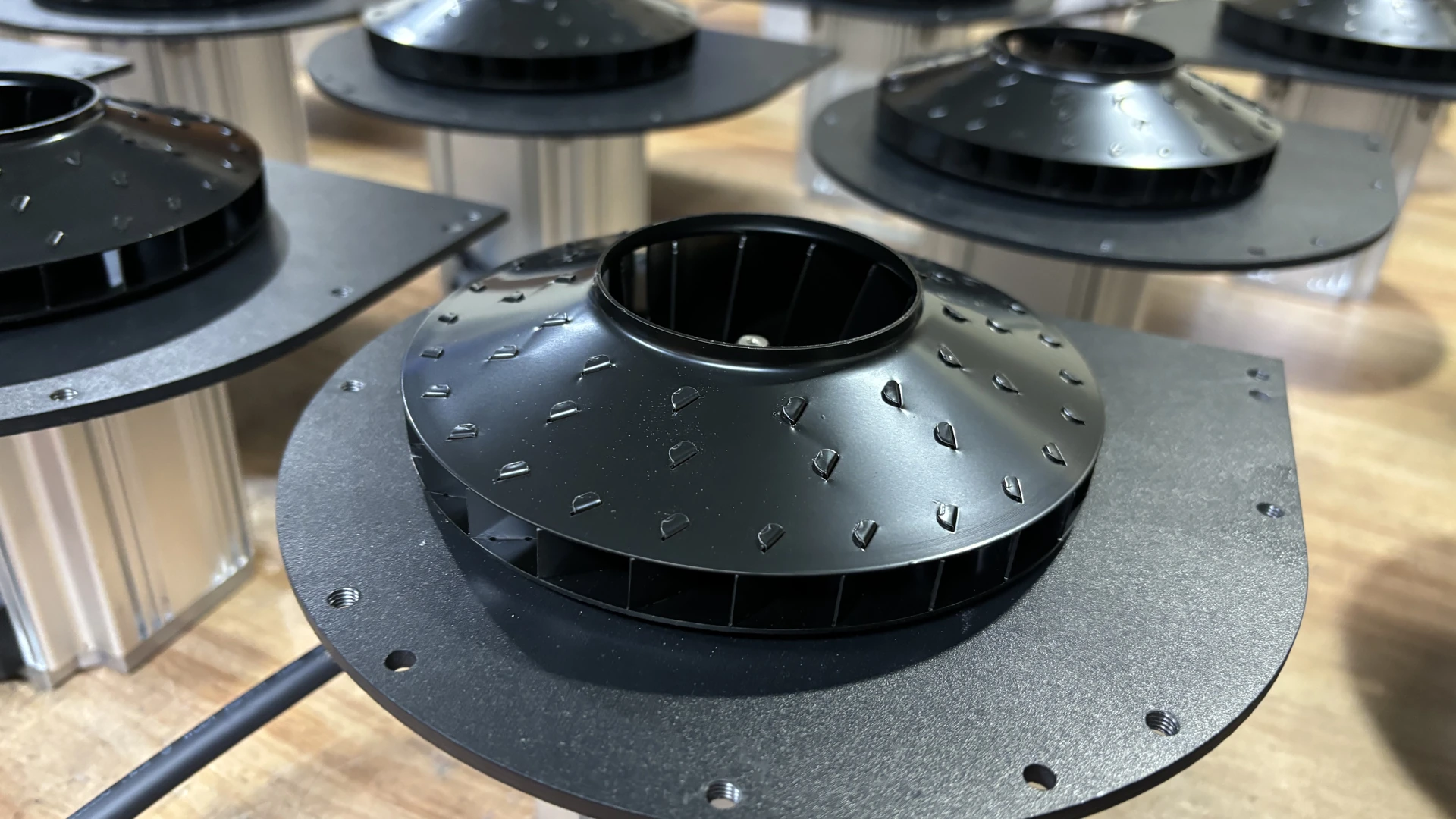
Airflow and pressure answer different questions. Airflow tells you how much air moves through the system. Pressure tells you how much resistance the blower must overcome to move it. One value cannot replace the other, and neither motor power nor a catalogue maximum tells the complete story.
This distinction matters when comparing quotations. A blower with a high free-air flow may deliver far less after it is connected to filters, pipes and air knives. A high-pressure model may still lack the volume needed across several outlets. Selection becomes reliable only when pressure and airflow are stated together at the required operating point.
Quick Answer
Blower airflow is the volume of air delivered per unit time, commonly expressed as m³/h, m³/min, CFM or another defined basis. Blower pressure is the pressure difference used to overcome the resistance of the connected system, often expressed as Pa, kPa or mbar.
As system resistance changes, the delivered airflow changes along the blower’s performance curve. Therefore, compare blowers by the airflow available at the required pressure, not by two separate maximum values.
What Airflow Means
Airflow describes volume passing a point over time. It influences how much surface an air knife can cover, how many diffusers can receive air, how quickly heat can be carried away and how many branches can operate together.
The number is useful only with context. State whether it is standard or actual volume, where it is measured and under what pressure and temperature. In low-pressure industrial discussions, catalogue figures may use a defined test basis that differs from a field instrument reading.
Airflow should come from process demand. Count simultaneous outlets, establish their consumption and test the real product or process. More flow is not automatically better: it can disturb light products, waste energy, upset aeration control or increase noise.
What Pressure Means
Pressure is the difference that drives air through resistance. In blower systems, it may be discussed as static pressure, total pressure, pressure rise, discharge pressure or vacuum. These terms have specific measurement meanings, so the supplier and buyer should use the same basis.
Pressure is required to overcome filters, pipe friction, elbows, valves, manifolds, nozzles, air-knife slots and submerged depth. A pressure reading should always include its measurement location. Outlet pressure is not necessarily manifold pressure.
High pressure does not mean the blower creates more air under every condition. It means the machine can support a larger pressure difference within its performance envelope. The delivered flow at that pressure remains the selection question.
How the Two Values Interact
A blower has a pressure-flow curve. A connected air path has a system curve. Their intersection is the operating point.
If system resistance rises, the operating point moves. A loaded filter, closed valve or smaller slot can increase pressure and reduce flow. If resistance falls, flow may increase while pressure changes in the other direction. The exact response depends on the blower curve and control setting.
This relationship explains why a blower does not normally deliver its maximum pressure and maximum airflow at once. Maximum airflow is generally measured near the low-resistance end; maximum pressure occurs near another endpoint.
A Simple Industrial Example
Consider one blower connected first to a short open pipe and then to a manifold with several narrow air knives. The blower itself has not changed. In the open-pipe arrangement, resistance is low and airflow may be relatively high. In the air-knife arrangement, the slots and manifold increase resistance, so the operating point moves.
If an engineer chooses the unit from open-air flow alone, the installed knives may receive too little air. If the engineer chooses only from maximum pressure, the unit may still fail to supply the total volume across all active knives.
The proper specification is a combined point such as the required flow at the required pressure, with the applicable process mode identified.
Static Pressure, Velocity Pressure and Total Pressure
Static pressure is the pressure exerted independently of the bulk flow direction and is commonly used to assess system resistance. Velocity pressure represents kinetic energy associated with air velocity. Total pressure is the sum of static and velocity pressure under the relevant measurement definition.
Confusion arises when a field reading and a supplier curve use different bases. A static tapping, Pitot traverse and pressure sensor in a disturbed elbow do not produce interchangeable evidence.
Use suitable measurement locations and instruments. Record whether values are static, total, gauge or absolute. For routine low-pressure diagnostics, consistency of method and location is often as important as the number itself.
Flow Velocity Is Not Total Airflow
Velocity describes how fast air moves at a point. Airflow is velocity integrated across the effective area. If velocity is uniform, a simplified relationship is:
Volumetric airflow = average velocity × cross-sectional area
Real profiles are not perfectly uniform. A single centreline reading in a duct or slot can overstate or understate average velocity. Bends, fans, obstructions and short straight runs distort the profile.
Use an appropriate traverse or flow-measurement method. For air knives, slot exit velocity may be useful for process review, but it should not be confused automatically with the blower’s total delivered airflow.
Why Pipe Diameter Changes Both
At the same airflow, a smaller pipe produces higher velocity. Higher velocity usually increases friction and fitting loss, so the blower must develop more pressure. The resulting increased system resistance can reduce actual airflow.
This is why replacing a large pipe with a convenient small hose may make a suitable blower appear weak. The model may be capable, but the installation has moved the operating point.
Conversely, increasing an unnecessarily restrictive main line can reduce pressure loss and allow the same process flow at a lower blower setting. Pipe optimization can be an energy measure.
Air Knives: Pressure and Flow Have Different Jobs
An air knife uses pressure inside its plenum to discharge a sheet of air through a slot. Total airflow depends on slot length, gap, pressure and knife geometry. A wider gap may demand more flow; a smaller gap changes resistance and does not guarantee a better drying result.
Several knives require the combined flow of all units operating together. The manifold must distribute air evenly. One pressure reading at the blower cannot prove equal flow along every slot.
Commissioning should connect instrument data with the accepted product result: dry surface, cleared debris or another defined outcome at production speed.
Aeration: Depth Adds a Pressure Requirement
In aeration, the blower must overcome hydrostatic pressure from submergence before air exits a diffuser. Diffuser and pipe loss add to that requirement. Meanwhile, total airflow depends on oxygen or mixing demand and the number of active diffusers.
A shallow pond and a deep basin can require similar airflow but very different pressure. A blower with high maximum flow at open discharge may not deliver that flow at depth.
Calculate pressure and flow from the process and confirm both on the model curve. Do not reduce oxygen demand simply to fit a preferred blower.
Why Motor Kilowatts Do Not Resolve the Question
Motor rating is an electrical or mechanical capacity descriptor, not a direct airflow-pressure output. Two blowers with the same rated power can have different impellers, speeds, controls and curves. A larger motor can also operate at partial load, while an undersized unit may run near a limit.
Use power to check electrical supply and later to calculate energy. Use the pressure-flow curve and process acceptance to establish aerodynamic suitability.
For a retrofit, measure the existing operating point and input power. Do not assume a lower nameplate automatically proves energy savings or a higher nameplate proves greater useful output.
Towwind Specification Example
Confirm the selected model’s current specification, pressure-flow curve, electrical nameplate and installation requirements before assigning an operating point.
For model screening, request the current pressure-flow curve and electrical data for the exact proposed unit; do not combine separate catalogue endpoints into one operating point.
*The pressure and airflow values are separate maximum endpoints. They do not describe simultaneous delivery.
Verify the exact model’s usable control range, electrical supply, protection rating and performance from its current documentation; test the proposed setting against the process requirement.
What Buyers Should Ask a Supplier
A technically comparable proposal should state:
- required airflow and pressure at the same point;
- measurement or calculation basis;
- exact model and electrical variant;
- model curve with normal and peak duty marked;
- permitted operating range and margin;
- assumptions about filters, piping and active outlets;
- control setting or speed basis; and
- process acceptance method.
A quotation that lists only maximum airflow, maximum pressure and motor power has not yet demonstrated application fit.
Troubleshooting with Pressure and Airflow
When process performance falls, examine the two readings together. Higher pressure with lower flow can indicate increasing restriction, such as a loaded filter or blocked outlet. Lower pressure and lower useful flow can indicate leakage, an open bypass, reduced blower output or another fault.
Interpretation depends on measurement location and blower behavior. Compare with commissioning data under the same configuration. Avoid replacing the blower before checking valves, filters, hoses, branches and terminal devices.
Electrical current and temperature add useful evidence, but they do not replace airflow-pressure data.
Final Recommendation
Treat blower airflow as the amount of air required by the process and blower pressure as the resistance that must be overcome to deliver it. They meet at one operating point on the blower curve.
When asking Towwind for a recommendation, provide both values, the system layout, active outlets, process mode, voltage and accepted result. That information allows current models to be screened against their verified curves instead of unrelated catalogue maxima.
Frequently Asked Questions
Is blower airflow more important than pressure?
Neither is sufficient alone. The process needs airflow, and the system requires pressure to deliver that airflow through its resistance.
Does higher blower pressure create higher airflow?
Not automatically. Delivered flow follows the blower and system curves. Increasing system resistance can raise pressure while reducing airflow.
Can maximum pressure and maximum airflow be added together?
No. They normally occur at different endpoints. Use the performance curve to find airflow at the required pressure.
Why is manifold pressure lower than blower outlet pressure?
Pressure is lost through the components between the points, including pipe friction, bends, valves and filters.
What should be measured during commissioning?
Record pressure at labelled points, airflow where reliably measurable, blower command, power, open branches, filter condition and the accepted process result.