
A blower nameplate is the quickest place to begin a replacement enquiry. It can identify the manufacturer, model, motor power, voltage, phase, frequency, rated current, and sometimes speed or duty rating.
That information is useful, but it does not describe the complete air system.
Two blowers with the same motor power can deliver very different airflow and pressure. A replacement chosen only because the nameplate says “4 kW” may fit the electrical cabinet yet fail to provide enough air at the machine. It may also deliver too much pressure, overload the process, or waste electricity through throttling.
For buyers and purchasing teams, the safest approach is simple: use the existing nameplate to identify the starting point, then verify the actual operating duty before placing an order.
What Can You Learn from a Blower Nameplate?
The amount of information varies by manufacturer. A typical blower or motor nameplate may include:
- Manufacturer and model
- Serial number
- Rated motor power
- Rated voltage
- Number of phases
- Frequency
- Rated current
- Motor speed
- Insulation class
- Ingress protection rating
- Duty rating
- Manufacturing date
Some blower nameplates also show maximum airflow and pressure. These values require careful interpretation.
Maximum airflow is often measured close to free-air conditions, while maximum pressure is reached at a different point on the performance curve. A blower does not normally deliver its maximum airflow and maximum pressure at the same time.
This matters during procurement. Copying both maximum figures into an enquiry can create an operating requirement that the original blower never met.
Is the Nameplate Enough for Replacement Blower Selection?
No. A nameplate can help identify an existing blower, but it is not enough to select a reliable replacement.
A correct replacement decision should verify:
- Required airflow
- Actual positive pressure or vacuum
- System resistance
- Voltage
- Phase
- Frequency
- Operating hours and duty cycle
- Ambient and inlet-air conditions
- Control requirements
- Mechanical installation details
The original model number is valuable because a supplier may be able to locate its performance curve. Even then, the current system condition must be checked. Filters, pipework, production speed, and process settings may have changed since the blower was installed.
Start by Recording the Existing Nameplate Correctly
Send a clear photograph rather than typing the data from memory. The complete plate should be visible, with enough resolution to read every line.
A useful photo set includes:
- Blower nameplate
- Motor nameplate, if separate
- Complete blower installation
- Inlet and outlet connections
- Filter, relief valve, and control panel
- Pipework around the machine
Photographs often reveal details missed in a written enquiry, including installation orientation, limited clearance, flange type, hose diameter, or an external frequency converter.
If the plate is damaged or unreadable, record every visible character. A partial model number combined with the motor data and installation photographs may still help identify the original unit.
Verify Airflow at the Real Operating Point
Airflow is one of the most important replacement parameters, but buyers should ask where and how it was measured.
The process may require airflow for air-knife drying, vacuum holding, aeration, material conveying, dust removal, cooling, or cleaning. Each application reacts differently to changes in flow and pressure. An air knife may need stable airflow against nozzle resistance, while a vacuum application may be more sensitive to leakage and suction pressure.
If reliable airflow data is unavailable, the original blower curve can provide a reference. It should be read together with the measured pressure or vacuum. A flow value taken from the curve is more meaningful than the maximum airflow printed in a catalogue.
Also confirm whether the stated flow is actual or standard volume. Temperature, altitude, and inlet conditions can affect air density and performance.
Confirm Pressure or Vacuum Under Production Conditions
Do not use “high pressure” or “strong suction” as selection data. Record a measured value and its unit.
Common units include kPa, mbar, mmAq, Pa, and psi. Positive-pressure and vacuum applications must be identified clearly. A value without direction can lead to the wrong interpretation.
Take measurements during normal production, not only when the pipe is disconnected. An open-pipe test may show airflow, but it does not represent the resistance the blower must overcome during operation.
Peak conditions also matter. A dirty filter, a valve that changes position, or a nozzle that is periodically restricted may increase pressure during part of the production cycle.
Check System Resistance Before Blaming the Blower
The blower and pipework operate as one system. A replacement cannot be selected properly without considering the resistance created by:
- Pipe diameter and length
- Elbows and tees
- Filters and silencers
- Valves and dampers
- Nozzles and air knives
- Heat exchangers and diffusers
- Process equipment
- Dust or deposits inside the line
A blocked filter or restrictive pipe may make the existing blower appear too small. Installing a larger blower can increase power consumption and temperature without correcting the restriction.
The opposite problem is also common. If the existing blower is oversized, operators may control excess air by closing a valve or opening a bypass. Selecting another blower with the same nominal capacity preserves the same energy loss.
Before requesting a like-for-like replacement, check valve positions and relief-valve activity. They can show whether the process uses the blower’s full capacity.
Match Voltage, Phase, and Frequency
Electrical compatibility should be confirmed before commercial details are finalized.
Voltage and phase
The new blower and its controller must match the available supply. Check whether the nameplate lists one voltage, dual voltages, or a voltage range. Confirm the wiring arrangement and plant supply with the electrical team.
A single-phase blower cannot always be replaced directly with a three-phase unit, or vice versa. Cable size, protection devices, contactors, and control logic may need modification.
Frequency
A 50 Hz blower and a 60 Hz blower may operate at different speeds. That difference can affect airflow, pressure, motor load, temperature, and noise. The supplier should confirm performance at the intended frequency.
Rated current and protection
Compare rated current with the existing overload protection, wiring, and control equipment. If the proposed blower uses an electronic controller, confirm its input and protection requirements as part of the installation review.
Confirm the Duty Cycle and Operating Schedule
A blower that runs for five minutes per cycle has different demands from one operating continuously across three shifts.
Record:
- Hours per day and days per year
- Starts per hour
- Continuous or intermittent operation
- Normal load duration
- Idle or standby time
- Seasonal production changes
The motor nameplate may show a duty classification such as continuous duty. That rating must still be considered alongside cooling, ambient temperature, and actual load.
Operating hours are also essential when evaluating energy cost. A small efficiency difference may have limited impact on an intermittent machine but become significant on a continuously operated line.
Mechanical Fit Is Part of the Selection
A suitable performance curve does not guarantee an easy retrofit. Purchasing should confirm:
- Overall dimensions and mounting-hole positions
- Inlet and outlet sizes
- Connection direction and installation orientation
- Weight and required service clearance
- Filter and silencer arrangement
- Flexible-joint requirements
- Controller location
- Cooling-air clearance
Avoid forcing rigid pipework into alignment with a new blower. Pipe strain can transfer load and vibration into the housing. An adapter or modified support may be better than pulling the connection into position.
Allow access for filter replacement, wiring, inspection, and future removal. A compact installation that cannot be serviced will create avoidable maintenance cost later.
What Purchasing Teams Should Compare Beyond Price
A replacement quotation should make technical differences visible. If two suppliers quote different sizes, ask each one to state the selected operating point.
| Purchasing item | What to confirm |
|---|---|
| Air performance | Airflow at the required pressure or vacuum |
| Electrical supply | Voltage, phase, frequency, and input requirements |
| Control | Fixed speed, speed adjustment, signal type, and protection |
| Installation | Dimensions, connections, weight, and required modifications |
| Operating cost | Verified input power at the required duty |
| Maintenance | Filter access, service requirements, and spare-part availability |
| Commercial support | Warranty terms, technical response, and documentation |
| Delivery | Production time, shipping terms, and included accessories |
The lowest quotation is not necessarily the lowest-cost replacement. An inexpensive blower that needs pipe modifications, draws more power, or cannot meet peak pressure may cost more after installation.
Can a Towwind Energy Saving Blower Replace the Existing Unit?
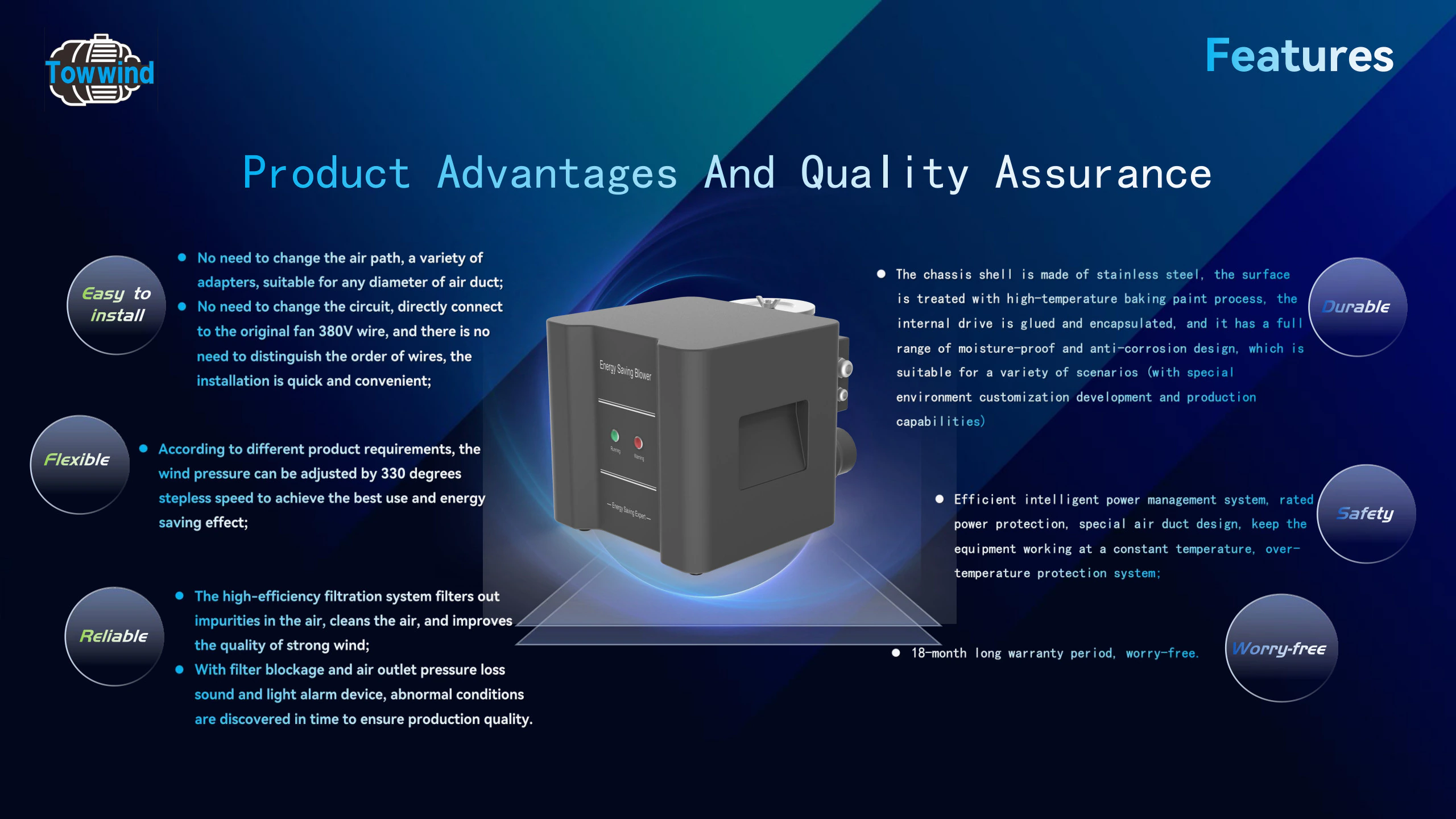
Towwind Energy Saving Blowers use high-efficiency BLDC motor technology and may replace traditional ring blowers, regenerative blowers, side-channel blowers, or vortex blowers in suitable applications.
Traditional blowers in the 2.2 kW to 5.5 kW range are common candidates for evaluation. This does not mean motor power alone confirms compatibility. Towwind needs the required airflow, pressure or vacuum, system conditions, electrical supply, duty cycle, and installation information before recommending a model.
Energy performance is site-specific. Actual savings depend on the existing blower efficiency, operating point, airflow demand, pressure, operating hours, system resistance, piping, and control method. A project estimate should compare verified power input under equivalent process conditions.
A Replacement Enquiry Checklist
Before contacting a supplier, collect:
- Clear nameplate photographs
- Existing blower model
- Motor power and measured current
- Voltage, phase, and frequency
- Required airflow
- Normal and peak pressure or vacuum
- Application and process description
- Daily and annual operating hours
- Pipe diameter and approximate length
- Filter, valve, nozzle, or air-knife details
- Ambient and inlet-air temperature
- Current control method
- Installation photographs and available space
- Reason for replacement
State the reason honestly. A failed motor, excessive electricity use, insufficient airflow, high temperature, difficult maintenance, and discontinued spare parts require different solutions.
Final Buying Advice
The existing nameplate is a useful identification tool, not a complete replacement specification.
Start with the manufacturer, model, motor power, voltage, phase, and frequency shown on the plate. Then verify airflow, pressure or vacuum, system resistance, duty cycle, control method, and mechanical installation.
This work protects the buyer from two common errors: purchasing a blower that fits electrically but fails at the process, or purchasing unnecessary capacity that continues wasting energy.
For a Towwind replacement assessment, provide the nameplate photographs, application, required airflow and pressure, operating schedule, pipe information, and installation photos. With those details, the proposed energy-saving blower can be checked against the real duty instead of being selected from motor power alone.
Frequently Asked Questions
Can I replace a blower with another model of the same kW?
Not safely without further checks. The same motor power does not guarantee the same airflow, pressure, efficiency, or control characteristics. Compare both blowers at the required operating point.
What if the blower nameplate does not show airflow or pressure?
Use the manufacturer and model to find the original performance curve. Measure operating pressure or vacuum and obtain airflow data where possible. The application, pipework, and valve positions can provide additional evidence.
Can a 50 Hz blower be replaced with a 60 Hz blower?
Only after the supplier confirms performance and motor compatibility. Frequency can change blower speed, airflow, pressure, current, temperature, and noise.
Why must system resistance be checked before replacement?
System resistance determines where the blower operates on its performance curve. Blocked filters, small pipes, valves, bends, and process restrictions can make a correctly sized blower appear inadequate.
What information does Towwind need to recommend a replacement?
Provide the existing model and nameplate, airflow, pressure or vacuum, voltage, phase, frequency, operating hours, application, pipe information, control requirements, and installation photographs.