
A drying line that used to leave products clean and dry begins sending wet pieces downstream. An aeration branch looks weaker than the others. Operators increase the blower setting, but the result improves only slightly. These are often described as blower failures, although the blower may be only one part of the problem.
Good blower airflow drop troubleshooting starts by proving what has changed. The measurement, process load, filter, pipework, valve positions, controller command and blower operating point all need to be considered. Replacing the unit too early can add cost without correcting the actual fault. For a buyer, the aim is not simply to obtain a new quotation; it is to establish which part of the installed air system no longer performs as accepted.
First Confirm That Airflow Has Really Fallen
“The air feels weaker” is useful as an operator observation, but it is not a complete diagnosis. Before dismantling the system, reproduce the operating condition in which the problem appears. Record the product, line speed, open branches, valve positions, blower command, filter condition and relevant process result.
Then compare like with like. An airflow reading taken with every nozzle open cannot be compared fairly with a commissioning value taken with one branch isolated. Likewise, a pressure value from the blower outlet is not the same as airflow at an air knife or diffuser.
Check the instrument as well. Confirm its range, units, location, zero condition and calibration status. Inspect sensing tubes for kinks, loose connections, blockage or condensation. If the “drop” appeared immediately after an instrument was replaced or a measurement point was moved, validate the measurement before changing the machine.
Where a direct airflow measurement is unavailable, use a combination of evidence: pressure at defined points, controller data, electrical input, branch behaviour and the process result. None of these proves airflow alone, but together they can show where to investigate next.
Decide Whether the Air Requirement Has Changed
Sometimes the blower delivers approximately what it always did, while production asks more of it. A faster conveyor, wider product, additional air knife, opened branch, deeper aeration point or finer diffuser can change the required operating point. More water carried into a drying stage can also make an unchanged air supply appear inadequate.
Ask what changed before the complaint began:
- Was line speed increased?
- Were nozzles, diffusers or air knives added or replaced?
- Is a new product size or process recipe running?
- Are more branches open at the same time?
- Has the required pressure changed because of liquid depth or terminal equipment?
- Was the acceptance criterion made more demanding?
These are not blower defects. They are duty changes. Purchasing should distinguish them because a repair quotation and a system-capacity upgrade solve different problems.
Inspect the Inlet and Filter
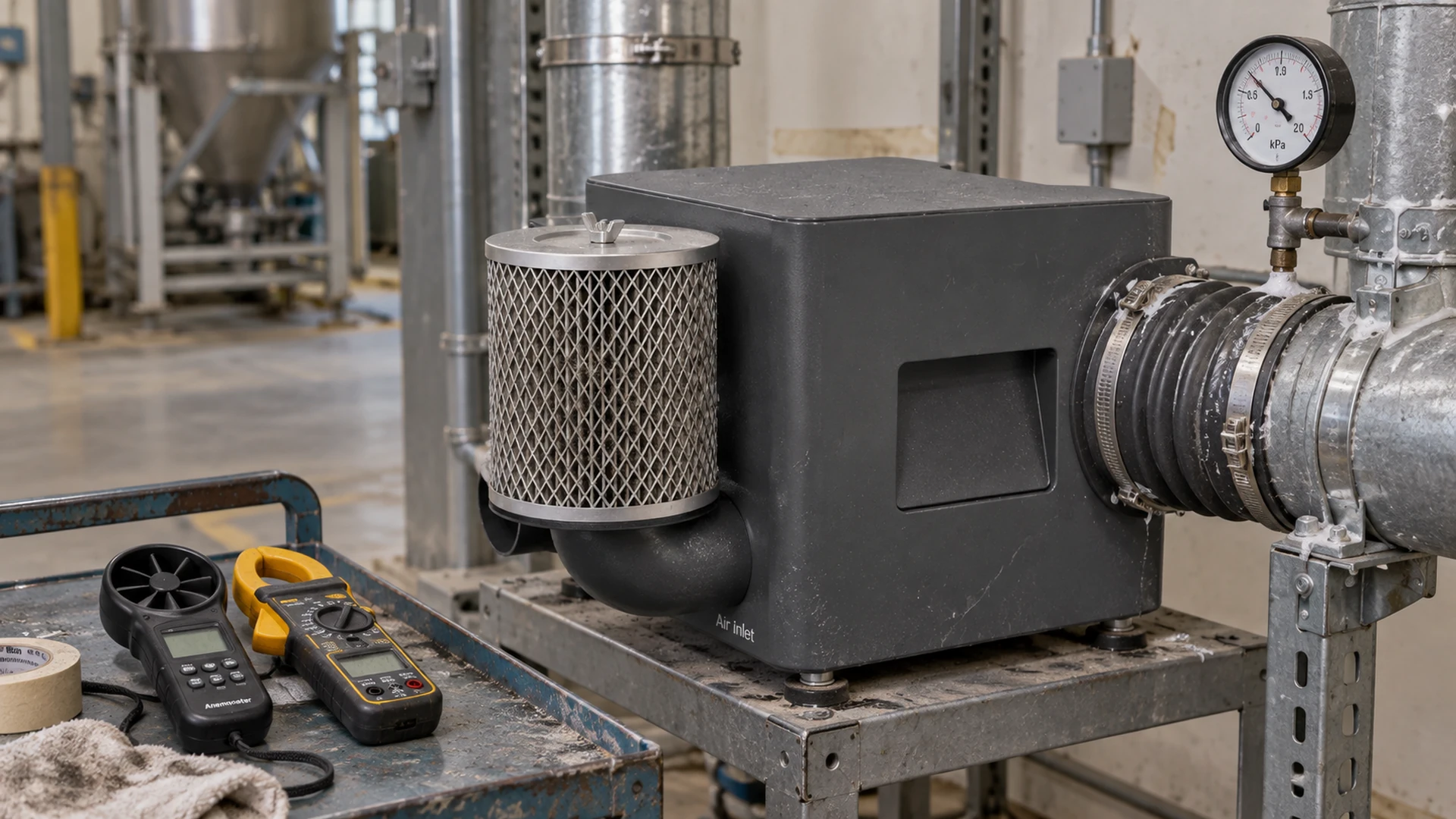
The inlet is a sensible first physical check because a blocked intake or loaded filter can reduce available airflow. Look for packaging, dust deposits, a panel installed too close to the intake, a collapsed inlet hose or contamination drawn from a nearby process.
Inspect the filter as an assembly, not just as a piece of media. Check its seating, seals, housing, clean side and any differential-pressure indicator. A dirty element may create excess resistance, while a damaged seal may allow unfiltered air to bypass it. Visual appearance alone does not establish whether the filter is serviceable.
Use the action limit and service method for the installed filter and blower model. Do not wash, blow out or reuse an element unless the supplier documentation allows it. After service, restore the housing correctly and record the part number, date and reason for replacement. That record helps purchasing identify abnormal consumption or an unsuitable filtration arrangement.
Check for Restrictions Through the Air Path
Walk the actual installation from inlet to process. Compare it with the accepted drawing and note late changes. A partly closed valve, crushed flexible hose, delaminated liner, blocked silencer, undersized adapter, contaminated manifold or obstructed nozzle can consume pressure and reduce delivery.
Branch behaviour is particularly useful. If one branch is weak while the others remain normal, the fault is likely to be local. If every branch deteriorates together, inspect common upstream components and the blower operating condition.
Pressure readings can narrow the search when suitable test points exist. At comparable duty, an increased pressure difference across a filter, valve or pipe section suggests additional resistance there. High pressure near the blower combined with poor downstream delivery also points toward a restriction between the two locations. However, the pattern must be interpreted with airflow, valve state and system configuration; pressure alone is not a verdict.
Do not increase speed merely to force air through an unidentified blockage. That may increase electrical input, temperature or stress elsewhere while hiding a maintenance problem.
Look for Air That Escapes Before Reaching the Process
A leak can produce the same complaint as a restriction: insufficient air at the point of use. Inspect joints, clamps, flexible connectors, unused branches, drain points, cracked hoses and manifold covers. Use an approved leak-check method appropriate to the pressure, temperature and cleanliness requirements of the process.
Also consider internal bypass paths. A valve may fail to seat, or a distribution manifold may send more air to one branch after adjustment. In systems with several outlets, an unintended open branch can reduce delivery elsewhere without creating an obvious external leak.
After repairing a leak, repeat the test in the original operating mode. A quieter joint is encouraging, but the accepted process result and recorded readings are what confirm the correction.
Verify the Speed Command and Control State
If the air path is clear, confirm that the blower receives and follows the intended command. Check the selected operating mode, local or remote status, speed reference, current limit, interlocks and any production recipe that supplies the setpoint. A controller left in manual mode or a scaled analog signal can reduce output without a mechanical failure.
Review recent parameter changes and alarm history before resetting anything. Record the displayed code, timestamp, command, feedback and operating condition. Repeated power cycling can erase context that the equipment builder or supplier needs.
Only trained personnel should make electrical or control checks, following the delivered manual and the site’s safety procedure. Do not change protection limits to recover airflow. A limit may be active because the system has excessive resistance, inadequate cooling or another condition that still needs correction.
Compare Pressure, Electrical Input and the Operating Point
A blower does not deliver one fixed airflow under every condition. Its airflow depends on speed and the resistance imposed by the installed system. As resistance changes, the operating point moves along the relevant performance curve.
Compare current readings with a valid baseline at the same configuration. Useful information may include:
| Recorded evidence | What it can help reveal |
|---|---|
| Blower command and actual feedback | Whether the unit follows the intended setting |
| Pressure at named locations | Where system resistance or pressure loss has changed |
| Filter differential pressure | Whether inlet restriction has increased |
| Electrical input at a defined boundary | Whether load has changed at comparable duty |
| Temperature, sound and vibration observations | Whether physical condition has changed |
| Process output at the same line condition | Whether delivered air still achieves the required result |
Interpret the readings against the manual and performance information for the exact model. A motor nameplate rating cannot tell the actual airflow, and maximum catalogue airflow is not the expected value once system resistance is applied.
Inspect the Blower Only After the System Checks
When measurement, demand, inlet, pipework and controls have been reviewed, inspect the blower according to its model-specific instructions. Look for abnormal sound, vibration, temperature, contamination, loose mounting, damaged connections and evidence associated with alarms. Compare observations with the accepted baseline rather than relying on memory.
Do not open the unit or remove guards unless the task is authorized and hazardous energy has been controlled. Internal diagnosis, component replacement and permissible clearances vary by design. Send the supplier the exact model, serial number, controller information, runtime, alarm history and readings instead of requesting advice for a generic “blower.”
For purchasing, this evidence separates three different decisions: restore a failed component, correct the surrounding system, or select a different blower because the required duty has genuinely changed.
What to Send When Requesting Supplier Support
A useful support request is short but specific. Include:
- blower model, serial number and controller version where available;
- application and required process result;
- when the airflow problem began and what changed beforehand;
- operating mode, command and feedback;
- pressure or airflow readings with units and exact locations;
- filter condition, valve positions and open branches;
- electrical input boundary and relevant readings;
- alarm codes, timestamps and reset history;
- photographs or an updated air-path drawing;
- comparison with commissioning or known-good records.
This package reduces guesswork. It also allows competing suppliers to quote against the same duty and scope, which makes commercial comparison more meaningful.
Evaluating a Towwind Energy Saving Blower
A Towwind Energy Saving Blower may replace certain traditional ring, regenerative or side-channel blowers when the required airflow, pressure, control, installation and duty cycle match an available model. A drop in airflow does not automatically mean the installed unit is undersized, nor does it automatically justify replacement.
Before Towwind recommends a model, provide the normal operating point and the evidence gathered during troubleshooting. If the old system has a dirty filter, restricted pipe or leaking branch, sizing a new blower around that fault can produce a poor proposal. The comparison should use a representative air path and the same accepted process output.
In suitable applications, Towwind technology may reduce electricity use compared with an existing arrangement. Claims of up to 60%–80% apply only under suitable conditions; actual savings depend on airflow, pressure, load profile, operating hours, system resistance and the efficiency of the existing blower. Measure electrical input at defined boundaries and compare equivalent production conditions.
Diagnose the Drop Before Buying More Capacity
When airflow falls, start with evidence rather than capacity. Confirm the symptom, reproduce the same duty, check whether production demand changed, and then inspect the inlet, air path, leakage, controls and blower condition in a controlled order.
That sequence gives maintenance a repair target and gives purchasing a defensible buying decision. The correct answer may be a filter, hose, valve, control correction or service action. If a different blower is genuinely required, the same records provide the operating point needed for responsible selection.
Frequently Asked Questions
What is the first thing to check when blower airflow falls?
First confirm the symptom under a defined operating condition. Record the blower command, open branches, valve positions, filter state, process load and measurement method, then compare them with a valid baseline.
Can a dirty filter reduce blower airflow?
Yes. A loaded filter can add inlet resistance and reduce available delivery. Inspect the element, housing, seals and differential pressure according to the instructions for the installed model.
Does low airflow mean the blower is undersized?
Not necessarily. Restrictions, leakage, changed valve positions, lower speed commands, measurement errors and increased process demand can all cause low delivered airflow. Confirm the required operating point before selecting a larger unit.
Should blower speed be increased to recover lost airflow?
Not until the cause is understood. Increasing speed may conceal a blockage or leak and may alter power input or operating limits. Correct abnormal system conditions first, then verify the required setting.
What information does Towwind need to troubleshoot low airflow?
Provide the exact model, application, command and feedback, pressure or airflow readings with locations, filter and valve condition, open branches, electrical readings, alarms, operating hours and the expected process result.