
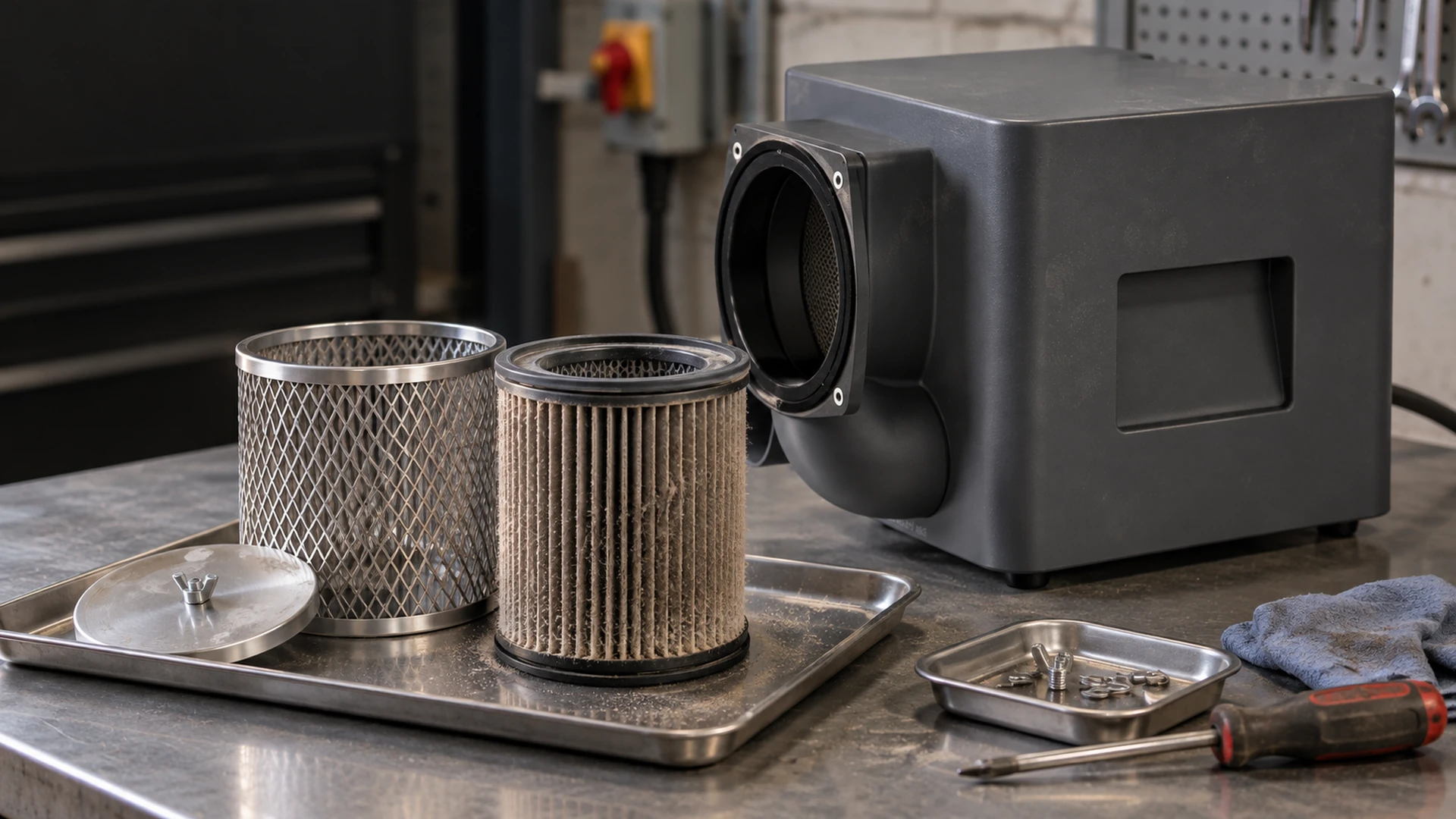
A blower inlet filter can look dusty and still have service life remaining. Another filter may look acceptable from the outside while a damaged seal lets unfiltered air pass around the element. Replacing both by appearance alone leads to poor decisions: one wastes consumables, while the other leaves the blower exposed.
A useful blower inlet filter inspection combines four checks: the installed part and housing must match the equipment; the element and seals must be physically intact; operating restriction should be compared with the correct model-specific limit; and the clean side should show no evidence of bypass. Record the operating state and measurement location so the result can be compared later.
This article is written for equipment owners and buyers who want a practical inspection standard. It is not a universal cleaning or replacement instruction. Filter construction, action limits, permissible cleaning methods and service intervals vary. The delivered blower and filter manuals take priority.
Understand what the inlet filter is protecting
An inlet filter protects the blower and, in some applications, the process air path from particles drawn from the surrounding environment. Its job depends on where the blower takes air, the contaminant present and the sensitivity of the selected machine. A workshop with fine abrasive dust poses a different challenge from a clean enclosed equipment room.
The filter also creates resistance. As material accumulates, the pressure loss across the element can rise and the blower’s operating condition may change. The process may receive less airflow, or a controlled unit may work at a different setting to maintain the required result. For that reason, a filter inspection is not only a housekeeping task; it is part of checking whether the complete system still serves its intended duty.
Before opening anything, identify the filter model, element part number and installation arrangement. Check that the part fitted is the one specified for the delivered blower package. A replacement that happens to fit the housing may have different filtration or pressure-loss characteristics. Purchasing should treat the correct filter specification as an operating requirement, not merely a spare-part description.
Make the inspection safe and repeatable
Inspect the filter under the isolation and access procedure required for the machine. A stopped blower may still be capable of automatic restart, and connected equipment may contain electrical or mechanical hazards. Authorized personnel should isolate the relevant energy sources, verify the safe state and wait for any model-specific cooling period before opening the filter housing.
Prepare a clean area for the element if it must be removed. Dirt knocked from the dirty side should not fall into the clean-side pipe or blower inlet. Note the element orientation before removal, especially if the two sides are not obvious. If tools are required, use the method stated in the final manual; forcing a cover can damage its sealing surface.
Record the date, blower runtime if available, application, operating hours since the last service, installed element identification and reason for inspection. A scheduled check, a high-restriction indication and a low-airflow complaint provide different diagnostic context.
Inspect the housing before blaming the element
Start with the parts around the filter. Look for a loose cover, missing fastener, cracked housing, damaged latch, distorted flange or connection that can admit air around the intended inlet path. Check that the housing is supported rather than hanging from the blower connection. Vibration or pipe strain can disturb a seal even when the element itself is sound.
Examine the inlet location. Is it still clear, or has a box, panel, rag or stored material restricted it? Is the intake drawing hot discharge air, spray or more dust than the original layout allowed? A filter that loads unusually fast may be reporting an environmental or installation change, not a filter-quality problem.
Dust patterns can be useful. A concentrated trail around a cover edge may point to a gasket or closure issue. Dirt on the nominally clean side can suggest bypass, an incorrectly seated element or element damage. Treat these as investigation clues rather than proof from a photograph alone. Clean the relevant surfaces using an approved method, then identify the path before returning the system to service.
Check the element for loading and physical damage
Inspect the element in good light. Look for tears, punctures, collapsed or distorted media, broken support material, damaged end caps, separated bonding and contamination inconsistent with the application. Check whether the element is wet, oily or chemically affected when it is intended for a different condition. The correct response depends on the filter design and contaminant; do not improvise a cleaning method.
Uniform surface loading may be expected in service. A heavy patch on one area can indicate uneven intake flow, a leak path inside the housing or a contaminant source aimed directly at the filter. An element that has deformed may have experienced excessive restriction, incorrect installation or an operating condition beyond its intended use. Replacing it without checking the cause invites a repeat failure.
Do not judge remaining life only by colour. Fine particles can create meaningful restriction without producing a dramatic visual change, while coarse dust may make an element look dirty before it reaches its specified action point. Conversely, an element with a tear should not remain in service simply because differential pressure is low. Restriction and integrity answer different questions.
Inspect seals, seating surfaces and the clean side
The filter must force incoming air through the media. Check the gasket or sealing feature for cuts, flattening, hardening, displacement or missing sections. Inspect the mating surface for dirt, damage or an old gasket left in place. Confirm that the element orientation and retention method match the manual.
A bypass path can give a misleadingly low restriction reading because air is avoiding the media. Look for dust downstream of the element, particularly around the edge corresponding to a questionable seal. If clean-side contamination is found, do not simply install a new element and close the housing. Determine whether the housing, gasket, installation or element failed, and assess whether downstream cleaning or blower inspection is required under the supplier’s guidance.
When refitting, make sure the element seats evenly and the cover closes without using excessive force to overcome misalignment. Replace only the seals or hardware specified for the assembly. A makeshift gasket may alter compression, shed material or fail to hold the intended seal.
Use differential pressure or restriction data correctly
Where the system provides a filter restriction indicator or measurement points across the filter, read them in a documented operating state. Differential pressure depends on airflow, so a value taken at reduced blower speed cannot be compared directly with one recorded at full process demand. Note the blower setting, open branches, valve positions and process mode.
Compare the reading with the limit in the final filter or blower documentation. Do not copy a change threshold from another filter or a general web article. The proper action point depends on the element and system. Also check the instrument: blocked tubing, leakage, a damaged indicator or an incorrect zero can create a false conclusion.
A rising trend at comparable duty supports the conclusion that restriction is increasing. A sudden drop does not necessarily mean the filter has cleaned itself. It can indicate lower system airflow, a bypass path, a damaged element or an instrument problem. Use the physical inspection and the process result alongside the reading.
If no restriction measurement is available, follow the specified inspection and replacement method for the delivered assembly. Buyers ordering equipment for a dusty or critical application can ask whether a suitable indicator or test points should be included. That decision is easier during design than after the filter becomes difficult to reach.
Decide whether to return, clean or replace the element
The inspection should end with a written disposition, not “filter checked.” Possible outcomes include return to service, perform an approved cleaning procedure, replace the element, repair the housing or seal, investigate abnormal contamination, or keep the blower out of service pending supplier review.
Only clean an element when its documentation permits cleaning and specifies the method. Some media can be damaged by high-pressure air, washing, impact or handling that looks harmless. A cleaned element also needs an integrity and seating check before reuse. Never use visible improvement as proof that its filtration performance has been restored.
When replacing, compare the new element’s part number and construction with the approved spare. Inspect it for shipping damage, record the installation date and establish a clean baseline at the normal reference condition where the system supports such measurement. Keep the removed element long enough for investigation if its failure was unusual.
| Inspection area | Evidence to record | Typical decision question |
|---|---|---|
| Housing and inlet | Damage, obstruction, support and contamination source | Is air entering only through the intended path? |
| Element | Loading pattern, damage, wetting and identification | Is the media intact and suitable for continued use? |
| Seal and clean side | Gasket condition, seating and downstream dust | Is unfiltered air bypassing the element? |
| Restriction | Reading, location, operating mode and trend | Has resistance reached the model-specific action point? |
| Service action | Part used, approved cleaning method or repair | Can the blower return to service, or is follow-up required? |
What buyers should require from the equipment supplier
A serviceable filter arrangement is part of the equipment purchase. Before acceptance, ask the builder to demonstrate safe access, element removal and correct refitting with the machine in its installed configuration. The filter should not require the blower pipe to carry its weight, and a guard or wall should not block the removal path.
Request the exact spare-part identification, applicable manual, inspection method, replacement or cleaning criteria and any restriction-indicator information. Clarify which items are included in the initial spare-parts package. A cheaper blower offer can become inconvenient if the filter element is unidentified or requires dismantling half the machine for routine inspection.
The handover record should include a clean baseline where applicable, the measurement condition and photographs or a drawing showing the access point. This gives maintenance a reference and allows purchasing to reorder the correct element without guessing from dimensions.
Inspecting a filter on a Towwind Energy Saving Blower
A Towwind Energy Saving Blower may be used in suitable industrial air-supply applications or as a replacement for some traditional ring, regenerative or side-channel blowers. Its inlet filter remains part of the complete operating system. A loaded filter, bypass leak or poorly located intake can affect the air duty and make an energy comparison misleading.
For the selected Towwind model, use the supplied documentation to confirm the filter assembly, element identification, service method and applicable restriction or alarm limits. Send Towwind the application environment, operating schedule, required airflow and pressure, and photographs of the inlet arrangement if the filter loads rapidly or contamination appears downstream. That information is more useful than reporting only that “the blower has low airflow.”
Do not increase blower speed automatically to compensate for a restricted filter. The process may temporarily recover while electrical input and operating conditions change, but the cause remains. Inspect the filter and air path first, then verify the process at the required operating point.
Likewise, a clean filter does not establish an energy-saving percentage. Savings must be based on measured electrical input while old and proposed systems deliver the same accepted process result, with filter condition and other relevant system states documented.
A short inspection that leaves useful evidence
The best filter inspection does more than find dirt. It confirms that the correct element is installed, air cannot bypass it, restriction is interpreted at a known operating state, and the housing can be serviced without damaging the installation. It also records why the element was returned, cleaned or replaced.
If the filter is intact and within its documented service criteria, keep the record as a baseline. If it is damaged, bypassing or abnormally loaded, investigate the cause before treating a new element as the complete repair. That approach protects the blower and gives the buyer a clearer view of the system’s real maintenance cost.
Frequently Asked Questions
How often should a blower inlet filter be inspected?
Use the interval in the delivered blower or filter documentation and adjust only through an approved site maintenance plan that considers runtime and contamination. A dusty application may require more frequent checks. Do not invent one interval for every filter design.
Can a blower filter be judged by appearance alone?
No. Visual inspection can find damage, wetting and loading patterns, but it cannot reliably establish remaining life. Use the specified restriction measurement or service criterion where available, and also check seals and the clean side for bypass.
Why can a dirty filter have a low differential-pressure reading?
Possible reasons include reduced airflow, a bypass leak, damaged media or a measurement problem. Record the blower setting and system mode, inspect the element and seals, and verify the instrument before concluding that the filter is acceptable.
Can an inlet filter be cleaned with compressed air?
Only if the filter manufacturer or final blower manual permits it and provides a method. Unapproved air pressure or handling can damage the media. Some elements are intended for replacement rather than cleaning.
Does a blocked inlet filter increase blower energy use?
It changes system resistance and may reduce airflow or alter how a controlled blower operates. The energy effect depends on the blower, controls and process. Measure electrical input and process output under comparable conditions rather than assuming a fixed penalty.