
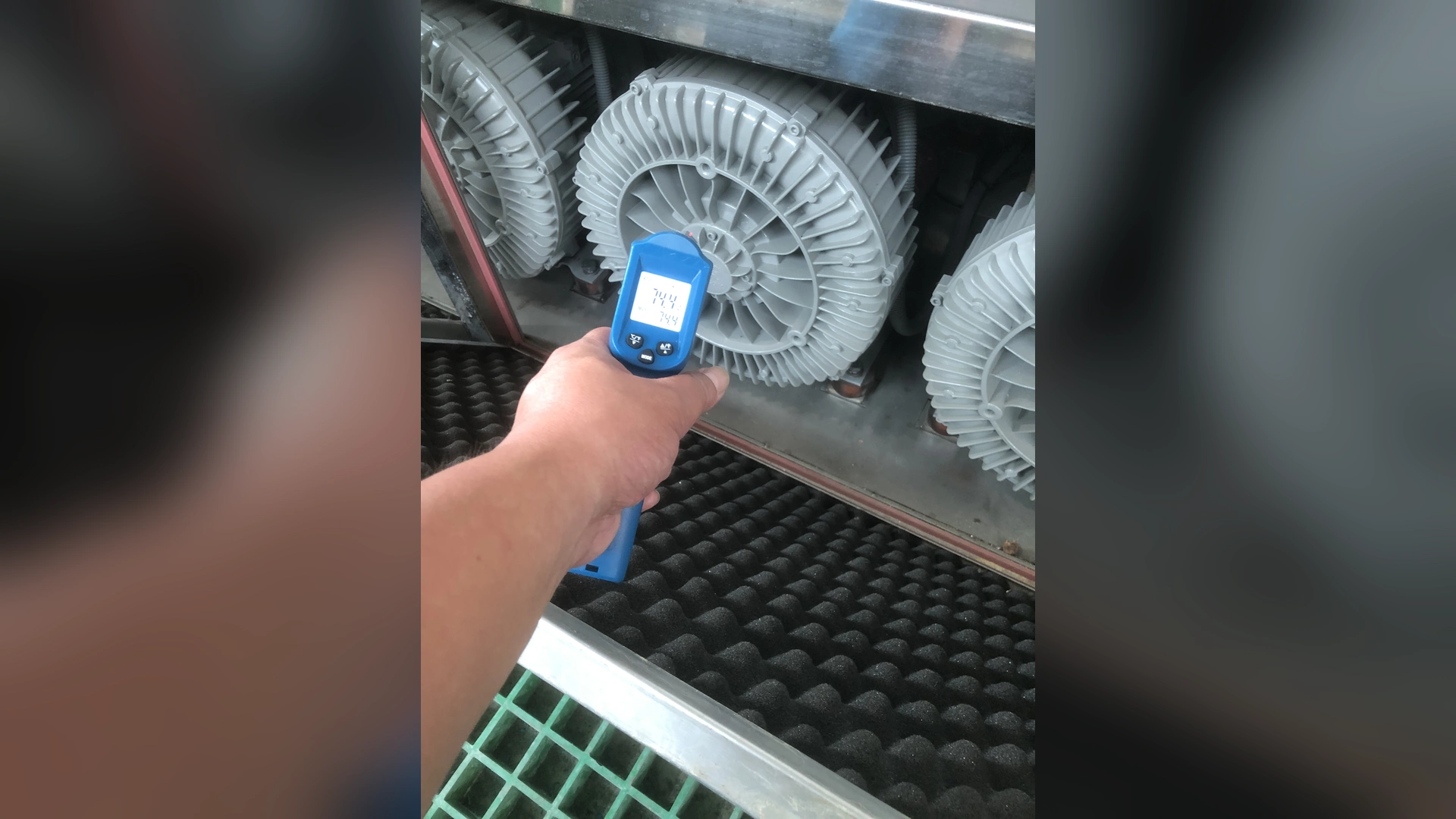
Your blower may run for hours during a slow shift and become too hot soon after the line reaches normal throughput. That pattern is more useful than a single temperature reading. Record what changed when production accelerated: blower speed, open branches, nozzle settings, inlet air temperature, enclosure ventilation and start frequency. Stop using the equipment if its own protection or site procedure requires a shutdown; a hot casing alone is not a calibrated trip criterion.
Reproduce the condition without hiding it
Compare a reduced-output run with a full-production run using the same measurement locations. Capture elapsed time, outlet and inlet pressure where available, electrical input, ambient temperature, alarm code and product result. For a ring or regenerative blower, the full speed and pressure combination matters more than the nameplate kW alone. A fixed-speed machine can also see a different duty when more knives or valves operate together.
In a glass washing and drying application, the wider or faster product mix can change the required air delivery. Record the glass width and line speed with the thermal readings; otherwise two shifts may look comparable when their air demand was not.
Look for two different heat paths
One is process load. Trace a closed or partly closed branch, loaded intake filter, changed nozzle gap and relief valve activity. A higher discharge reading with poor drying may mean air is being lost to resistance rather than reaching the glass. The other is heat removal. Inspect clearance around the blower, fan inlet and outlet, enclosure vents and any warm exhaust drawn back into the cooling path. Do not interpret an infrared surface reading as bearing temperature without the maker’s measurement guidance.
Electrical checks belong to a qualified technician. Record voltage and input during the hot condition and compare them with the exact model’s permitted range and protection record. The existing article on general blower overheating covers common causes; this test focuses on why the fault appears only when production reaches its demanding mode.
Use the result to decide whether replacement is necessary
Correct a blocked air path or cooling problem and retest before ordering equipment. If the accepted process still needs a duty outside the old blower’s continuous operating envelope, compare actual pressure and airflow requirements against the curves for TW750, TW1500 and TW2000. Verify cooling and electrical interfaces for the selected model as well. A lower rated power is not proof that a retrofit will run cooler at the required output.