
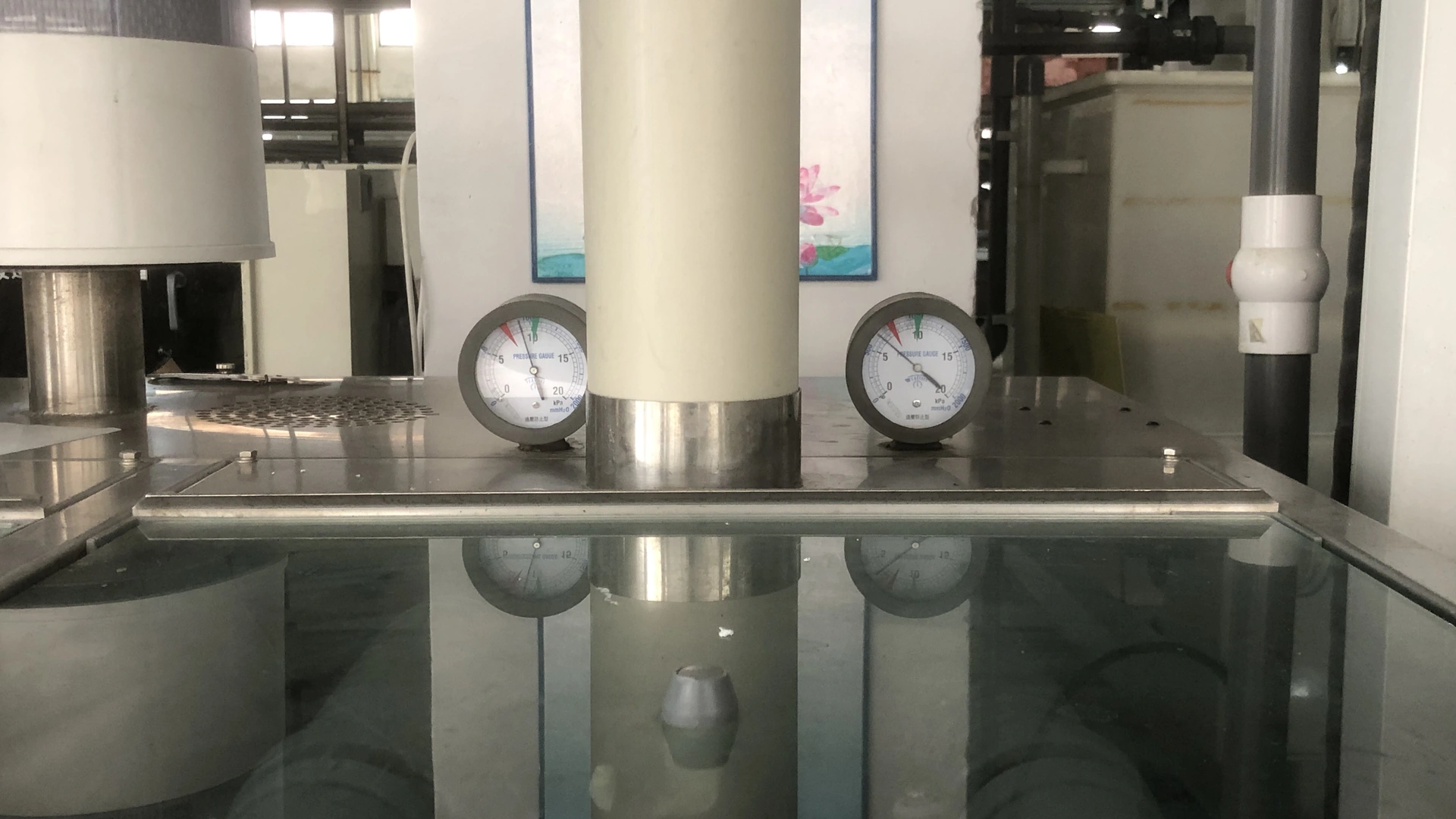
The gauge near your regenerative blower reads higher than usual, but the air knife is weaker. That combination often points to resistance between the blower and the process, yet it is not a diagnosis by itself. A partly closed branch, a changed nozzle, a restricted hose or a gauge installed before a loss point can produce very different readings at the two ends of the system.
Put each reading on the air-path sketch
Mark the inlet, blower outlet, relief connection, header, branch valves and final nozzle. Write the gauge location beside every number. If the blower-side gauge climbs while pressure close to the air knife falls, investigate the section between them. If both readings rise, the final opening may have become smaller. If flow falls without a corresponding pressure change, inspect measurement method and leaks before assuming the machine itself changed.
Record the production mode, blower setting and relief-valve activity. The pressure difference across a ring blower matters; a discharge reading without inlet condition can be misleading. The broader current, pressure and airflow diagnostic guide explains those signals together. This article stays with one specific contradictory-looking pattern.
Test the process result, not the gauge alone
On an industrial air-knife system, compare air delivery and drying at the worst-performing knife under the same product and line speed. Do not close an outlet on a running blower to make pressure “look better.” The result could increase pressure while making useful airflow worse and challenging the protection device.
Where direct flow measurement is unavailable, say so in the record. Use a repeatable process test and pressure readings from known locations rather than reporting an estimated flow as measured fact. If the piping or nozzle configuration was changed, obtain the as-built arrangement before calculating a new duty point.
Decide whether to repair or resize
Correct a confirmed restriction or valve error first. If useful flow remains below the process requirement, compare the complete required pressure–flow point with the old blower curve. For a positive-pressure retrofit, the TW750, TW1500 and TW2000 product curves are three possible screening references. None should be selected because its maximum pressure exceeds the single gauge reading. Send a marked air-path sketch, actual readings and a description of the failed process output.