
Vibration that rises in a narrow speed band and falls outside it may indicate a resonance in the blower, base or connected pipework. It may also reveal a fault that becomes more noticeable at that speed. The pattern is useful evidence, but it does not identify a safe speed range or prove the blower itself is defective.
If vibration is severe, a guard is loose or the machine has a protective alarm, follow the site shutdown procedure. Do not run repeatedly through an alarming band to gather data. Qualified personnel should evaluate the installed machine and its exact operating limits.
Record the pattern with a repeatable measurement
At permitted operating states, log speed reference and actual speed, vibration magnitude and direction at named points, process pressure, airflow or damper state, current, and the product or line mode. Record whether vibration increases during acceleration, at steady speed or during deceleration. A handheld reading at one housing location cannot distinguish a motor, blower, frame and duct response by itself.
Compare the same locations under the same process demand. If vibration tracks speed while demand stays constant, inspect structural or rotating causes. If it tracks a valve position, nozzle state or pressure pulsation, investigate the air system as well. Towwind’s current-pressure-flow diagnostic guide helps separate an air-path change from an electrical reading.
Check the installation before changing speed settings
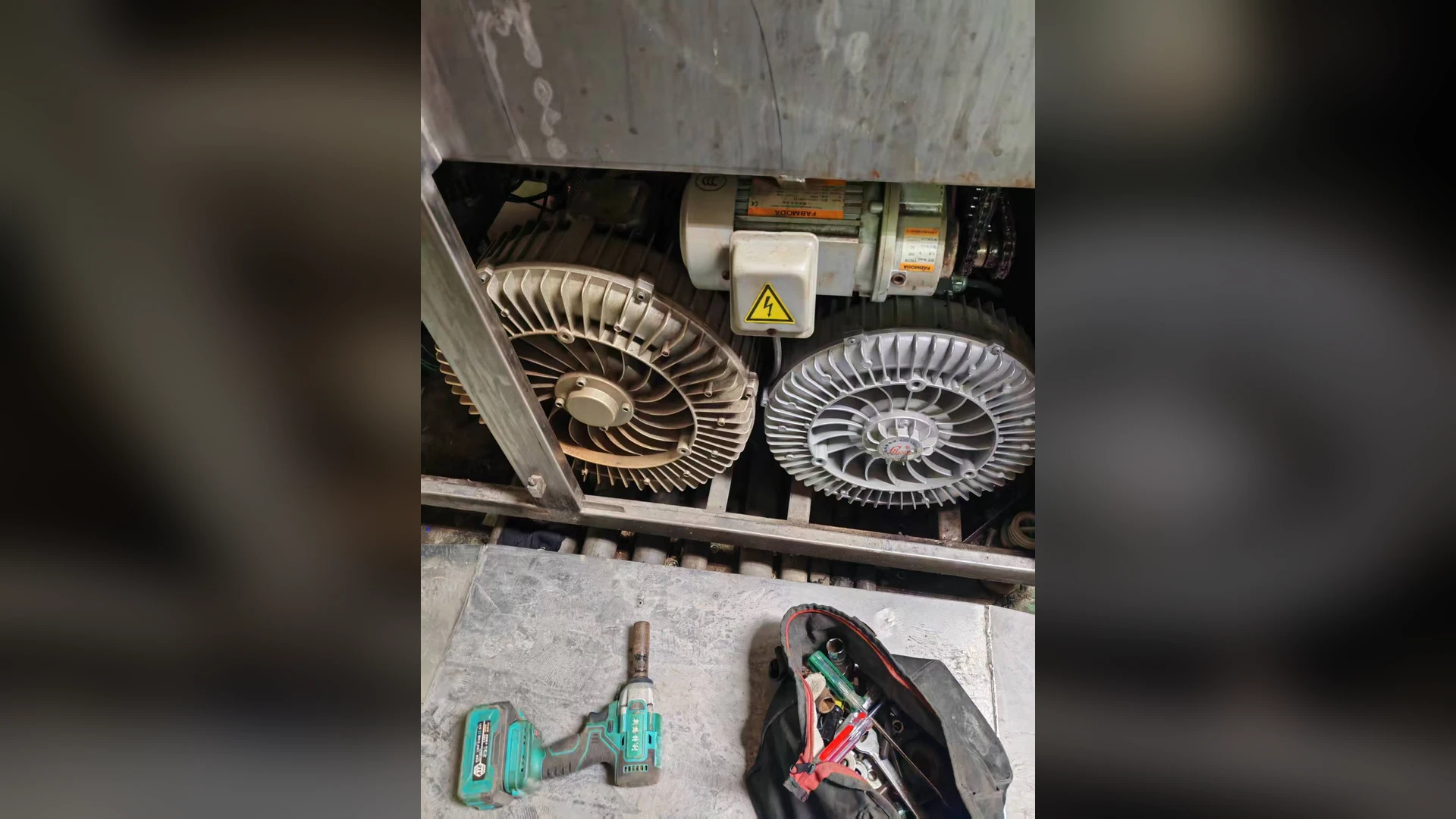
Inspect mounting bolts, base stiffness, feet contact, alignment where applicable, flexible connectors, pipe supports and any pipe load transferred onto the blower. Look for a bracket or panel that moves at the problem speed. A flexible connector does not correct a pipe that is out of position or unsupported. The pipe-strain installation guide gives a more complete inspection sequence.
Rotating causes such as contamination, damage or bearing wear require trained inspection after isolation. Do not open or repair the unit while it is energized. A sudden new vibration after a service event should prompt review of what was removed, cleaned or reassembled.
Treat a speed exclusion band as an engineered control
Changing the speed setpoint or skipping a narrow band can sometimes avoid an operating resonance, but that decision needs approval from the equipment maker. The new operating modes must still deliver the required airflow and pressure, remain inside the blower and controller limits, and meet the process result. An exclusion band must also account for acceleration and deceleration through the band. Do not publish a universal vibration threshold or assume every variable-speed unit supports the same control setting.
TW750, TW1500 and TW2000 should be compared at the required installed duty. Model changes do not replace a mechanical inspection. For technical review, send Towwind speed-band logs, measurement locations, mounting photos and the air-system drawing.